Today Abramowski is remembered mostly for promoting the idea of the grass-roots self-organisation of society and his political conception of a ‘co-operative republic’. Abramowski’s legacy has later been referred to in various contexts – the functioning of the ‘Solidarity’ Independent Self-governing Labour Union, civil society, anarchism – but most of all, his concepts were products of the needs and intellectual climate of his era.
As a socialist, Abramowski viewed grass-roots initiatives as a means to achieving an economic and moral transformation of society, captive not only by capitalism, but also, in the case of Poland, the foreign powers that partitioned the country. In other words, there were supposed to be a real and, eventually, victorious alternative to foreign institutions. Philosophically and psychologically Abramowski’s projects were rooted in the anti-positivist movements of the late 19th and early 20th century.
The idea of social self-organisation, serving in favour of union of interests and moral bonds of friendship and fraternity, was a persistent element of Abramowski’s views, even though the sociopolitcal contexts changed throughout time.
As a young man, Abramowski moved to Warsaw, where he started his studies and simultaneously took part in activism for the socialist movement. He represented the pro-independence branch and deemed grass-root initiatives and exchange of help as essential to socialism. This is why he vehemently opposed terrorism and paternalistic attempts at executing social justice as incongruent with the spontaneous movement of civic self-organisation.
In 1898 Abramowski formulated the postulate of ‘moral revolution’. Its main objective was the necessity for an individual to change his or her ethical stance as to make the formation of community initiatives possible. The Polish philosopher was inspired by the thought of Immanuel Kant, which – as interpreted by Abramowski – juxtaposed social determinism with the initiative of a free, active individual, organising life in congruence with an ideal.
On the grounds of psychology, Abramowski justified his faith in people’s readiness to help each other with the potential for fraternity, which, according to Abramowski, resided in the non-rational, subconscious sphere of the psyche. Abramowski’s though also comprised a sociological approach to the matter, linking the idea of solidarity with the notion of modernity. Although in his youth the Polish thinker idealised primaeval communities (in accordance with the views of Engels), he later on changed his mind and differentiated between an early merging of an individual with the social environment (typical of children) and real solidarity, which required a developed individual identity, the ability to recognise the common interests, and an intention of forming a social union.
This is why in 1904, in the book Socjalizm a Państwo: Przyczynek do Krytyki Współczesnego Socjalizmu [editor’s translation: Socialism and the State: An Attempt at Critique of Contemporary Socialism], he associated the idea of solidarity with the processes of social modernisation, claiming that it is only in a varied, dynamically changing reality that people want to create elastic networks of associations. In this perspective, the apparatus of regulation was the enemy of modernity, as it suppressed both human individuality and the grass-roots impulses of solidarity. Thus, ‘statelessness’, understood as opposition towards the coercion of the state, was characteristic of Abramowski’s socialism.
Abramowski’s ideas have been embodied in various ways. Some of the undertakings animated by him were inconspicuous, like the so-called communes – small groups united by the idea of fraternity, which were created in 1901 in Warsaw, Geneva, and Zakopane. These included communities of students, highlanders, and members of intellectual elites. Other initiatives, aimed at rebuilding an autonomous national culture and regaining independence, became more widely popular. In the brochure Zmowa Powszechna Przeciwko Rządowi [editor’s translation: Common Collusion Against the Government], written in 1905, Abramowski called upon the people to boycott the partitioner and foreign institutions, such as schools, courts, police, banks and offices, by creating self-governed Polish equivalents.
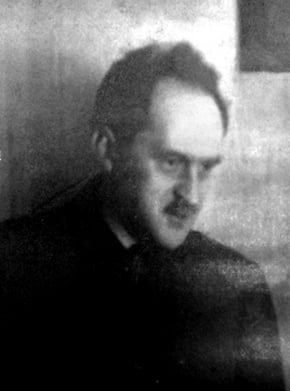
Edward Abramowski, photo: Wikipedia
After the revolution of 1905, Abramowski became an animator of the the cooperative movement, which was to be the first step towards the political rebirth of the nation. In 1906 Towarzystwo Kooperatystów [the Cooperative Society] and the periodical titled Społem (Polish for ‘together’; a name created by Abramowski’s friend, writer Stefan Żeromski) were created. Społem was aimed at propagating the idea of cooperatives in Poland. Intellectuals, social activists, and representatives of various circles engaged in the movement, feeling responsible for their country. The future president of Poland, Stanisław Wojciechowski, was a crucial organisor. Other prominent figures, such as Maria Dąbrowska, who later became a writer and propagator of cooperatives, were also fascinated by Abramowski’s approach. His ideas assumed a practical dimension: before the outbreak of World War I, several hundred food cooperatives were established on the partitioned territory of Poland that belonged to Russia at the time, alongside with the blooming of rural cooperatives. Abramowski supported these with his writings. The cooperative movement continued the idea of grass-root ssupersession of the institutions of the partitioner by creating a Polish culture based on self-governance. It developed economic self-sufficiency, crucial for national growth. It was also aimed at teaching people responsibility and thrift. Abramowski’s objective was to create a ‘cooperative republic’ – a society based entirely on associations.
Once Poland regained independence, the state was supposed to perform only two functions: protect its citizens against external enemies and grant freedom of associations in the constitution. The remaining rights and duties were to be formulated by the associations themselves. The main objective was to grant people freedom and their own place in the community. Solidarity was supposed to guarantee that the reborn Polish state was to be democratic. Abramowski didn’t see democracy as merely a political system, but as the work of a new type of man – a socialised individualist, able to both realise his ideals, creating communities with similar people, and respect one another’s views.
During World War I, the cooperative movement was still hugely popular; the organisations supporting it earlier were suspended, but the martial needs of society powered grass-root mobilisation. Abramowski couldn’t wait for Poland to regain independence, believing that minor, but numerous emanations of self-governance foreshadow the rebirth of Poland as a ‘cooperative republic’. In the end this didn’t happen – once Poland regained independence, the state took over the fields that in Abramowski’s republic were supposed to be governed by associations. Abramowski died in 1918, before Poland regained its independence, and wasn’t able to influence the politics of the reborn Polish state.
Originally written in Polish by Anna Dziedzic, translated by NS, February 2017.

