The artist has created his own visual language, verging on the figurative and abstract styles. The borderline is usually quite fluid – he tends to cross it, and, introducing dissonance and interfering with viewers’ perceptive habits. The artist is nevertheless so consistent in his strategy that, maybe paradoxically, he manages to conjure a certain harmony. In his paintings, one notices elements from the organic realm which the artist transforms and uses to build biomorphic compositions. On the other hand, his graphic works usually represent more tangible, though surrealist, forms derived from an industrial world – they are like unidentified mechanisms with mysterious functions and uses.
I look for balance, for a proper and accurate relationship between the sensual and the material, real world; for a dialogue between physics, colour, composition, and shape.
In his acrylic paintings, he tends to apply visual ‘shortcuts’ and reduce the means of expression to the minimum. Formally, a lot of them resemble calligraphic or graffiti works, but there are also some that are closer to poster or comic aesthetics. Flat patches of black paint are applied in an almost lazy manner, making the pieces somewhat primitive. Occasionally, however, one will come across elements of a more ornamental nature.
All in all, the artist is equally far from creating clear shapes as from directly communicating the narratives behind them. The ambiguity or indeterminacy underlying Poniatowski’s output generates a tension and makes its recipients pursue unexpected associations from philosophy, popular culture and fantasy.
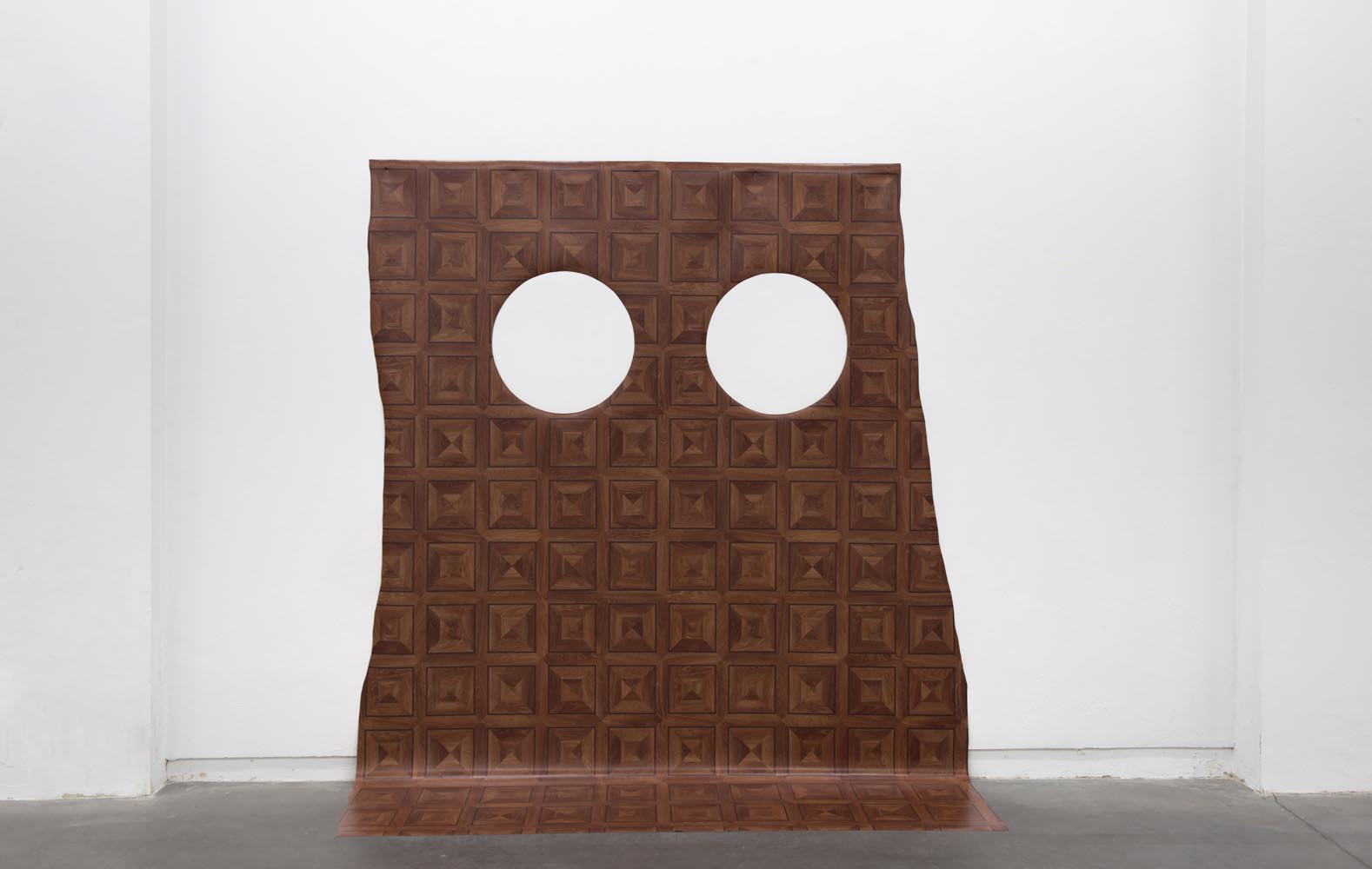
Cezary Poniatowski, Untitled, 200 x 180 cm, pvc, 2013, photo: Bartosz Górka
In spite of his great interest in the history of art, the artist tries to capture the Zeitgeist of the present times, diagnosing them as permanently uncertain, or even decadent. His paintings, therefore, describe the contemporary world, but don’t necessarily illustrate it.
In 2013, Poniatowski’s first solo exhibition Atrofia (Atrophy) took place at the Warsaw’s Praca Gallery. The artist introduced it like so:
The title refers to the process of gradual wasting away that permeates practically every sphere of contemporary reality. Our increasingly nihilistic and decadent life progresses. The paintings reflect this world filled with apathy and internal derangement. Ascetic and sterile. Approaching blackness. They reference the aesthetics of vanitas and ars moriendi. The overall aura remains melancholic, and releases an ever-increasing metaphysical anxiety. These are paintings about our era.
Occasionally, Poniatowski’s works enter the third dimension – the artist sometimes creates installations that grow naturally out of his paintings. His individual exhibition Sceny rodzajowe (Everyday Scenes) at BWA Olsztyn (2014) included, apart from paintings, two black round kitchen stools mounted on the wall – looking like a pair of wide open eyes observing the visitors. In the exhibition room, the artist also placed a vertical palm tree cut out from a camo-patterned sleeping mat, and a black rectangle of black foil with four artificial pot plants, painted black, stood in its corners – an installation that was finished off with a white painted smiley face or half-moon.
http://www.cezaryponiatowski.pl
Selected Exhibitions:
- 2014 – As You Can See, Museum of Modern Art, Warsaw; Sceny Rodzajowe, BWA Olsztyn
- 2013 – Salon Zimowy, The Branicki Palace, Warsaw; Gumoleum, Piktogram, Warsaw; 11th E. Geppert Competition, BWA Awangarda, Wrocław; Atrofia, Praca Gallery, Warsaw
- 2012 – Kissprint, Soho Factory, Warsaw
- 2011 – Urlaub, Atelierhof Kreuzberg, Berlin
- 2010 – Young Polish Printmaking Cracow 2009, Dalarnas Museum, Falun, Sweden
Awards:
- 2013 – Grand Prix in the 11th E. Geppert Competition in Wrocław
Author: Ewa Gorządek, August 2014, Transl. AM

