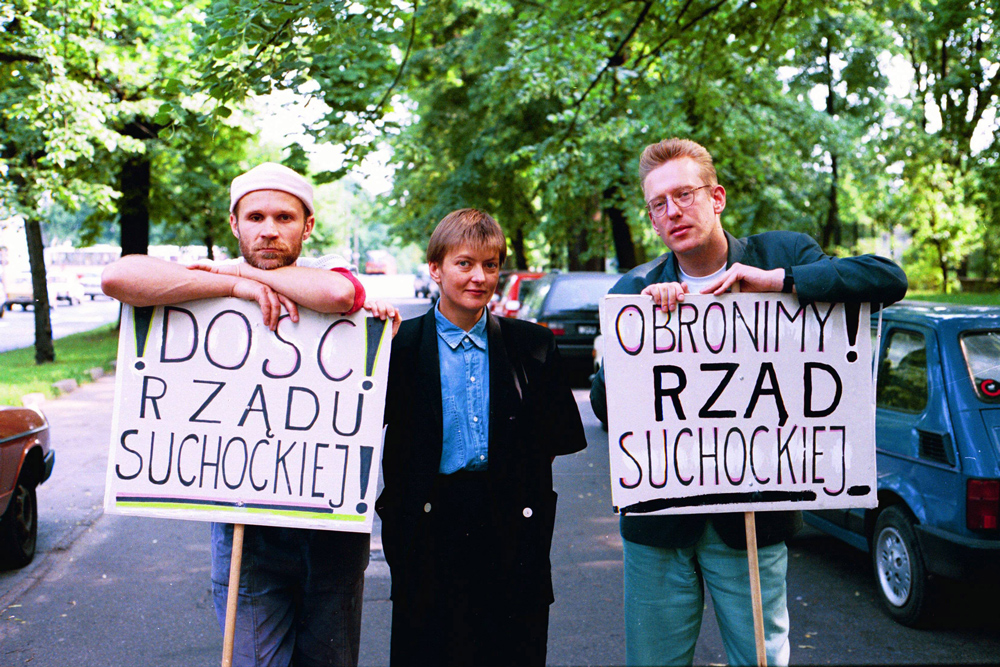
On 12th October, news came of a series of bomb attacks on Bali. They were carried out by the fundamentalist organization Jemaah Islamiyah, connected to Al-Qaeda. Islamic terrorists killed 202 people.
She stayed in Indonesia for a long time, but decided to exchange Sumatra for Bali. Due to bad luck, that evening she decided to enter one of the bars in the Kuta resort, famous for its clubs. One could say her passion killed her – Islam, which was only a violent weapon for terrorists from Jemaah Islamiyah.
– Jakub Noch [To już 10 lat od śmierci Beaty Pawlak / It’s been 10 years since Beata Pawlak's death, natemat.pl, October 12th 2012]
Many commentators note that Beata Pawlak, a Polish reporter fascinated with Islam, was among the victims of Islamic fundamentalists.
It was an improbable coincidence, a derisive irony, that Beata Pawlak lost her life, killed by those whom she wanted to understand or even protect, and what’s more, in a place where she didn’t expect an attack, where she went privately, to be far away from the chaos of world politics and religion. Indonesia is a Muslim country, the biggest Islamic state in the world (80.3% of its population is Muslim), but Bali is an island different from other thousands of Indonesian islands – it has a different religion, not connected to Islam in any way. It’s a mixture of Hinduism and animistic faith. Polytheism. People from Bali believe in gods and demons that rule the world. Gods and goddesses of mountains, lakes, trees, rivers, of rice and of dead ancestors… they all come from the One Highest God, Emperor of the Universe. He’s not Allah, but Sang Hyang Widi Wasa in his omnipresent being. Hinduism from Bali is a pantheistic polytheism (1.9 Indonesians follow this faith). The Balinese believe in samsara, karma and in achieving happiness through enlightenment. The religion from Bali is a very complicated system of the prehistoric peoples of the island, mixed with the faith of pre-Islamic arrivers from India. What’s important in the context of the Islamic attack is that the Balinese don’t try to disavow other religions, they don’t fight the world. They want to live on their island in peace with gods and people. They welcome tourists with open arms, contrary to Islamic fundamentalists. For them, touristic centers from Bali are the home ground of evil and sin, as is the whole Western culture. [Elżbieta Binswanger-Stefańska, Beaty Pawlak śmierć w raju / Beata Pawlak’s death in paradise, sofijon.pl, October 12th 2012]
Beata Pawlak’s body was one of the last to be identified in an Australian laboratory. In February 2003 her ashes were buried in Milanówek cemetery.
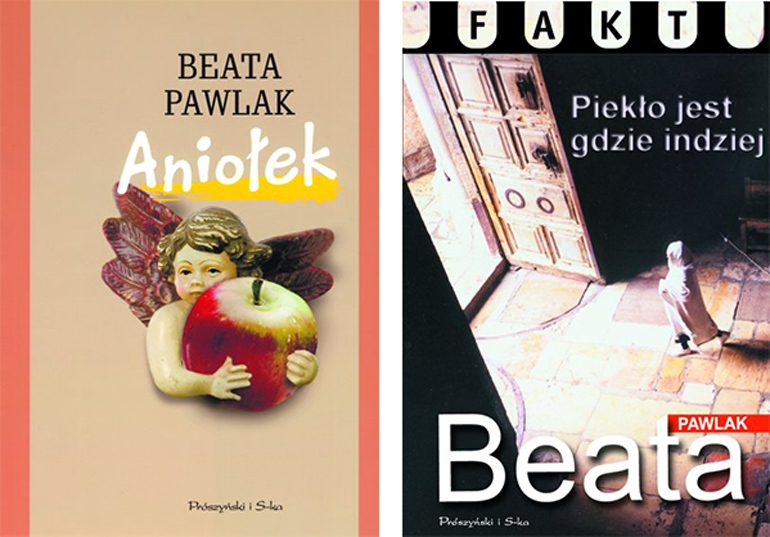
Covers of Beata Pawlak's books, photos courtesy of Prószyński i S-ka publishing house
Before leaving Poland for the last time, Beata Pawlak left the manuscript of her first novel, Aniołek / Angel. She wrote about her parents and sketched her own portrait. The author shares her thoughts about life and death. It says enough that the book starts with these words:
On Friday Karolina dreamt of being dead. Her whole body started to turn green and her skin cracked like burned soil. But since she could walk, she went to the doctor, who gave his diagnosis. He examined her thoroughly and said: Effectively, you are dead.
Aniołek is an unusual, tender story about taming death through love. The main character, Karolina, has to bury her husband and face the consequences of his further, nonobvious presence.
Since 2003 the Beata Pawlak Prize for a text on foreign cultures, religions and civilizations has been awarded – the journalist established a special fund to that end in her will. It is now administered by the Stefan Batory Foundation, and the award is given by a jury which consists of Adam Szostkiewicz, Urszula Doroszewska, Wojciech Jagielski, Piotr Kłodkowski, Maria Kruczkowska, Antoni Rogala, Olga Stanisławska, Wojciech Tochman, Joanna Załuska, and Wojciech Załuska.
Works
Books:
- Mamuty i petardy. Czyli co naprawdę cudzoziemcy myślą o Polsce i Polakach / Mammoths and Firecrackers: What Foreigners Really Think about Poland and the Poles, PWN, Warszawa 2001
- Aniołek / Angel, Prószyński i S-ka, Warszawa 2003
- Piekło jest gdzie indziej / Hell is Somewhere Else, Reportages about the Islamic World: Algeria, France, Bosnia, Gaza, Israel, Lebanon, Iraq, Kurdistan, Egypt, Poland, Turkey, Ali Ağca and John Paul II, Prószyński i S-ka, Warszawa 2003
Co-author of reportage collections:
- Kraj raj / Paradise Country, 1993
- Anna z gabinetu bajek. Reportaże roku / Anna from the Fable Cabinet. Reportages of the Year, Warszawa 1999
- Nietykalni. Reportaże roku 1999 / The Untouchables. Reportages from 1999, two Beata Pawlak's reportages about Poland, Prószyński i S-ka, Warszawa 2000
Protagonist of the book:
- Wojciech Tochman, Córeńka (powieść reporterska) / Little daugher (reporter's novel), Znak, Kraków 2005
Film:
- Wszystkie kobiety Mateusza / All Mateusz's Women, based on "Aniołek", dir. Artur Więcek "Baron", 2012
Author: Janusz R. Kowalczyk, translated by N. Mętrak Ruda, November 2015.