He was born on September 1st, 1883, in Narva; he died on October 1st, 1948, in Kraków.
Born in Narva (in what is now Estonia), from 1902 until 1909 he was a student of St. Petersburg Academy of Arts under the patronage of Professor Benoit. Afterwards, he studied art history in Kraków. In 1909, he embarked on a study tour around Austria, Bohemia, and Moravia, which ended in 1910. Until 1912, he lectured at the Academy of Fine Arts in Kraków and the Jagiellonian University. Between 1912 and 1916, he was an academic teacher at Lviv Polytechnic University.
His first design works were a synagogue in Kharkiv (1910), a house at Plac Mariacki 7 in Kraków (1912), a school building in Różany Stok, and a residential building in Radom. The shapes he applied to those projects were derived from his native architecture, from the Polish Renaissance or Baroque, although they were simplified and romantic creations. In 1911 in Rome, he was awarded a medal for his flawless design for a country church inspired by the style of temples found in the historical Polish region of Lesser Poland. He also launched works at the Wawel Hill, where he studied buildings from the Pre-Romanesque and Romanesque periods. It was then he discovered the remnants of the rotunda of Saints Felix and Adauctus. After World War I broke out, he served at the front, but after a year he was restored to his works at the Wawel Hill. In 1919, upon presenting his dissertation on the Wawel rotunda at Lviv Polytechnic University, he obtained a PhD degree.
In 1920, he designed a cenacle and a confessional at Jasna Góra in Częstochowa and restructured the front of the temple of the Blessed Virgin. There, he used motifs typical of Polish Late Baroque churches. He also created architecture designs for missionaries in Lviv that were never carried out, a competition entry for a seminar in Pszczyna and a design for a cathedral in Katowice. Between 1922 and 1925, a monumental edifice of Pocztowa Kasa Oszczędnościowa (PKO Bank Polski) in the academic classicism style and an adjacent PKO housing estate were erected in Kraków. In 1926, a church in Terebovl, Ukraine, was built.
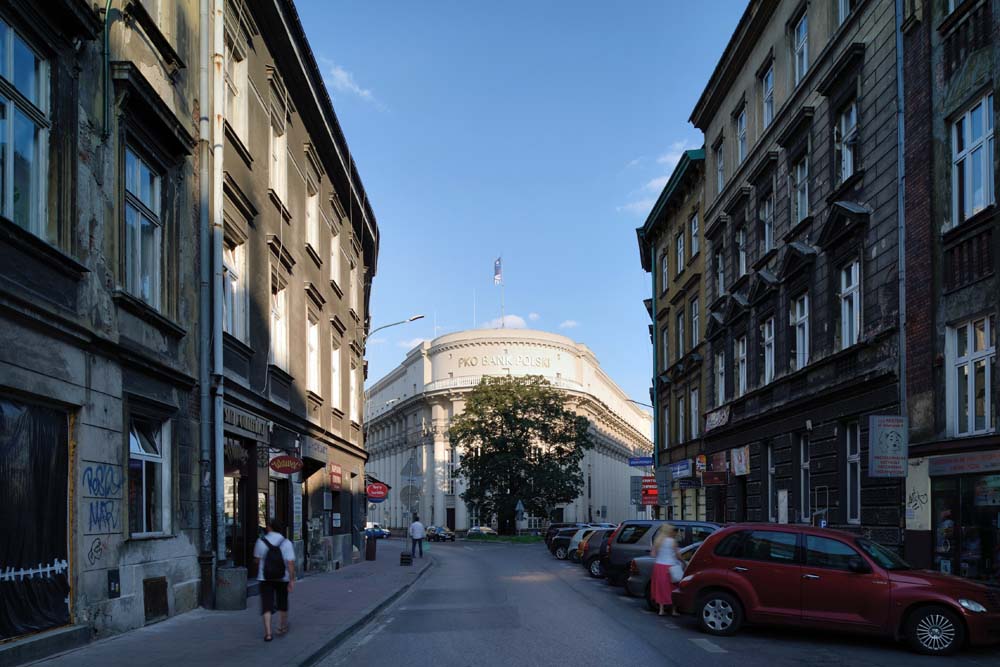
Adolf Szyszko-Bohusz, PKO Bank building in the Wielopole Street, Cracow
Since the mid-1920s, Szyszko-Bohusz had been creating designs with the characteristics of the height of modernism and an avant-garde touch, e.g. the building of Poczta Główna (Main Post Office) in Częstochowa, and buildings in Krynica: an officers’ holiday house, the Bristol hotel, Warszawianka and Felicja boarding houses, and Dom Zdrojowy in Żegiestów which combines a modernist elevation with a neo-classical interior. He also erected Dom Plastyków (Visual Artists’ House) at Łobuzowska Street in Kraków and modernist villas.
Between 1928 and 1931, one of the most distinctive designs by Szyszko-Bohusz – the office building of Feniks, a Viennese insurance company - was built in Krakow (Rynek Główny 21). Situated in the heart of Stare Miasto (The Old Town), the building aroused numerous controversies as well as opposition from the circle of restorers even as it was being designed. Ultimately, an avant-garde edifice with aluminium joinery was erected. Aside from bay windows on all storeys, its characteristic feature was a modern attic with tall pinnacles (which is the reason why the building was spitefully referred to as ‘the house under the chimneys’). Boldly standing out against historical buildings of the Old Town, Szyszko-Bohusz’s design was altered under Nazi occupation: the attic was replaced with a mansard, and the elevation was enriched with pilasters. Part of the elevation on the wall running along Św. Jan Street remained unchanged.
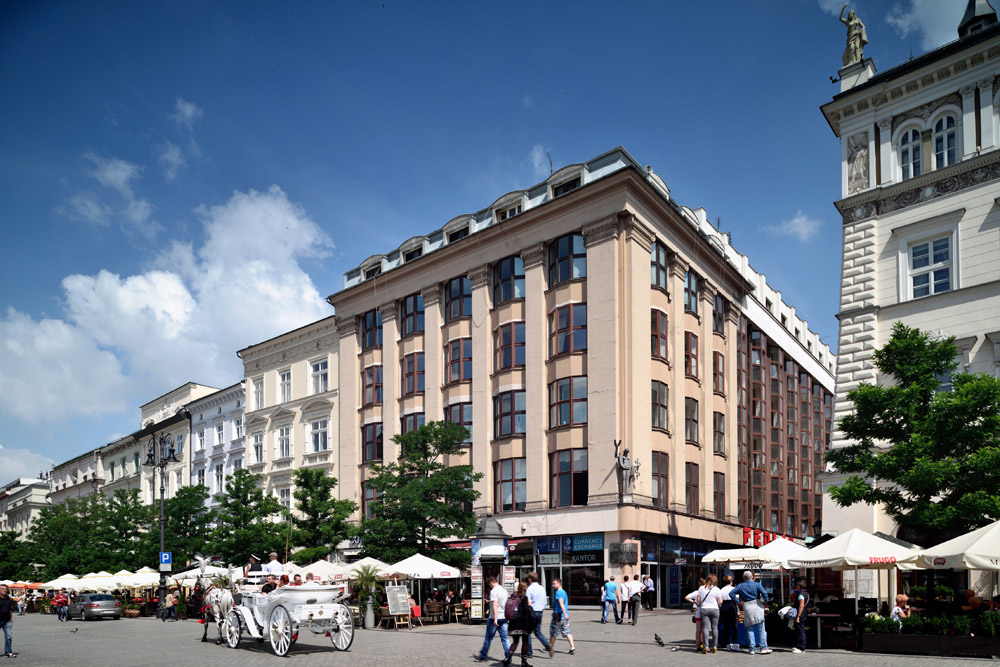
Adolf Szyszko-Bohusz, Dom Towarzystwa Ubezpieczeniowego 'Feniks' (Feniks House) in Cracow, 1928-1932
Around this time, the architect also built his own house in Przegorzały near Kraków, and Zameczek Prezydenta Rzeczypospolitej Polskiej (the Castle of the President of the Republic of Poland) in Wisła. Szyszko-Bohusz won the Lithuanian competition for a presidential residence in Kowno (the project was never launched).
Szyszko-Bohusz’s greatest completed projects were the restorations of two historic complexes of cardinal importance to the state: the Wawel Hill, where he renovated the structure, erected a new entrance gate, and designed Józef Piłsudski’s sarcophagus and crypt in the Royal Castle in Warsaw (1928-1939). Moreover, the architect carried out restoration work on a collegiate church in Wiślica, where he reconstructed its western façade.

