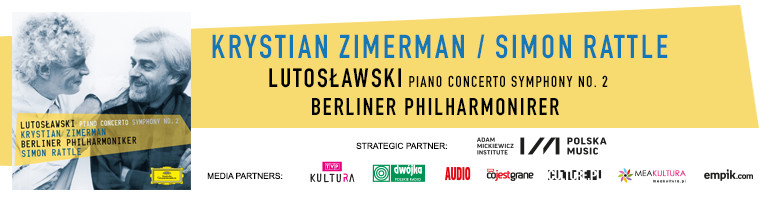
The album is available to pre-order at the Berliner Philharmoniker's website.
'He is someone whom I greatly miss'.
– says Sir Simon Rattle.
'He suffered greatly, I can clearly see it in the score. This tension is truly shocking to me; the multitude of tensions that are reflected in this soul that was so badly hurt after those events [of 1980s Poland]'.
– comments Krystian Zimerman on the Piano concerto.
It is hard to think of a better choice of artists to perform the music for this concert. Krystian Zimerman, one of the Poland’s finest pianists and winner of the 9th International Chopin Piano Competition, a man who supported Lutosławski and encouraged him to compose a piano concerto ('It is not a secret that Krystian Zimerman’s encouragement and interest were a great inspiration for me to write this concerto,' said the composer). Simon Rattle scheduled a series of Witold Lutosławski’s concerts in the Berliner Philharmoniker in 2012/2013. He also performed the Symphony No. 2 and No. 3, as well as the Piano concerto (with Zimerman), Double concerto, Cello concerto and Preludes and Fugue.
'He was a patrician, an aristocrat, a gentleman. But it was evident for me that under this coat there slept a volcano. He was the most civilized composer with the best of manners. You’ll find these traits in his music, which isn’t to say that it doesn’t have its darkness, aggression, and violence'.
- says Sir Simon Rattle about the Polish composer.
In 1989, a recording of the Piano concerto conducted by Lutosławski and performed by Zimerman and the BBC Orchestra was released by the Deutsche Grammophon. 26 years later, in July 2015, Zimerman's new interpretation of this score, along with the Symphony No.2 and with Simon Rattle conducting, will be released by the Berliner Philharmoniker Recordings and Deutsche Grammophon. Polska Music is a partner of the project.
In the Piano Concerto the music remains Lutosławski's own, but as we have observed, more than in any other composition by him it ‘mingles' with the musical tradition, which stands in contrast to the uses of tradition found in his other works.
– said Andrzej Chłopecki.
He was aware of the fact that there is no place for any revolution in the concerto at the end of the twentieth century, a fact that also made him its creative continuator. What is striking is that although the trace of the Baroque widens the perspective, Lutosławski becomes a continuator of Romanticism with Chopin, Liszt, and Brahms at the forefront, and perhaps with the (unloved) Rachmaninoff; moreover, with Debussy, Ravel, Bartók, Prokofiev, and Messiaen. But not Cage. Apart from discernible mini-quotations from Fryderyk Chopin's Concerto in f-minor there are no direct references to be found; instead, the references are to conventions. A super-conventional composition?
– added the music critic.