Agnieszka Sural: In your work, you move between architecture and art. What links them are social issues, history, and tradition, as well as themes connected with Jews. Where do these interests come from?
Jakub Szczęsny: The Jewish theme was taken up by us as the Centrala Design Group, even before I began to take on solo projects. It was a time when nationalistic formations wanted to depict Poland as a mono-cultural space. The kind of space that we encountered after the tragedies of the 20th century, and after communism, which didn’t tolerate any religious, ethnic or cultural differences – because they were not easy to control.
We didn’t want a culture defined by the one and only correct narrative, whether it was the communist or the nationalist version. There are many motifs in Poland which are linked to different cultures, religions, and races. The Jewish theme is a very abundant and interesting one, and for many of us, it was also something exotic and unknown. Like a tabula rasa.
Do you remember your first encounter with Jewish Polishness – or with Polish Jewishness?
It was in the 80s, when I saw a reportage by Tomasz Tomaszewski published in the National Geographic, about a Polish-Jewish minority who lived in poverty in the later years of the communist regime. It was then that I started to realise that things used to look different, things were once a lot more prosperous here. Of course, I also read historical books and the literature of the Romantic period, where the Jewish motif is very important sometimes.
Sometime in 2002, before the competition for designing the Museum of the History of Polish Jews, we became aware of how together with the disappearance of Jews, Poland actually suffered from a horrible cultural loss.
You lost the competition to design the Museum, but you won another one, for the temporary pavilion which was to announce and present the Museum’s construction. You raised a blue tent on the Heroes of the Ghetto Square. It served as an information desk, an exhibition space, and a meeting spot. You called it Ohel.
The name is derived from the Hebrew word ohel, meaning ‘tent’. It is a unit for delimiting space, in ways that are both geographical, practical, and symbolic. Places of special significance require the simplest form of a roof, which begins with four poles and a piece of fabric. And then it grows, until it finally becomes a home.
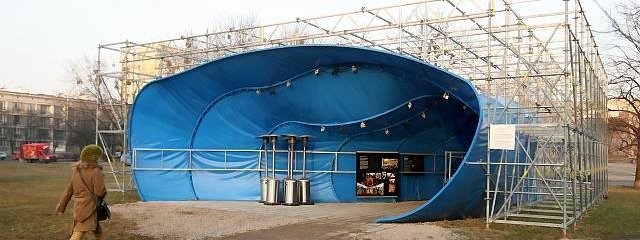
Ohel by Centrala Design Group (a pavilion announcing the construction of the Museum of the History of Polish Jews)
What did you want to concentrate on, apart from the need to remember?
For me and for Centrala, it was always important to look for motives from the past and to give them meanings. A kind of contextual archaeology which served the purpose of a dialogue about the future.
During that time, you were working on projects for the Polish Season in Israel.
That cultural season was one of Lech Kaczyński’s best ideas. I co-authored a Polish-Israeli cartoon which was published as part of the Kompot book, as well as the Pchechong installation, together with the Eifo Dana group, about Poland’s coldest winter of the century.
Most of the things you do are outside of architecture, they make the world a better place, but they are ethereal. The project in Israel is an exception, it has continued to function until the present.
Apart from two installations in the Palestine Autonomy, the Aureola in Wrocław and the Keret House, Tamagotchi Park is probably the longest living artistic project of mine. It is the result of long-term collaboration with Ofer Bilik from the Eifo Dana group and the city of Bat Yam. In 2010, due to a water shortage, people were not allowed to water their private gardens and orchards, we came up with the proposal of using desalinated sea water.
It was also important not to deepen the conflict with Palestinians, and this happened whenever water was pumped from underneath the mountains of east Jerusalem, or from territories that belong to the Autonomy. This sea water only had to be desalinated, and energy is required to do that, solar energy, for example. Simple technological solutions had to be connected with the motivation for action.
How can you desalinate sea water using solar energy?
We built a swing which pumped water from the level of the beach to the water tower, from which excess water shoots out into the air if you apply minimum effort. When you go to the beach in Bat Yam, you swing, standing up, together with another person – and at the same time, you are pumping sea water. From the water tower, it gets transported to little Makrolon copulas with a network of tubes. UV rays make the copulas desalinate the water and they direct it onto plants which are also capable of resisting higher levels of salt. While playing on the swing, one can help sustain the life of a seaside garden on the dunes. It’s an entity which is animated through the effort of humans, hence the name – Tamagotchi Park.
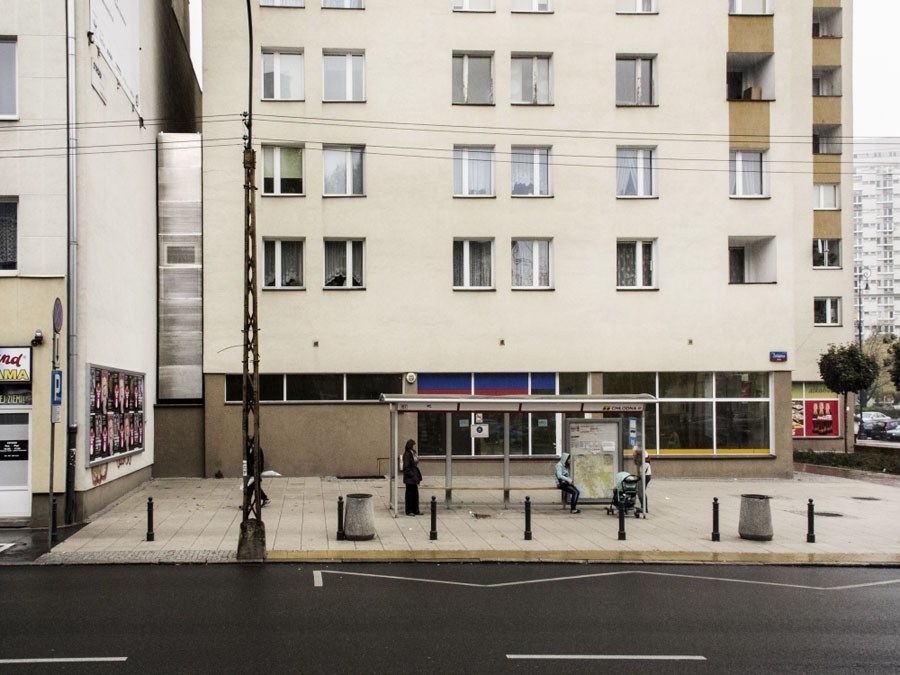
The Keret House (in the gap between the buildings), 2012, corner of Chłodna and Żelazna streets in Warsaw, photo: Bartek Warzecha / Fundacja Polskiej Sztuki Nowoczesnej
Another permanent object is the Keret House, which you raised in a gap between two buildings in the district of Wola, in Warsaw. Where did the idea come from?
It came from a fascination with the gap between the two buildings, which is so typical for Warsaw’s architecture. A large part of the city which was raised after the war did not relate to the pre-war part of the capital. It almost avoided it, leaving this layer of air. The glue that can connect them is not necessarily architecture as such, but human beings, an action, an activity, a life.
And why Keret?
I wanted to use the potential of people I met in Israel, and whom I could bring back to Poland, making them part of a network. Keret and his family have a strong sense of being connected with Poland and with Warsaw. From my high school years, I remembered reading an interview with a young Israeli writer who came to Poland and said it was cool. That was in the early 90s, Keret totally ignored everything that was gloomy and martyrological and he said, ‘Let’s concentrate on the present. You have an interesting tension within society.’ This struck me. How someone connected to the difficult past of this place suddenly lands here, and he doesn’t draw back.
How did he react to your proposal?
He said it sounds great, but it’s impossible to realise. That’s what most Polish administrative officials said. A building, which is 14 metres square – they said it’s impossible, but they gave their approval, ‘maybe you’ll succeed’. It was a common effort, dozens of good-willed people, authorities, sponsors, builders, cultural officials, all helping out a crazy guy.
In 2016, as part of the presentations of Polish culture in Brazil, you are planning a project inside a Jewish cultural centre in São Paulo.
I want to build an installation on the roof of Casa do Povo, which will be the structure of survival for an immigrant-refugee. I want to speak about contemporary national identity, of assimilation, of the inadequacy of the construct of nations as such with respect to people. The idea emerged one year ago, and suddenly, it has become incredibly pertinent in the theme it takes up.
This project is meant to interrogate how our national identity is imposed on us by the cultural tone of a given place. In the case of Brazil, it’s a clearly legible construct of modernism from the late 20s and early 30s of the 20th century. It was co-created by luminaries of science and culture of that time, such as Oscar and Fernando Freire and Flavio de Carvalo.
The essence of this construct is the ‘metissage’, an opening up onto the mixing of influences from Europe, Africa, and India. In Brazil, they will tell you it’s an ideological construct that doesn’t correspond to reality, because the mixing only takes place within the lowest classes of society. The middle and upper class in São Paulo are almost exclusively people of European origin.
Looking at Poland, we could say we are a bit lost in constructing our own identity.
We aren’t aware of it, our ideological sphere is an inconsistent mix of difficult pasts. The mixture of a victim complex with the proliferating ego of a nation that once used to be a local empire will always be an explosive one. On the other hand, the tragedy of wiping out of certain social classes, and repressions during the Partition period became the fundament of the intelligentsia. That was the case with my family. Because of their participation in the January Uprising, the tsar took away my family’s aristocratic status and its fortune, sending it into exile beyond the Ural mountain range. As a result, the third generation became engineers of the oil industry and early aviation, and they returned to Poland in the inter-war period, with the intention of rebuilding the country. As a consequence, if this class still exists, it carries with it the good, as well as the bad aspects of the aristocratic ethos…
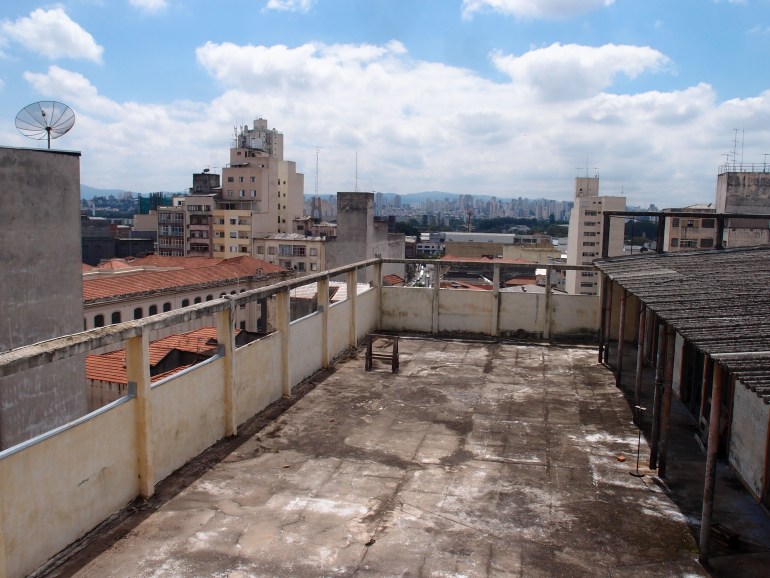
The terrace on the roof of the Casa do Povo in São Paulo, where Jakub Szczęsny is going to build his installation – the house of the emigrant-refugee, photo: Agnieszka Sural
What kind of Poles did you meet in São Paulo?
I met people who didn’t match this construct in its Polish version. They were often people of Jewish origin, who would stretch their arms out enthusiastically, saying ‘I’m Polish, too!’ As a Pole I know I don’t have to do a DNA test in order to see that I am the result of a historical exchange of genes between Slavs, Armenians, and Prussians. My fiancée also claims, looking at my nostrils, that there must have been an African somewhere along the line too. I am also a liberal agnostic, which doesn’t quite fit into the contemporary model of Polishness.
What is the history of Casa do Povo?
It used to be an enclave of Jewish emigrants from Poland, the cultural house was designed in the aesthetics of huge industrial warehouses, which could be filled with new content every once in a while. It’s a wholly modernist concept, created by people who spoke Polish and Yiddish, but also Russian. Because the Polish-Jewish intelligentsia was split between the three.
The idea for the Casa do Povo came in the late 1940s, and the building was constructed in 1953 thanks to contributions from society. Through to the 1980s, it housed a theatre with 1000 seats, a huge workshop hall, a school, a kindergarten, and the editorial office of a newspaper. Later, there was not enough of a generational exchange, and the place started to crumble to nothing. Only the choir continues today.
What kind of influence did Poles have on the history of Brazil?
This is what I want to address in the second part of my project, it will be a Polish guide to São Paulo. A collection of expressions by different Poles, starting with the Polonia which was forced to emigrate from Poland, the gentry, and sometimes the aristocracy. I will also focus on the intellectual production of a big group of artists and architects, as well as designers and people connected to theatre who are often unknown in Poland – such as Jorge Zalszupin and Paulo Kuczyński. In a city which had a rather small number of Polish emigrants, it was a group of people of really high intellectual qualities.
There was also a Jewish motive, and one linked to prostitution – very much a shameful issue for the community, which is now erased from its history. It was an idea suggested by Renato Cymbalista, a professor of architecture at the University of São Paulo. Together with Professor Janowicz and Roney Cytrynowicz, a historian and publisher, they proposed a special way of commemorating these women in the context of their burial – because for some 50 years, anonymous people kept on erasing the names from their tombs.
From the 1890s through to the 1950s, young women from the Galicia territory and from the area occupied by Russia were sent overseas, as if to be married off to American farmers. Forcing them into prostitution was a huge business, conducted by specialised gangs for some 70 years. Even today, the meaning of the word ‘Polka’ for the oldest generation in Brazil and in Argentina means ‘prostitute’.
How do you intend to honour their memory?
We want to make a mobile synagogue. We will get a Torah from a friendly rabbi in Brooklyn, and we want to consecrate a light architectural object, which will be carried by a few people into different public spaces, starting with cemeteries and ending with parks and squares.
It will be a form of historic storytelling, connected to transformations of lifestyle within Brazilian society. In the 1950s, Brazil saw the flourishing of a specific form of Catholic puritanism, all framed in nationalistic ideology. The effect was a political dictatorship which lingered through to the 1980s, and significant emigration of Brazilian intelligentsia, whose effects are still sensed in the country to date.
Contemporary Brazilian culture suffers from dementia, which quickly wipes out the past. People only want to look to the future.
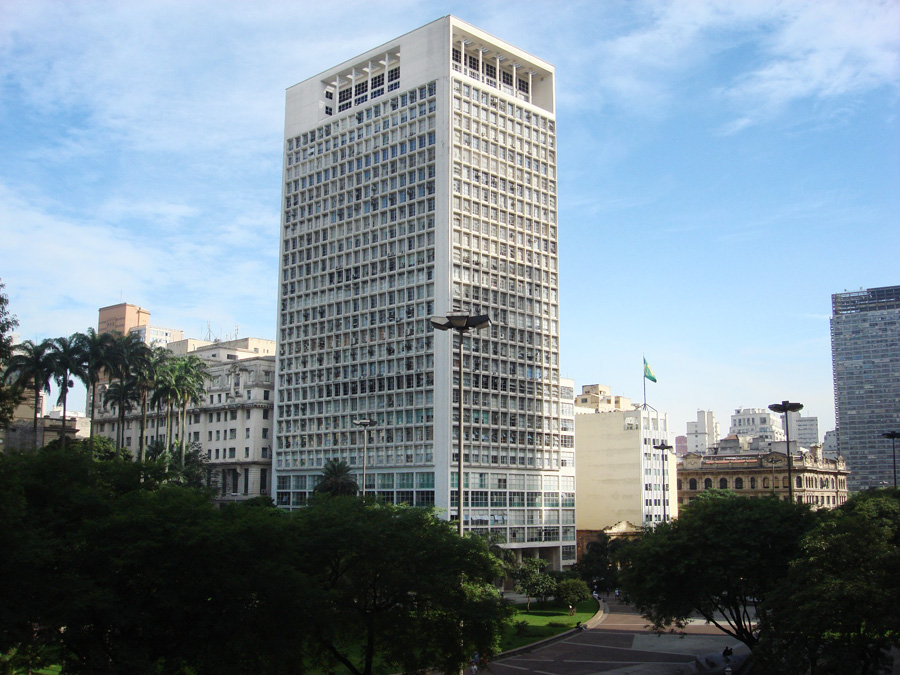
The CBI Esplanada high rise building, 1948, São Paulo designed by: Lucjan Korngold, photo: São Paulo na foto
What is the reason for this?
It’s due to the fact that it was a country of many waves of emigrants who fled war-stricken Europe in search of bread and peace. It was a country of promises of a brighter future. They were ‘making America’ there, in its Southern version. A lot of Europeans found their luck there, such as a Samuel Leiner, a football player for Legia Warszawa, who became an industrial businessman and an art collector.
Currently, the biggest waves of migration in Brazil are the interior movements from rural areas into the cities.
That is also the promise of a better future. Last year, thanks to the support of the Musagetes foundation, I made a project about a former São Joao hotel, which was supposed to be a model for people from the provinces who moved into buildings in the centres of Brazilian cities.
The centre of São Paulo has been dying out since the late 1970s, ever since the big industries moved to other areas, leaving behind beautiful high rise buildings in the art deco style, which are now difficult to rent. Places such as as the six-storey São Joao hotel are now taken over by organised groups from small towns, who want to work in the service sector and who wish to live close to the city centre.
Whole villages live together. In the beginning, they send out scouts who start the occupation, and negotiate illegal water and electricity connections with the neighbours. Then, they begin the renovations, changing dead buildings into living structures. One of the largest among the so-called ‘ocupação’ settlements is the Hotel Cambridge, which has 15 storeys. In spite of the semi-legal status, there is a bakery that operates there, and each floor has a trained fireman.
In collaboration with the Goethe Institute, we created a vertical garden inside the former São Joao hotel. We wanted to create a model of independent vegetable, fruit, and herb production within constrained urban spaces.
Does the legal status of such an ‘ocupação’ change with time?
After five years, they gain semi-legal status, thanks to which they can apply for funding. São Joao, for example, has a registered cultural house. They are allowed to teach, to conduct workshops, capoeira classes and even religion classes. The buildings are usually owned by private families, and the city plays the role of an agent – the family’s land tax is extinguished, as it accumulated over a period of 30 years of the land not being used, but the family has to sell the building for a price which is lower than a regular market one, and it has to be sold to the cooperative of the ‘occupants’. The Caixa Bank, for which the City Office is a guarantor, grants this cooperative a low-percentage loan.
It’s a social experiment, which is meant to contribute to the revitalisation of the centre. It will undergo a specific form of gentrification, with the participation of the working class, the so-called C class, which constitutes nearly half of Brazilian society.
Didn’t you ever want to realise a project in Poland which would be closer to your own traditions – to Poland, to Christianity?
Yes, of course, I am just about to ‘fire off’ my little chapel, a brazier on Agrykola street in Warsaw (10.02-24.03.2016). It’s the personal narrative of me as an agnostic, about the power of faith, one which is not framed in any limits of a religious system. The object will have a utilitarian pretext, much like the ordinary, vulgar steel braziers we know from the streets of Polish towns. But it will not only warm our bodies, but also our unwashed souls. The little chapel is going to be raised as part of the Gorzkie Żale festival, organised by the Centre of John Paul II’s Thought. I considered this invitation a fortunate turn of events, because even though I don’t think of myself as Catholic, I was always drawn to simple, archetypal, small-scale objects connected to meditation, memory, and self-reflection. We discussed the project for nearly two years!
I am offended by unleashed manifestations of religion in architecture. I am not surprised by the power of the Reformation, when I look at the scale of the Vatican, or the peasants’ uprisings in Mexico, or when I look at the gilded ceilings of the Pueblo cathedral. But I am very much interested by the phenomenon of experimental churches build in Poland from the mid-1970s, as a gesture of resistance towards ruling authorities. I also have a certain nostalgia for the Rüstem Pasha mosque in Istanbul, where I always liked taking afternoon naps on the thick carpet.
So, my stance with respect to religious architecture is full of contradictions. That is why our Warsaw chapel is supposed to be a place where you can warm up and think, in an almost primordial reflex of thought which the contact with fire seems to incite. I hope that some lost winter runner will stop by the chapel, and while warming up his hands, he will think about what Henryk Tomaszewski once beautifully captured in his cartoon without words. It’s a figure of a little man running faster and faster through the subsequent images, only to finally run into a grave. ‘Why the hell am I rushing?’
Warsaw, December 2015
Translated by Paulina Schlosser, June, 2016
For more about Polish culture in Brazil, click HERE