This is first of all erroneous, since Poland has an impressive history of sporting exploits. Second, this misconception prevents a comprehensive understanding of Polish culture: Polish sporting culture often ties in with major events in history, even art, and always testifies of an indomitable fighting spirit.
It may seem surprising that a non-Pole would write about Polish sport. This interest dates back to when I first started watching the Olympics as a child, at which point, I developed an odd tendency: If I left the room to grab some drinks, I would rush back to the TV screen and try not to mistake the Indonesian flag for the Polish one, especially if they had just aired the badminton results. The Indonesians usually won... I obviously don’t make this mistake any more, but Poles never cease surprising me with their sporting feats. Even better, I currently live in Poland and can watch or actively participate in sport events throughout the year.
It is always a hot topic to discuss the role and the political games sport plays in the construction of national identity, but most important of all, since when is sport a cultural subject? Perhaps, this is rather obvious in the context of mass culture, as modern sport provides an ideal source of content for the media of mass entertainment. For the same reason, creating an image of a country as a “sports superpower” needs lots of backing from the mass media in general.
There are countries that skilfully publicize and sell their sporting exploits: to the dismay of Noam Chomsky, who once defined sports as a collection of “irrational attitudes of group submission to authority,” the biggest promoter among them is the United States. Indeed American athletes admittedly prove successful in numerous worldwide competitions, and yet the majority of the American public is interested in sports for purely entertainment reasons.
While the American model may represent the transformation of sports from honourable conduct to commodity and commercial spectacle, Poland remains a country whose sporting feats are even diminished, never mind spectacularized. Poland’s sporting reputation has never been at forefront, and numerous Polish accomplishments are rather unknown. Especially during the Cold War era, if TV airtime was ever stolen from American achievements, it was given to their major rival, the Soviet Union. The policy remains similar today; unless they make it on American or major European channels, news is muted on a global scale.
How to Read Those Consonants?
As an outsider, it may be hard to recognize some Polish athletes by their names, most of which consist of consonants which are hard to pronounce. The names I got to recognize as a kid by hearing them on TV were slightly easier. First, I heard the name Roman Kosecki (born February 15 1966), mainly because he played for the Turkish team, Galatasaray, between 1991-1992, and my dad was a devoted fan.
Then, there was the hammer-thrower Kamila Skolimowska (4 November 1982 – 18 February 2009), who won gold during the 2005 Universiade held that year in Izmir, Turkey. And most recently, when I travelled home for the summer, Polish weight-lifter Adrian Edward Zieliński (b. 28 March 1989) was on the news, because he won a gold medal with a 383 kg total at the 2010 World Championships in Antalya, Turkey.
Freshest Feats From 2014
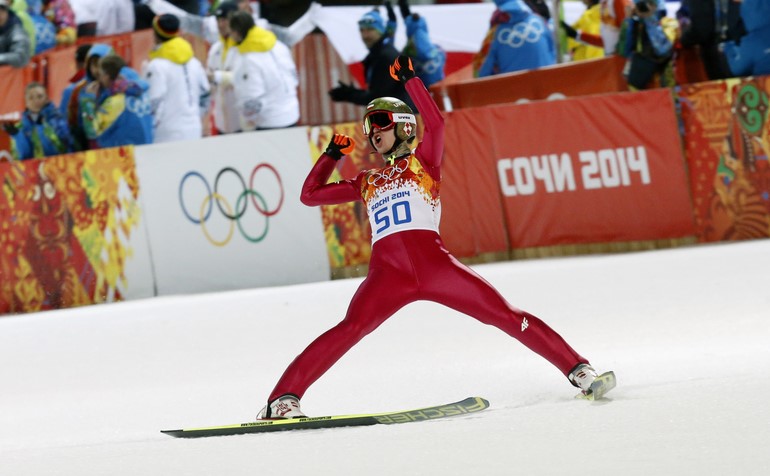
Kamil Stoch, Soczi 2014, photo by Piotr Nowak /Forum
My own memories aside, some of the freshest marks Poland’s gold medallists have left worldwide are actually from within the past year, and simply put, there are so many of them! Most recently, Poland defeated the reigning World Cup champions Germany 2-0 in their Euro 2016 qualifier on 11 October, 2014. This came as the first victory over the Germans in the history of Polish football. Just a month prior, Poland also hosted the 2014 FIVB Men's Volleyball World Championship, in which they won the gold medal and became world champions, beating Brazil 3 to 1 on 21 September, 2014.
Also fresh are the gold medals won during the 2014 Sochi Winter Olympics. Polish speed skater Zbigniew Bródka (8 October 1984), who also works as a firefighter in the State Fire Service station in Łowicz, became the 2014 Olympic Champion in the 1500m. Rising Polish ski jumper Kamil Stoch (May 1987), who was the 2013 World champion in the large hill, became the 2014 double Olympic Champion in the normal hill and large hill. He is also the current World Cup holder.
The iconic Polish cross country skier Justyna Kowalczyk (19 January 1983) won her gold medal in Sochi in the 10km classical. Kowalczyk, among Poland’s most awarded athletes ever, is also a double Olympic gold medallist and a double World Champion. She is also the only skier to have won the Tour de Ski four times in a row and holds the all-time record for the most Tour de Ski wins.
Probably not as memorable as “Poles conquering Brazilians” or better yet “defeating Germans,” Poland’s achievements in international speedway are also fresh since their most recent gold medal in August 2014 at the Junior Speed Way Cup. The Polish national speedway team has won the Speedway World Team Cup Championships three times consecutively, in 2009, 2010, and 2011. As of yet, no other country’s team has ranked as high.
First Things First – a bit of Physics and a bit of Physique
The reason to refresh our memory is to be able to go back in time. I’ve always thought that Maria Skłodowska Curie, widely known as Marie Curie (and most frequently mistaken for a French madame) was the first person honoured with two Nobel Prizes, and yet she was much underrated considering her achievements.
Some pioneering Polish names in numerous athletic fields are as remarkable for their achievements in physique as Curie was for her physics. Here we present a broad range of names who were groundbreaking in their respective categories, and highlight Poland as a successful sporting country, if not the world’s sports superpower.
The Soviet Generation
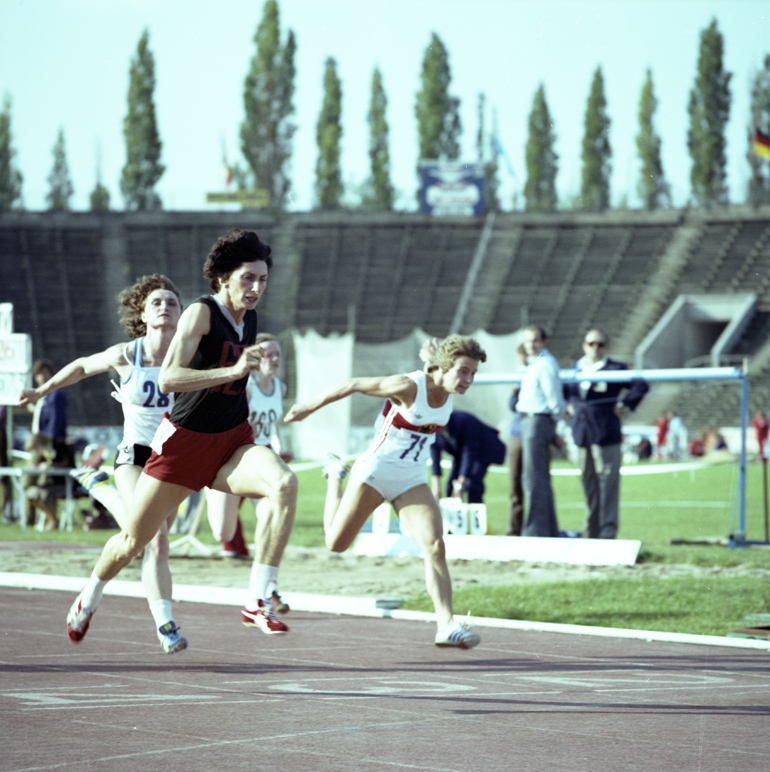
Irena Szewińska during Janusz Kusociński Memorial, 1980, photo by Bogdan Łopieński / Forum
Among the successful athletes of communist Poland was the legendary sprinter Irena Szewińska (born 24th May 1946, died 29th June 2018), who participated in five Olympic Games between 1964 and 1980, winning seven medals, three of them gold. She also broke six world records and was the first woman to hold world records at 100m, 200m and 400m at the same time. Szewińska is also a six-time World Champion.
Polish Alpinist and Tatra Mountains climber Andrzej Zawada (16 July 1928 – 21 August 2000) was the pioneer of winter mountaineering. Organiser and leader in numerous high-mountain expeditions, Zawada was also the co-author of various Alpinist books in the field. Helena Rakoczy (23 December 1921 – 2 September 2014) was a gymnast who became the World Individual All-Around, Vault, Balance Beam, and Floor Exercise champion in 1950. Rakoczy’s name was added to International Gymnastics Hall of Fame in 2004.
Another key historical figure in athletics, pole vaulter Władysław Kozakiewicz (8 December 1953), became an icon not only for breaking the world record three times, but also for Kozakiewicz's gesture (gest Kozakiewicza) which is very famous in Poland. Also called a bras d'honneur (arm of honour), and commonly practised in France, Spain, and Italy, as well as Georgia, Bulgaria and Latin America, the arm of honour is the Mediterranean equivalent of the middle finger. After securing a gold medal during the 1980 Summer Olympics in Moscow, Kozakiewicz raised his arm of honour against the Soviet crowd as a statement of defiance. While photos of the incident circled global media and stirred Russian anger, fellow Polish fans in Poland, preparing for the Solidarity movement only two months later, also raised their arms and applauded Kozakiewicz.
Another name among the Soviet-generation sport icons is former Polish football winger and coach Grzegorz Lato (8 April 1950). Lato's playing career coincided with the golden era of Polish football, which began with Olympic gold in Munich in 1972 and ended a decade later with a third place finish at the 1982 World Cup in Spain. He was the leading scorer at the 1974 World Cup. Lato is also the only Polish player ever to win the Golden Boot at a World Cup.
The Younger Generation
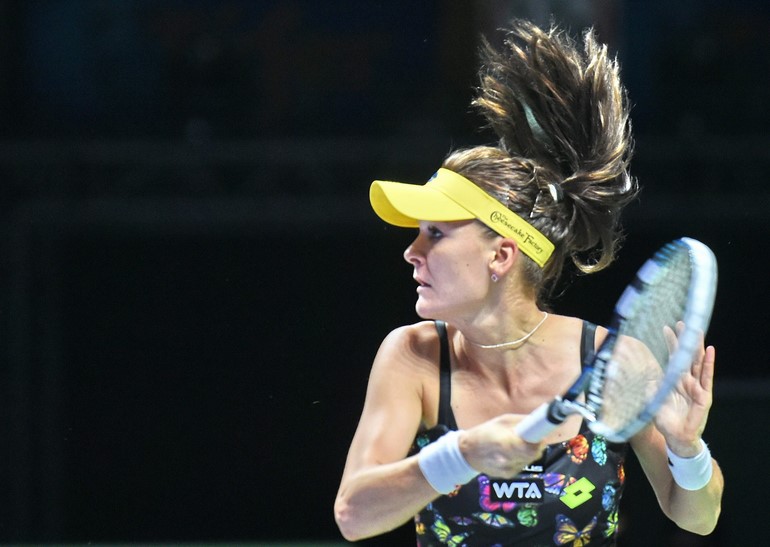
Agnieszka Radwanska of Poland plays against Simona Halep of Romania during the semifinals of the Women's Tennis Association (WTA) Finals in Singapore on October 25, 2014, photo: AFP PHOTO / Roslan Rahman / East News
Among the younger generation of athletes, there are also numerous first-timers with remarkable world class achievements. Adam Małysz (b. 3 December 1977) is the first ski jumper ever to win the World Cup three times in a row. Another well-known name today, Agnieszka Radwańska (b. 6 March 1989) is a Polish tennis player who holds a career-high singles ranking of World no. 2 in July 2012, and is currently ranked World No.6 by the Women's Tennis Association (WTA).
Robert Kubica (7 December 1984) is the first Polish Formula One driver. He made his racing debut at the 2006 Hungarian Grand Prix. During the 2006 Italian Grand Prix race, he finished third and stood on the podium next to the legendary Michael Schumacher of Germany and Kimi Räikkönen of Finland.
Ball Games? Poles Prefer the Oddballs!
There is more to the story of new Polish athletes: They are good in sports that one may not expect them to be good at, or perhaps one may not even know they existed!
In the quite peculiar Olympic field of racewalking, for example, athlete’s cadence rates – the number of full cycles taken within a minute by the athlete's feet – are comparable to those achieved by Olympic 800m runners. Robert Korzeniowski (30 July 1968) is a former racewalker who won three world championships in 1997, 2001, and 2003 and four gold medals at the Summer Olympics. Korzeniowski became the first athlete to claim both the long distance 50km and the short distance 20km golden crown during the same Olympics in 2000, in Sydney.
While the title “professional strongman” may sound odd, it does exist as an official rank issued by the International Federation of Strength Athletes, which operated until 2007. The Strongman Champions League now operates independently of IFSA. Polish Mariusz Pudzianowski (b. 7 February 1977) still remains one of the three men to consecutively win the title of World's Strongest Man – in 2002, 2003, 2005 and 2007. He was considered the iconic face of weight-lifting in the U.S. during that same period.
Another seemingly exotic field, Muay Thai – a combat sport of Thailand, characterized by the combined use of fists, elbows, knees and shins – made Paul "The Sting" Slowiński (b. 24 September 1980) four-time WMC Muay Thai World champion, and winner of the K-1 World GP 2006 in Auckland and K-1 World GP 2007 in Amsterdam. Another martial artist, Paweł Marcin Nastula (26 June 1970), is the 1995 and 1997 Judo World Champion, and 1996 gold medallist in the U95kg weight category at the Olympic Games in Atlanta, Georgia, USA.
Last but not least odd, a luge is a small one or two-person sled, on which one sleds facing up and feet-first. Luge is also the name of an at times deadly Olympic branch, also recognized as an extreme sport. Jerzy Wojnar (7 October 1930 - 2 February 2005) was a Polish pilot and luger who competed from the mid-1950s to the late 1960s. He won the three medals in the men's singles event at the FIL World Luge Championships with two golds in 1958 and 1961, and one silver in 1962. Meanwhile, Polish-born British luge racer, Kazimierz Kay-Skrzypecki (1909 – 23 January 1964), who was also a former pilot in the Royal Air Force, died during one of the training runs for the world’s first Olympic luge competition at the 1964 Austrian Winter Olympics in Innsbruck.
It is a Fact: Women Too Can Sweat!
Sports, in both traditional and modern forms, were typically practised by men, rarely allowing female competitors. While the official Olympics web page states the date when women first competed as the 1900 Games in Paris, it also notes that only 22 women out of the 997 athletes that year were able to compete in five sports: tennis, sailing, croquet, equestrianism and golf. Even though sports and athletic endeavours may still continue to carry the image of masculine muscularity, Polish women athletes rank among world’s best.
With roots dating back to the 15th century, the contemporary version of hammer throwing is among the oldest of the Olympic sports. While men’s hammer was included in the 1900 Paris Games, women’s first ever staging of hammer throwing was not until the 2000 Sydney Summer Olympics, during which my good old Kamila Skolimowska (4 November 1982 – 18 February 2009) became the youngest Olympic hammer champion, a little before turning 18, and set the first women’s Olympic record, which stood for four years. The current world record holder in women’s hammer is Anita Włodarczyk (born 8 August 1985).
Among my personal icons, Polish mountain climber Wanda Rutkiewicz (4 February 1943 – 12 May 1992) was the first woman in the world to successfully summit K2 – the second highest mountain at 8,611 metres, after Mount Everest. The K2 victory came in 1986, when Rutkiewicz summitted K2 without supplemental oxygen, while her expedition group leaders, Lilliane and Maurice Barrard of France, died on the descent. Previously, on 16 October 1978, Rutkiewicz became the third woman in the world, the first Pole, and the first European woman to reach the summit of Mount Everest. Kinga Baranowska (b. 17 November 1975) currently leads women’s mountaineering.

Wanda Rutkiewicz, Pakistan/China, 1982, during the K2 expedition, in the background K2's summit, photo from the Jerzy Kukuczka's archive / Forum
Another personal iconic name for me remains Krystyna Chojnowska-Liskiewicz (15 July 1936). Though not formally a trained athlete, she became the first woman to sail solo around the world. Starting from the Canary Islands on 28 February 1976, she returned on 21 April 1978, completing a 57,719km in a total of 401 days on her boat Mazurek, which was constructed in Poland with the help of her husband.
Born without a right hand and forearm, table tennis player Natalia Partyka (27 July 1989) participates in competitions for both able-bodied and disabled athletes. Most recently, Partyka reached the last 32 of the London 2012 Olympic women's table tennis. Competing in class 10 at the 2008 Beijing Paralympics, she won gold by defeating China's Fan Lei by three sets to nil. Later on 3 September 2012, Partyka became the Paralympic Champion after defeating China's Qiang Yang 3 to 2 in the Gold Medal match.
Fencing, even though a practice deeply rooted in the history of the Polish-Lithuanian Commonwealth, does not seem to bear as many gold-winners, leaving the current rank to countries like Italy or France. This does not change the course of events for Danuta Dmowska (b. 1 March 1982), who is the 2005 World Épée Champion and a world-leader in women’s fencing. In October 2005 at the World Championship in Leipzig, Dmowska achieved her greatest success in her career so far by winning the individual Gold Medal.
Another young woman athlete on the list, Polish swimmer Otylia Jędrzejczak (13 December 1983) broke the world record in the women's 200m butterfly three times. She is the Olympic champion from Athens 2004 in the 200m butterfly. Same year in the Olympic games, she also silvered in 400m freestyle and 100m butterfly.
Perhaps among the reasons why record-breaking swimmers like Jędrzejczak could establish better ranks were practical means, such as the Polish government investing in indoor swimming facilities. But certain names who get closest to creating the image of a living Polish sports superpower, such as cross country skier Justyna Kowalczyk, stand among top gold-medallist even if they still do not have the most established facilities at home.
The World Is Not Enough
Among the Polish athletes and sports players who decided to seek glory outside of Poland are also some major names, some of which have achieved superstar status especially in fields of football and ice hockey.
Polish football has been famous for its legendary goalkeepers. Among them, Jerzy Dudek (23 March 1973) played for Liverpool in the British Premier League, where he won the League Cup in 2002–03, the UEFA Champions League in 2004–05, and the European Super Cup in 2005–06, as well as the FA Cup in 2005–06. Now retired, between 2007 and 2011 Dudek also played for Real Madrid. Polish football has also bore superstar strikers such as Robert Lewandowski (21 August 1988), who currently plays for Bayern Munich and captains the Polish national team. Lewandowski was crowned the Bundesliga's top scorer in 2013-14, and he scored 4 goals against Madrid in the 2013 UEFA Champions League semifinal. This result made him the first player to score 4 goals at a Champions League semi-final match.
Mariusz Czerkawski (13 April 1972) has enjoyed a successful career in the National Hockey League for 14 years. Czerkawski played for major teams such as the Boston Bruins, Edmonton Oilers, New York Islanders, Montreal Canadiens and the Toronto Maple Leafs, and appeared in the NHL All Star game in 2000. Another hockey star, Krzysztof Oliwa (12 April 1973), nicknamed The Hammer due to his physical presence on ice and his signature fighting skills, also scored as an NHL player for various teams, among them his main team New Jersey Devils, as well as Pittsburgh Penguins, New York Rangers, Boston Bruins and Calgary Flames.
Last but not least, it is also worth mentioning the revival in Polish basketball since 2000. Poland hosted the 2009 European Basketball Championship and is known for NBA players such as Marcin Gortat of Washington Wizards.
Poland All Year Round For Active Holiday Lovers
Fortunately, Curie and Chopin’s Poland is a land of four seasons in full gear! From kayaking and skiing to hiking and fishing, the Polish landscape offers enchanting natural resources for all kinds of recreation. Among them, the Polish Tatras, most recently made it on CNN’s top 30 list for world’s most beautiful national parks. Hiking, climbing, skiing and ultramarathons on icy peaks attract numerous locals, as well as tourists from all over the world throughout the year.
If you are a sporty extrovert and love nature, spending the summer season in Poland can also be your dream vacation. From mid May through late August, the sun sets in a combination of spring and summer, vitalizing plenty of green parks, forests, and numerous other outdoor recreational environments. You will see lots of Poles and travelling foreigners engage in biking, trekking, long distance running, kayaking and canoeing throughout the country. Other popular summer recreation activities include water-sports in particular, with numerous locations for fishing, canoeing, kayaking, sailing and windsurfing, especially in the northern regions of the country.