‘They were murderers, killers, butchers…’
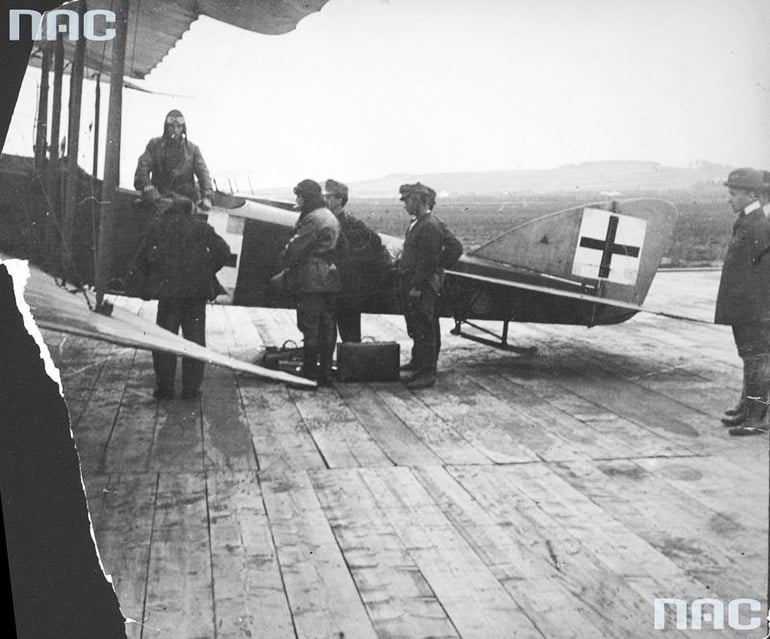
LVG C.II, Lviv, 1918, photo: National Digital Archive
World War I was the first military conflict during which armies used combat aircraft. The fledgling technology of aviation was hastily adapted to the demands of war and it resulted in its being supremely dangerous for the pilots and devastating for the planes. It had only been eleven years since the Wright brothers first lifted off the ground and, unsurprisingly, the death toll was horrific! Planes had no proper armour, and no specialised devices that would allow the pilots to defend themselves or spot the enemy in advance. Meanwhile, the press and war propaganda did everything to create the image of pilots as romantic lords of the sky to build national pride with their stunning aerobatic successes, and to encourage young boys to enter the air force. Disappointingly, reality was much less romantic. Krzysztof Mroczkowski from the Polish Aviation Museum describes it in an interview with Polish Press Agency's journalist Grzegorz Grzyb:
During World War I, pilots were nothing more than murderers, killers, butchers… There was nothing beautiful about it. Long hours spent in an aircraft made out of canvas, laths and wires, sitting on a barrel full of petrol and having only a whirling propeller as a shield could not have left their psyches unaffected. From their memories it becomes clear that they were drunk on adrenaline, insanity, alcohol.
These were kids whose main objective was to kill, who saw their friends die, one by one. Would you imagine that the British Army did not supply their pilots with parachutes?! Instead, pilots used to equip themselves with revolvers in order to commit suicide in case their petrol tank got hit and started a fire. During World War I, fifty per cent of air force personnel were killed! Fifty per cent, including the ground personnel! The casualties were appalling…
The Albatros D.I's twin, synchronous machine guns set the standard for other fighters, photo: Public Domain / Real aircraft might be seen in Polish Aviation Museum
The sum of the costs of the production of a plane and the training of a pilot was comparable to the cost of the production of a single high calibre shell used by the navy. This is why air force staff tended to use its pilots almost as kamikazes, sending them into mad engagements or giving nearly impossible recon/scouting missions. The average pilot survived on the front for approximately 72 hours. Every boy arrived at the airbase knowing that his time was short.
The German army was the only one to have a slightly different approach. By means of cold calculation, they decided to care for their pilots a bit more. They started a whole new programme aimed at searching for the most talented young boys, and prepared manuals for air combat (which are still used to date!). The same approach concerned their aircraft. Instead of producing the lowest quality, attack-only, quasi-kamikaze machines, they trained numerous personnel in repairing aircraft and increasingly modified them so that they became more than flying coffins for the pilots.
Mass Destruction of the German Air Force
Yet, because of the provisions of the Treaty of Versailles, almost all German aircraft from World War I were destroyed or burnt to ash after they became useless and abandoned. Germany was forced to give away all of the assets of its air forces including fuselages, spare parts, ammunition, etc. Personnel had to be demobilised and Germany was banned from trading planes and aircraft components for a period of six months. Provisions of the article 198 of the treaty of Versailles were strict:
Germany may, during a period not extending beyond October 1, 1919, maintain a maximum number of one hundred seaplanes or flying boats, which shall be exclusively employed in searching for submarine mines, shall be furnished with the necessary equipment for this purpose, and shall in no case carry arms, munitions or bombs of any nature whatever.
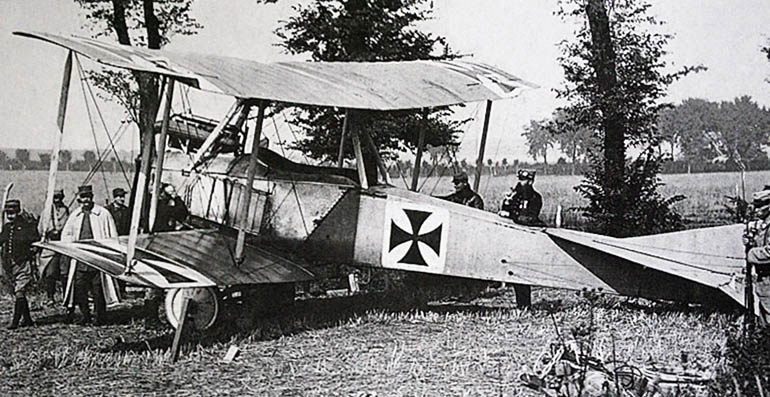
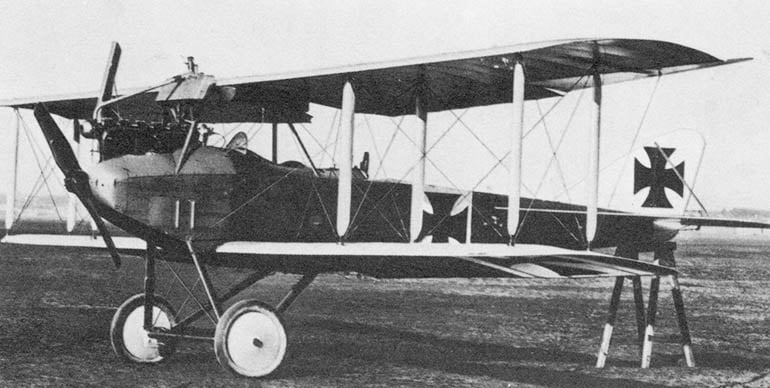
LVG B.II, a 1910s German two-seat reconnaissance biplane designed by Luft-Verkehrs-Gesellschaft for the Luftstreitkräfte, photo: Public Domain / Real aircraft might be seen in Polish Aviation Museum
That meant that those numerous unique aircraft were delivered to the ‘Governments of the Principal Allied and Associated Powers’, a very wide group of states which, according to above mentioned Krzysztof Mroczkowski were ‘indifferent and too preoccupied with healing wounds after World War I to take care of some out-dated planes’. Almost 100% of these aircraft were destroyed deliberately or locked up on junk yards, where they were lost and forgotten. On the other hand, this chaotic post-war period enabled one of the few surviving pilots to secretly preserve some of the German planes and start his collection. This pilot was, horror of horrors, Hermann Göring.
Hermann Göring’s Collection
Herman Göring was a renowned fighter pilot during World War I. He was not the ‘ace’ type (he was ranked around 70th on the list of pilots with most enemies shot down) but he managed to survive the whole of the war, which was an impressive achievement in itself.
After World War I, he joined Adolf Hitler’s movement and became one of the most powerful characters of the Nazi Government and the Third Reich but he never gave up his passion for aviation. This is why he didn’t hesitate to use his leverage to build a collection of aircraft from 1908 to the 1920s. Even if it was officially called the Deutsche Luftfahrtsammlung (German Collections of Aircraft), it was obviously Göring’s private collection, and the apple of his eye. At its height, the collection consisted of several dozen pieces and was the biggest assembly of that kind of plane in the world. What he had there were not only some miraculously preserved planes from World War I but also, after the breakout of World War II, some war trophies from Poland, France and the Soviet Union.
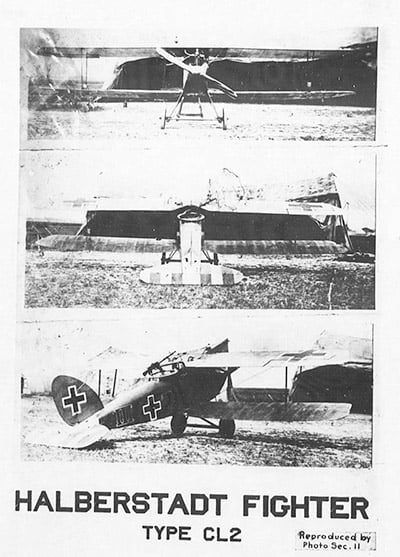
German Halberstadt CL.II, photo: Public Domain / Real aircraft might be seen in Polish Aviation Museum
The collection was kept and exhibited in beautiful 19th century hangars near Berlin Railway Station. In 1943, the station and the area surrounding it was heavily strafed and many planes were destroyed or burned down in the huge fire started by the Allied Forces’ bombs. Aircraft that were lucky enough to survive the bombing were chopped into pieces, loaded on trains and sent east. It is not clear how many transports were prepared (estimates vary from three to over a dozen, but no documents survived) but all those transports were sent east – to Pomerania (currently the north western part of Poland) and to the Greater Poland (the western region of present Poland). The Polish Army discovered the trains in the beginning of spring, 1945, near Poznan, hidden in the forest near the tiny village of Kuźnica. They found bare fuselages with no wings, engines, cockpits and other parts and even an almost complete Polish fighter aircraft. It is a true miracle of history that this find hadn't been burned, that somebody hadn't got rid of it once and for all using a canister of petrol and a match. People who witnessed the discovery of the collection said of this moment:
The war was barely over and the planes were painted with German Crosses which, back in a day, made people react very hectically. They used to destroy and burn down everything that belonged to the invaders’ army.
Over the subsequent years, the collection wandered from one place to another, falling considerably into disrepair till it reached Kraków and the Polish Aviation Museum in 1963.
Kraków – The Collection’s New Home
The collection came to Kraków in miserable condition. The German soldier who took care of its evacuation from Berlin worked in a hurry and ‘adjusted’ the size of the planes to fit the carriages by cutting them up with axes and hacksaws. Aircraft were cut through and broken, and a lot of parts were missing. For example, there were no wings found at all. They must have been sent in another transport and been lost irreversibly. At first, the experts who took care of the restoration couldn’t believe that the Germans damaged those planes so much but it was probably the only way to save them from being completely destroyed and burnt to cinders. All in all, it is easier to put together disassembled parts and weld them than to rebuild a plane from ashes.
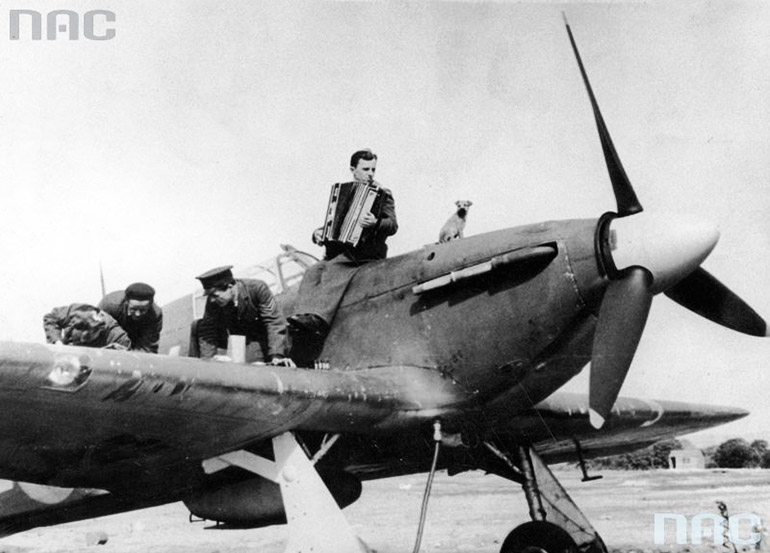
Hawker Hurricane, 1940, photo: National Digital Archive
The restoration took years, and during those works, new methods of restoration were established. All over the world engineers rebuilt many planes by producing new spare parts, adding their own little inventions, and recreating lost parts according to their imagination and ideas. What Polish experts decided to stick with was the rule of absolute ‘verism’ - they didn’t rebuild anything, only filling in holes and broken structures with exactly the same material and using the exact methods of production that were used in the beginnings of the 20th century. The aircraft are shown in the way they were found in the village of Kuźnica – these are true historical pieces, not a reconstruction group’s props.

The Sopwith Camel quickly became a favorite with pilots of the Royal Naval Air Service, photo: Public Domain / Real aircraft might be seen in Polish Aviation Museum
The collection is an extreme rarity. It is often compared to another widely-known collection that is in Kraków – the Czartoryski Museum, which owns Leonardo de Vinci’s Lady With an Ermine. This is mainly because of the fact that out of total number of 70 aircraft from the dawn of aviation and World War I, 13 are in Kraków! Most of them are the only ones left of that type, for example the Roland D.VI or another gem: the British combat aircraft Sopwith Camel – the most valuable plane of the British air force during World War I. There are only five of them left, and the one that rests in Kraków has full documentation so we know that its pilots shot down eleven German planes. Other planes exhibited are an Albatros C.I (the type the Red Baron used in the beginnings of his career), a DFW C.V, a LVG B.II, a Halberstadt Cl.II, and a Aviatik C.III. These are all true milestones of aviation, preserved, restored and maintained in the best condition. A must see for every history lover!
Visit the Polish Aviation Museum