
Still from Andrzej Wajda's Man of Marble, 1976, Photo: Renata Pajchel / Studio Filmowe "Zebra" / Filmoteka Narodowa / www.fototeka.fn.org.pl
Andrzej Wajda (born 1926) is a chronicler of Polish history. His film Kanal was the first feature film made about the Warsaw Uprising, the tragic battle that continues to provoke discussions and inspire artistic commentary. As Kanal was being shot in 1957, Warsaw citizens would stand close to the film set and give Wajda and his cinematographer Jerzy Wójcik accounts of their own experiences. They showed the precise manholes insurgents used to enter Warsaw's sewers, and where fighting took place.
Wajda's films are not documentaries but reconstruct events, directed by a man who lived through circumstances he later captured through the moving image. Ordinary people treated him as a director who could tell their stories by putting them into cinematic language. Although the "Man" trilogy is not a trilogy in the strict sense (Walesa. Man of Hope no longer follows the fate of the same characters), the works are a commendable example of Wajda's skill at putting memories on film. Man of Marble (1977) is a window into the reality of the 1950s in socialist Poland, illustrating the tragedy of people who believed in the sense of communist changes then ended up destroyed by the system. Man of Iron (1981) documents the rise of the Solidarity trade union. and with Wałęsa. Man of Hope (2013), we have the first biopic of that hero.
The new film has its international premiere on the 5th of September at the 70th Venice International Film Festival (coinciding with Wałęsa's 70th birthday). In a statement, the festival director says,
I am well aware that Walesa is the most difficult subject I have ever dealt with in the 55 years of my career in films, but I just don’t see any other director making a movie about Lech that I would find satisfying. I have no other choice.
Man of Marble
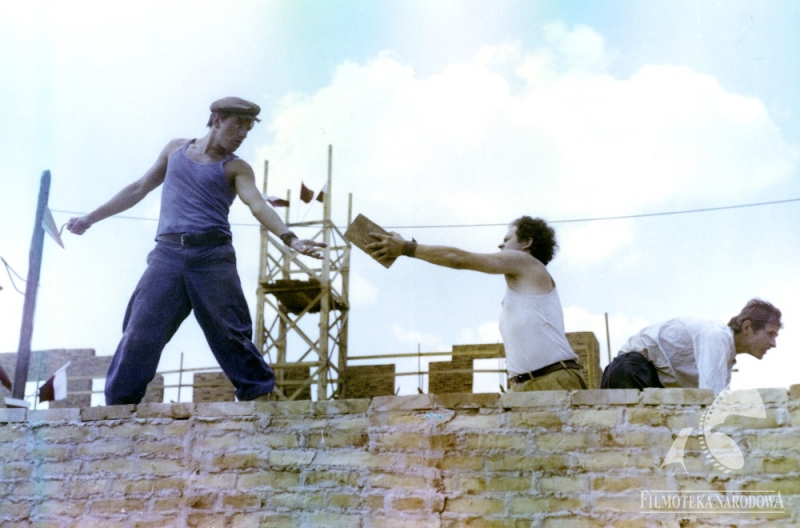
Still from Andrzej Wajda's Man of Marble, 1976, Photo: Renata Pajchel / Studio Filmowe "Zebra" / Filmoteka Narodowa / www.fototeka.fn.org.pl
The central figure in the trilogy's first film, Man of Marble, is an exemplary worker, the Alexey Stakhanov of the People's Republic of Poland. Mateusz Birkut is the record holder in bricklaying, who led a five-man team to lay 30,000 bricks in eight hours. With an empty, child-like look in his eyes and a perfect high-cheeked bride by his side, Birkut gazes from the window of his new apartment onto "buildings that he himself took part in constructing", as an enthusiastic narrator explains. This socialist-era propaganda video presents the Birkut couple as hard-working citizens who are never tired, never jealous and never expect anything in return. The system rewards them with a beautiful apartment. The plot thickens when Birkut starts speaking up against the regime and soons fall sinto disgrace.
His story is presented as a retrospective from the 1970s where, a young, hyperactive film director, Agnieszka, is doing her thesis on Birkut. She has to dig through archival material to research the man and find out how he died, then encounters derision from others. The people of the 1970s seem to have forgotten about the recent past.They find it pointless and trivial to be interested in a man like Birkut. The juxtaposition of the 1950s and 1970s sheds light on the different phases of the socialist era.
The script to Man of Marble was written by Aleksander Ścibor-Rylski years before, but censorship halted the making of the film and it was completed only in 1977. Among the film's international awards were the FIPRESCI Award at the Cannes International Film Festival.
Man of Iron
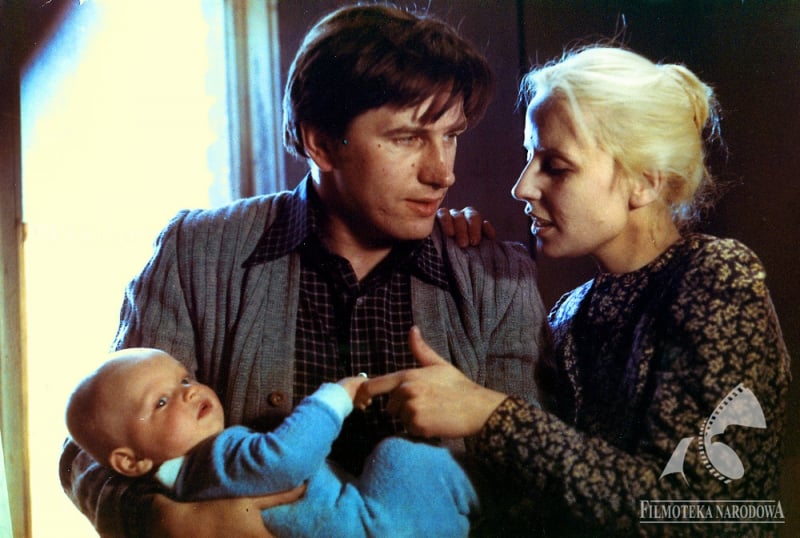
Still from Wajda's "Man of Iron" 1981, Photo: Renata Pajchel / Studio Filmowe "Zebra" / Filmoteka Narodowa / www.fototeka.fn.org.pl
The creation of Man of Iron echoes the film-set story from Wajda's Kanal, where Warsaw locals had gathered on the set. On the 29th of August 1980, the director came to the strike at the Gdańsk shipyards and was stopped by a worker, a member of shipyard security who was escorting him to the buildings. He asked Wajda to film the second part of Mateusz Birkut's story, then also told him what the title of the film should be - Man of Iron.
The film was made in the heat of evolving protests in 1980, during the thaw in communist censorship between the formation of Solidarity in August 1980 and its banning and the imposition of martial law in December 1981. The Man of Iron of the title, Maciej Tomczyk, is Mateusz Birkut’s son and is in a relationship with Agnieszka, the young filmmaker from Man of Marble. He is a shipyard worker involved in the trade-union movement, described as "the man who started the Gdańsk Shipyard strike". Winkiel, on the other hand, is a cynical journalist working for the communist regime's radio station who is assigned to slander Maciej. Man of Iron finally provides a clarification to the ending of Man of Marble.
August 1980 went down in history as a decisive month in the fate of the People’s Republic of Poland. The Gdańsk Shipyard strike led to the formation of the Solidarity union - the first in a communist nation - and, ultimately, to the collapse of communism. Man of Iron is living testimony to the beginning of the end, a docu-drama that makes use of archival material from the Polish Film Chronicle, as Man of Marble had, and includes songs, poems and excerpts from Ireneusz Engler and Leon Kotowski’s documentary August and Andrzej Chodakowski and Andrzej Zajączkowski’s Workers ’80. It won the Palme d'Or and the Prize of the Ecumenical Jury at the Cannes Film Festival in 1981.
Wałęsa. Man of Hope
The third part of the trilogy requires no introduction. It’s one of Poland's most anticipated premiers in 2013. Wałęsa has been portrayed in Polish films including Coffee in Gdańsk (2010), Strike (2006) and Pope John Paul II (2005), and in TV films including Tygrysy Europy / Europe’s Tigers (2003), Squaring the Circle (1984), Strike: The Birth of Solidarity (1981). He has been played by Ian Holm, Bernard Hill, Eugeniusz Jedrzejczak, Jacek Lenartowicz, Andrzej Chyra - and now by Robert Więckiewicz in Wajda's film.
Więckiewicz played the lead in Agnieszka Holland’s Oscar-nominated In Darkness. Scriptwriter Janusz Głowacki said of his skills:
He is a great actor, a revelation in Polish cinema. Talleyrand once said the language hides real thoughts. In the way he acts, we feel that he knows a lot more that he says. That is what Lech Wałęsa is all about.
Contrary to other film portrayals, Wałęsa. Man of Hope finely balances between historical narrative and an intimate portrait of its subject. The film traces the evolution of the man, from electrician to trade-union leader, the nation's president and hero, and shows the fates of his wife and children. Opening with a scene from December 1970, the film finishes with Wałęsa’s speech in the U.S. Congress in November 1989. Wajda’s efforts to represent changes undergone by Wałesa are intertwined with archival footage.
The film is based on the script by Polish playwright, novelist, screenwriter and part-time New Yorker Janusz Głowacki, with rich context given to Polish idiosyncrasies and intricacies for the appreciation of international audiences. "For me, Wałęsa's greatness began when he was detained, in the moment when he was alone and the authorities tried to threaten and blackmail him", the scriptwriter explains of his interest in writing the script in an interview with Culture.pl. He adds, "there were elements of grotesque in all of this, constant despair, fear and pathos that were sometimes almost ridiculous. And that is something that really attracts me in art".