'There Are No Children, There Are People': Janusz Korczak the Educator
here are no children, there are people’, ‘a child’s right to respect’, ‘a child’s right to preserve their identity’ – these slogans aptly sum up Janusz Korczak’s educational credo. But what do they actually mean?
Janusz Korczak, the penname of Henryk Goldszmit, was a Polish-Jewish educator, a children's author, a doctor and an educator. In Poland, he is most well-known for his kids’ book Król Maciuś Pierwszy (King Matt the First), which every Polish child reads in school. Abroad, the Old Doctor, as he was known, is mainly associated with his work with Jewish orphans during the Holocaust. As the director of an orphanage in the Warsaw Ghetto, he refused sanctuary and stayed with his orphans when they were sent to the Treblinka extermination camp.
In the past seventy years, many of Janusz Korczak’s ideas became part of the educational mainstream. The physical immunity of a child became a European norm and psychological violence is ever more frequently condemned. Respect towards children is becoming increasingly widespread. What does this mean in practice? What did the Old Doctor actually have in mind when writing down his theories?
Upbringing 101
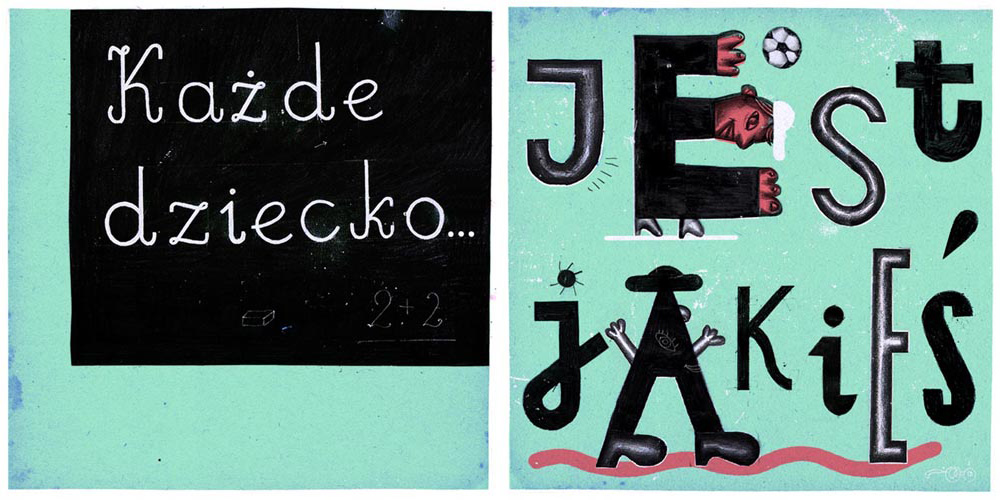
'Every child has value', photo: Jacek Ambrożewski / Jan Rusiński / illustrationstudio.pl
Korczak does not provide any universal formulas or upbringing instructions. In his works, he avoided definitions, rules, or recipes of any kind. In this sense, Korczak’s books are years behind modern manuals, which point to the exact number of hours a child should sleep, what children should eat, or provide tips on how to behave towards your offspring.
The lack of universal instructions stems from the value Korczak attributed to experience. He underlined the importance of mistakes made by parents or caretakers when raising a child, as he believed that they were the only way to gain knowledge.
His books consist of a never-ending set of questions. He wanted parents and caretakers to reflect upon the answers. A crucial part of his works are psychological explanations, however, he does not describe children, instead he focuses on adults and their feelings caused by the behaviour of their children (irritation, anger, etc.). Stanisław Tomkiewicz described this peculiar method:
Text
Including the parent, not to say therapist, in the description of the relationship- with their child remains unique in professional literature, even fifty years after Freud’s explanation of countertransference.
Author
From ‘The Originality and Timeliness of Janusz Korczak's Pedagogical Work’ by Stanisław Tomkiewicz, in ‘Janusz Korczak: Work and
The subconscious assumptions and psychological attitudes that arise when we approach a child have their source in the enormous set of restrictions associated with childhood:
Text
The more miserable the psychological level, the more colorless the moral make-up, the greater the concern for the teacher's own peace and comfort, the greater the number of orders and prohibitions dictated by apparent concern for the well-being of the children.
Author
From ‘How to Love a Child’ by Janusz Korczak
Korczak recommends an unprejudiced approach to children and highlights the importance of care and attention, together with a loving openness and attentiveness:
Text
Be yourself and watch children carefully whenever they can be what they really are. Look, and make no demands. For you will not force a lively, impulsive child to become cool, calm and collected. The distrustful and taciturn, will not turn frank and talkative. The ambitious and obstinate, will not be gentle and submissive.
Author
From ‘How to Love a Child’ by Janusz Korczak
Korczak strongly believed that each child has a pre-existing personality. He was convinced that you cannot shape your child according to your own dreams and expectations:
Text
I shall not be able to make any of the children other than what they are. A birch will stay a birch, an oak an oak, and a thistle a thistle. I may be able to rouse what is dormant in the soul but I cannot create anything.
Author
From ‘How to Love a Child’ by Janusz Korczak
Our House
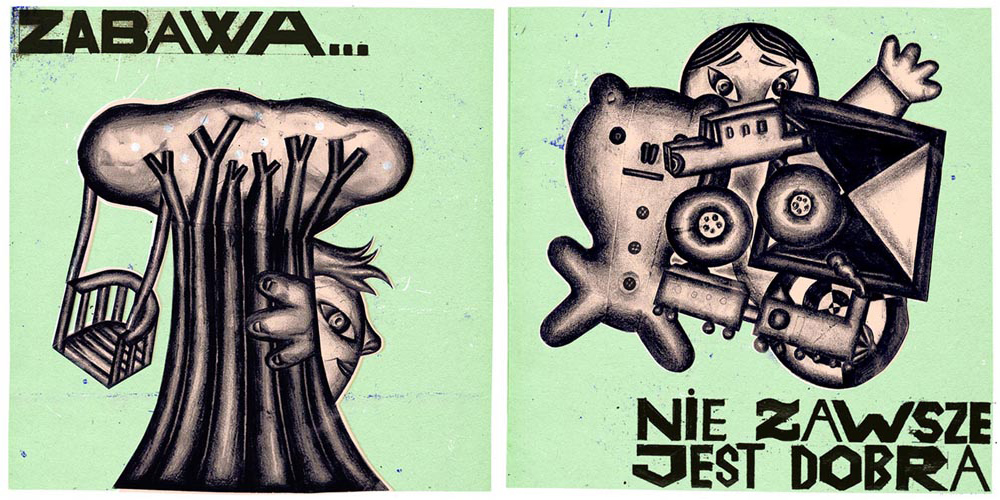
'A game is not always good', photo: Jacek Ambrożewski / Jan Rusiński / illustrationstudio.pl
It is much easier to discuss the upbringing system used by Korczak in Dom Sierot (Orphan House, although Korczak preferred to call it Dom Dzieci – the House of Children) and Nasz Dom (Our House, led by Maryna Falska since 1919). Its basis was upbringing in a team, as well as self-upbringing.
One of the most important symbols of the children’s independence in Dom Sierot the fact that they had their own parliament. Children were divided into groups of five, there were twenty parliament members. The parliament had a budget equal to 5% of the expenses of the orphanage. Children could spend it on toys, entertainment, books – whatever they saw fit.
Another crucial (albeit controversial) institution was the peer tribunal, established to resolve conflicts between children. Each child had the right to sue their friend or caretaker and the cases were tried by other children.
The orphanage had an extensive system of shifts – children worked in pairs (older - younger; boy - girl). These shifts were meant to teach social cooperation and the importance of work. Korczak attached huge importance to them and wanted them to be perceived as an honour rather than a mundane chore.
A similar idea was behind the caretaking committee, where older children were asked to watch over younger newcomers. It was set up to develop a sense of responsibility in the older children and a sense of safety and trust among the younger ones.Other innovative solutions in the Orphan House were a newspaper, a notice board, a mailbox, and a notebook, which kept a record of all transactions made between children. Korczak strongly believed in the importance of the written word (although some may have considered it excessive bureaucracy). He believed that it helps with expression and character development. He also claimed that there are things that children do not want to talk about, but may sometimes be willing to write down their feelings. He expressed similar views in his children-oriented supplement in Nasz Przegląd, the biggest interwar Jewish newspaper written in Polish. Mały Przegląd appeared every Friday from 1926 till 1939.
The newspaper was written and edited by children for children (with a little help from grown-ups). For 13 years, Mały Przegląd was distributed every week with a run of 50,000 copies, giving many children a voice in a world of adult strife and political unease.
Another method which Korczak used to shape the children’s characters were… bets. Every week, the Old Doctor made a bet with his pupils. They agreed on a maximum number of offences (e.g. ‘I won’t swear more than five times’). After a week, they verified the results. If a child achieved their goal, they won three sweets. No one controlled whether they lied that week – another example of the rule of self-discipline and self-improvement.
A child’s right to respect
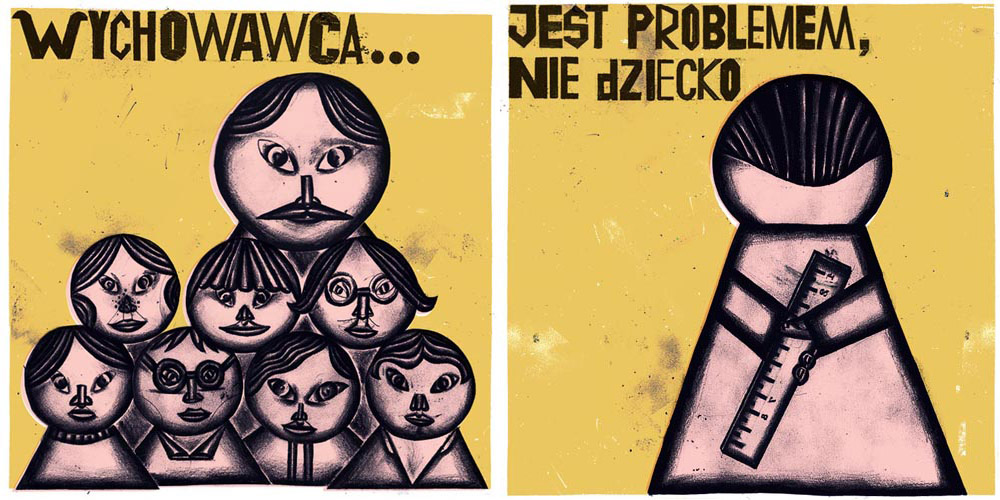
'The educator is the problem, not the child', photo: Jacek Ambrożewski / Jan Rusiński / illustrationstudio.pl
The basis of Korczak’s approach is a child’s right to respect. What does this actually mean? Similarly to his other ideas, this one too stems from the careful observation of children’s status in society. Korczak concluded that children have a paradoxical and incomplete position, which can achieve its full form only when they reach adulthood. He said:
Text
It is as though there are two kinds of life: one serious and respected, another forbearingly tolerated and less valued. We say that they are future people, future workers, future citizens. That they will be, that their life will truly begin later, that it is not serious until the future. We indulgently allow them dally alongside, but we are more comfortable without them.
Author
From ‘A Child’s Right to Respect’ by Janusz Korczak
The unequal status of children in our society is shown in yet another comparison made by the Old Doctor:
Text
Children are foreigners, ignorant of the language, of where the roads lead, and of laws and customs. Often, they prefer to explore for themselves, asking for directions and advice when they find themselves in difficulty.
Author
From ‘A Child’s Right to Respect’ by Janusz Korczak
Janusz Korczak became a sort of a guide or ethnologist, who examines an distinct tribe in order to understand its ways.
The incomplete status of a child is often a source of suffering and malfunction. That is why Korczak emphasised the child’s right to respect, to ignorance (a child is a foreigner who ‘requires a guide who will politely answer their questions’), to the task of understanding (this inborn curiosity, which often bothers adults), to tears and failures (a scratched knee, an inkblot in their notebooks, which is a problem – ‘even a child’s tears bring about mean comments, seem less important, infuriate’). He goes on: a child should have the right to their property and budget (‘so many essential needs, wishes, and temptations, but no money’), to secrets and fluctuations in the difficult task of growing (all states included here – feeling unworthy, tired, etc. – they all have their roots somewhere, but adults consider them whims). The last one is respecting the present hour, the current day: ‘respect for all separate moments, as they will pass and never happen again, and always seriously’:
Text
Let us eagerly drink in the joy of young life and trust one another. This is precisely what children wish. They do not regret time spent telling a fairytale, talking to a dog, playing catch, carefully examining a picture, or practicing their letters – they do all this warm-heartedly. They are the ones who have got it right.
Author
From ‘How to Love a Child’ by Janusz Korczak
This last rule is really at the core of Korczak’s thinking – it’s an existential appeal. He describes what can only be the fruit of internal improvement, he talks about respect, or rather attention, which cannot be imposed by an external order or legislation. In any other case, he predicts, everything is false:
Text
(…) it is the strong brutes who mold modern life, homo rapax: they dictate the way forward. Their concessions to the weak are lies, their respect for the elderly, the equal treatment of women, and their kindness to children are dishonest.
Author
From ‘A Child’s Right to Respect’ by Janusz Korczak
The flip side of a child’s right to respect is the guardians’ duty to find that respect and attention in themselves, which means work on the self-improvement, so often highlighted by Korczak.
Korczak?
In order to understand how far we still are from introducing Korczak’s unorthodox wisdom into everyday life, it is enough to read one of his works. It is also then, that we realise that the Old Doctor cannot be easily categorised. His vision of a child’s ideal room from How to Love a Child is a good example:
Text
The linoleum in a small child's room. Would not a large heap of lovely yellow sand, a sizeable bunch of sticks and a barrelful of stone be better? Perhaps a plank, cardboard, a pound of nails, a saw, a hammer and a lathe would be a more welcomed gift than ‘a game’. An instructor in handicrafts would be more to the point than a master in gymnastics and piano playing.
Author
From ‘How to Love a Child’ by Janusz Korczak
Surprisingly though, Korczak used corporal punishment. We can read about this in his Playful Pedagogy or Jak Kochać Dziecko: Internat. Kolonie letnie. Dom Sierot (editor’s translation: How to Love a Child: Boarding School. Summer Camp. Orphanage).
Many people will also be surprised to learn Korczak’s opinion on child’s play. He did not consider it a natural, inborn state:
Text
…he turns to playing of necessity, runs off to play to escape from the miserable boredom, shrinks from the awful emptiness, hides from the frozen duty.
Author
From ‘How to Love a Child’ by Janusz Korczak
Korczak was much more unconventional and radical than we think. In fact, we still do not know all that much about him. That is why it’s all the more worth reading his works.
Written by Mikołaj Gliński, December 2012, translated by AJ, Jan 2019