The museum’s new logo incorporates its new name: Polin, which means Poland in Hebrew and Yiddish. The P symbol, which bridges the Latin ‘p’ and the Hebrew ‘pey’, will remain in the design. As the museum's director Dariusz Stola pointed out, the logo was redesigned so that the Museum of the History of Polish Jews instantly embeds itself in people's mind as the Polin Museum. According to Stola, Before, the 'P' symbol wouldn’t be clear to everyone, now, by referring to Polin as well, it makes its presence more comprehensible.
Find out more about the story behind the Museum of The History of Polish Jews in Warsaw
The Forest Gallery
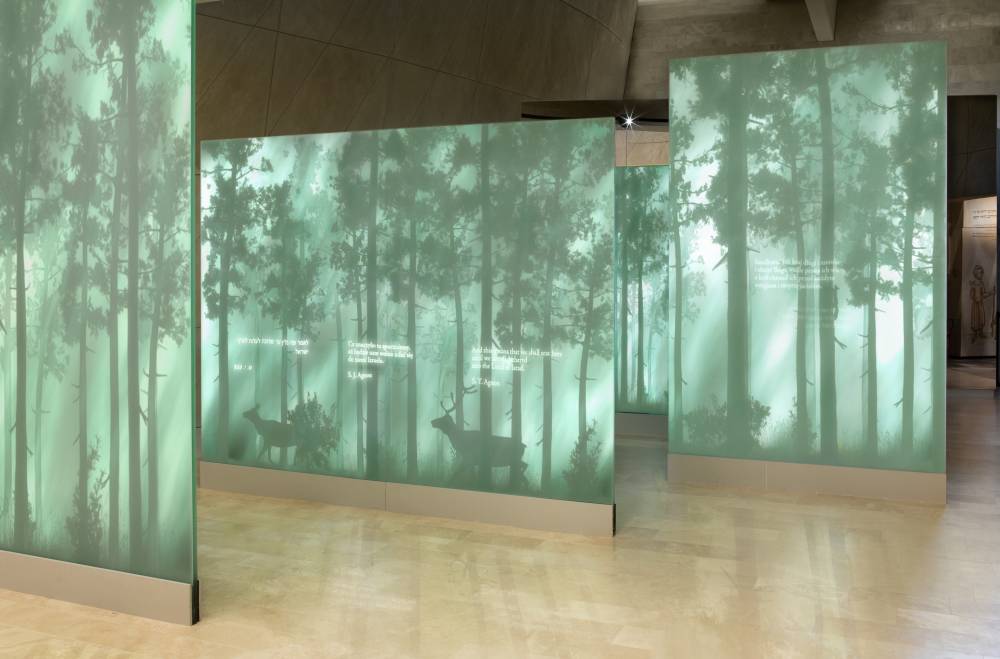
The Forest - first section of the main exhibition open to the journalists; photo by Magda Starowieyska
A legend explaining the origin of the term Polin supplied the concept of The Forest, an art installation in the first section of the exhibition. The piece consists of a few glass screens onto which digitally animated trees and animals are projected. The animations depict the symbolic forest in which the first Jewish settlers found themselves back in the Middle Ages when searching for a new homeland. It was where the birds chirped to greet them: Po lin! Po lin!, which supposedly meant ‘here you should lodge’.
…Afterwards, when they looked closely at the trees, it seemed to them that a leaf from the Gemara was hanging on every branch. At once they understood that here a new place had been revealed to them where they could settle and continue to develop the Jewish spirit and the age-old Jewish learning. - reads a 1927 Yiddish book by Gershom Bader.
This story accounts for the origins of Jews on Polish lands and has been passed on for centuries. The Polin legend is inscribed in the museum building, quite literally – the museum’s glass panel façade is covered with Hebrew letters comprising the word ‘Polin’.
See the initial version of The Forest
Polin Day
The Forest installation will open on September 6. The programme for this day, known as Polin Day, includes story-telling workshops, typographical workshops, a lecture by Professor Barbara Kirschenblatt-Gimblett, and the Art Wastelands social project. See the full Polin Day programme.
See the items designed especially for the Museum.