The Sierpiński Tetrahydron
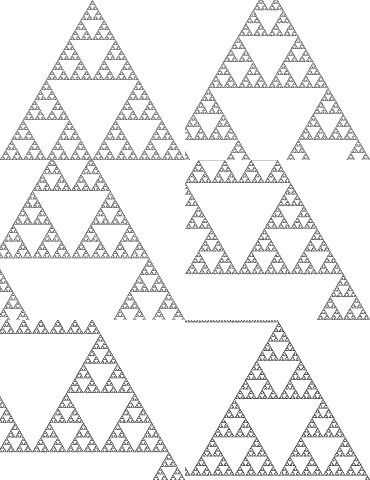
source: Wikipedia, public domain
In May 2015, the University of Cambridge unveiled a strange white structure shaped like a futuristic Christmas tree. The occasion was the 100th anniversary of the Sierpiński triangle, a type of fractal. Through the event, Cambridge wanted to celebrate Sierpiński’s mathematical genius and strengthen ties between the university and Poland. The Sierpiński triangle is one of the first fractals ever defined. It consists of an equilateral triangle divided into four congruent smaller versions. The middle triangle is removed and the pattern is repeated, creating a fractal. While the concept might appear difficult to grasp, most of us unknowingly use this triangular fractal every day: antennas based on this particular pattern can be found in most mobile phones.
But what is a fractal exactly?

Evolution of the Sierpiński triangle in five iterations, source: Wikipedia, public domain
Fractals are never-ending patterns that repeat themselves at different scales. They replicate very simple processes over and over to create seemingly-complex patterns. The term ‘fractal’ itself was coined by Benoit Mandelbrot, who was also born in Poland (in Warsaw in 1920). While mathematicians such as Sierpiński and Mandelbrot are famous for investigating mathematical versions, fractals actually occur in all sorts of places in nature: in lightning bolts, blood vessels, seashells, hurricanes, and river networks such as the Norwegian fjords. You can see them in the way trees grow through their branching patterns, and even in the structures of entire galaxies.
The Fractal Foundation in Albuquerque uses the Sierpiński triangle as an example to educate people of all ages about fractals, even using it in 2011 to break the world record for creating the largest one ever – it spanned 192 feet (58.5 metres)!
The Christmas tree-like statue in Cambridge is a 3D representation of this fractal triangle, known as the Sierpiński Tetrahydron. At the unveiling ceremony Sir Leszek Borysiewicz, vice-chancellor of Cambridge University, pointed out that the fractal was so ahead of its time that ‘[the Sierpiński triangle] is only seeing its true benefits in the mathematics of today.’ Called the Sierpiński Tree, the statue stands outside between the Institute of Mathematics and the Newton Institute.
‘Hopeless at maths’

Wacław Sierpiński, photo: FoKa/Forum
Sierpiński was born in Warsaw on 14th March 1882, the son of a doctor. He attended the Physics and Maths Faculty at the University of Warsaw 22 years later, receiving a gold medal for a paper on number theory. By 1908, he was already a Doctor of Science in Mathematics, a title he received from the University of Lviv. He later became an associate professor there, and immediately added a lecture course on set theory to the university’s curriculum – the first ever academic curriculum to include set theory. In 1910, he became a professor there and married Anna Leśniewska. (The latter frequently accused him of being ‘utterly hopeless at maths’ because he couldn’t take care of their bills.) It was in those years that he published his ground-breaking works Number Theory and An Outline of Set Theory. During World War I, he was forced to stay in Russia, but he managed to escape to Poland in 1918 through Finland and Sweden. Shortly after his arrival, he was named head of the Faculty of Mathematics at Warsaw University.
Soviet codes and underground gatherings
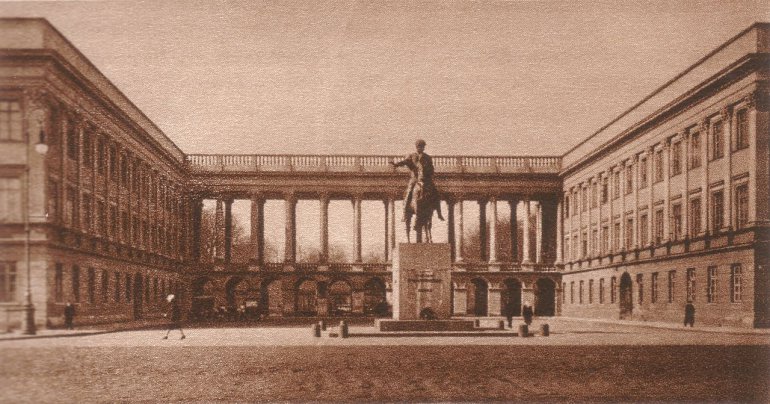
The Polish Cypher Bureau, Saxon Palace in Warsaw, Poland, photo: public domain
During the 1919-1921 Polish-Soviet war, Sierpiński put his talent to use and helped Poland triumph. He was employed by the Department of Codes of the General Staff, where he helped crack Soviet army codes for radio communications. The department’s efficiency was of great assistance to the Polish army ‒ it intercepted over 1,800 Soviet dispatches between June and October 1920 alone. It was the same department that would famously break the codes of the Germans’ Enigma cypher machine, a decade or so after Sierpiński’s departure.
In 1920, along with mathematicians Zygmunt Janiszewski and Stefan Mazurkiewicz, Sierpiński co-founded Fundamenta Mathematicae, the first magazine dedicated to set theory and mathematical logic. Throughout the rest of the interwar period he gave lectures on advanced algebra and measure theory, publishing scientific works like Analytically Representable Functions. During World War II, he worked as a clerk for the city of Warsaw, while secretly lecturing at underground educational gatherings. After the war ended, he regained his position Warsaw University and remained there until his retirement in 1960. In post-War Poland, he was also an esteemed member of the Polish Academy of Sciences and wrote numerous mathematical titles including the influential On the Congruence of Sets and their Equivalence by Finite Decomposition. Wacław Sierpiński died on 21st October 1969 and lays buried in Powązki Cemetery in Warsaw.
Countless contributions
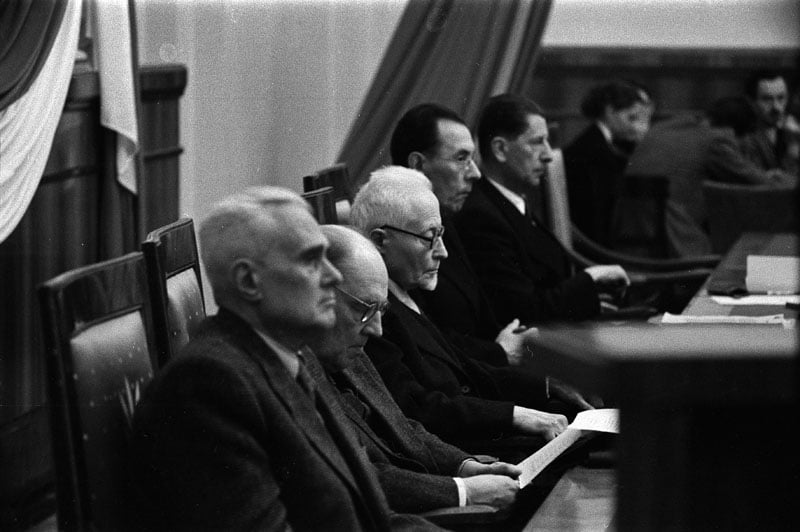
Warsaw, 13 November 1955. General assembly of the Polish Academy of Science (PAN). From the left: Witold Wierzbicki, Wacław Sierpiński, Kazimierz Nitsch, Jan Dembowski & Stanisław Kulczyński, photo: Władysław Sławny/Forum
The sum of Sierpiński’s achievements is nothing short of awe-inspiring. His pioneering work on fractals in the 1910s includes not only the Sierpiński triangle but also the Sierpiński carpet, a square fractal. He was a key figure of the Warsaw School of Mathematics, which thrived in the interwar period. He is also recognised for his contribution to the development of set theory, not only because he was the first person to give a course devoted to it, but due to his pioneering research on the axiom of choice and the continuum hypothesis. He also greatly contributed to point-set topology.
Sierpiński passed on his ideas as much as he could – he was an outstanding scholar who educated three generations of mathematicians, among them Adolf Lindenbaum and Otto Nikodym. In a 1972 paper on Sierpiński’s works, one of his students, Andrzej Rotkiewicz, said:
Sierpiński had exceptionally good health and a cheerful nature. [...] He could work under any conditions. [...] He did not like any corrections to his papers. When someone suggested a correction he added a line to it: 'Mr X remarked that...' He was a creative mind and liked creative mathematics. He was the greatest and most productive of Polish mathematicians.
Sierpiński was also awarded honorary doctorates from the of universities of Paris, Amsterdam and Moscow, to name just a few. He wrote over 700 papers and 50 books.
In short, he truly earned his crater on the moon...