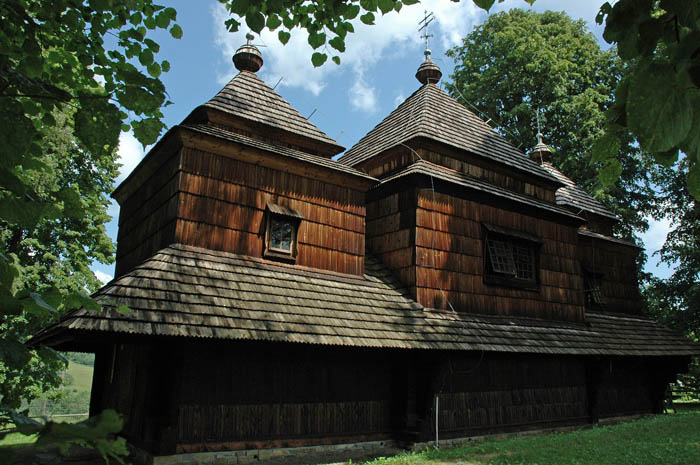
 St. Michael the Archangel Tserkva in Smolnik, photo: National Heritage Institute
Among the world sites inscribed on the 2013 UNESCO World Heritage List are 16 wood tserkvas of the Carpathian Region in Poland and Ukraine, and the Bochnia Royal Salt Mines in Poland
The tserkvas are Greek Catholic churches of which the oldest were built in the 16th century, preserved in their historic form, presenting features characteristic for the region and integrating the cultural and environmental qualities of local landscape.
A borderland culture
The Carpathian region in southeast Poland and Western Ukraine was once populated by Polish and Ruthenian Slavic tribes. Although the communities were Christianized by competing civilization centres - Rome and Constantinople - their common ethnic and linguistic roots managed to survive thanks to the creation of a specific borderland culture. Because it was a pre-Christian Slavic building tradition, and due to the abundance of high-quality wood provided by vast forest areas, wooden sacred architecture became one of the indicators of cultural uniqueness of Polish and Ukrainian Carpathians.
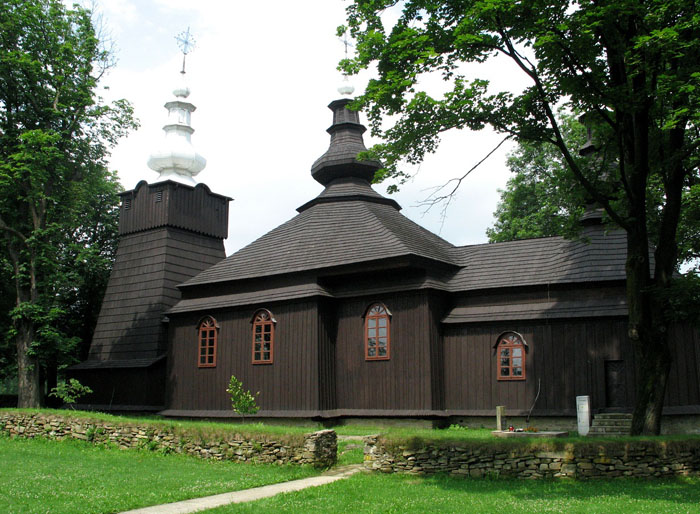 Tserkva of St. Michael the Archange in Brunary Wyżnie, photo: National Heritage Institute
Unique wood construction
Built in the typical horizontal-log construction technique, mostly from coniferous wood, on stone foundation with roofs from wooden shingle covering and three-section interiors covered with domes, such tserkvas don’t exist in any other region in the world. Ages of regional transformations did not alter their original, traditional style, and restotration principles currently being used continue the ancient methods. The buildings selected for the UNESCO list have been incessantly performing their liturgical and cult functions for centuries.
Wieliczka and Bochnia Royal Salt Mines
The Bochnia Royal Salt Mines are an extension of the Wieliczka Salt Mine, which had been added to the World Heritage List in 1978. They are now to be known as the Wieliczka and Bochnia Royal Salt Mines. The rock-salt deposit in Wieliczka-Bochnia has been mined since the 13th century. The mines are the oldest of their type in Europe. Spread over several levels are some 300 km of galleries with underground chapels, storerooms and more, including altars and statues sculpted in the salt, making for a fascinating pilgrimage into the past of a major industrial undertaking that developed over 700 years.
The World Heritage Committee
The last Polish site to be added to the famous list was Wrocław’s Centennial Hall, in 2006. The 37th session of the World Heritage Committee met between the 17th and 26th of June in Phnom Penh, Cambodia. The Committee has the final say on whether a property is inscribed on the World Heritage List. It is further responsible for the implementation of the World Heritage Convention, defining the use of the World Heritage Fund, and it allocates financial assistance upon requests from state parties.
For detailed information on each tserkva, see: UNESCO website
Editor: Marta Jazowska 24.06.2013
Sources: UNESCO, World Heritage Convention