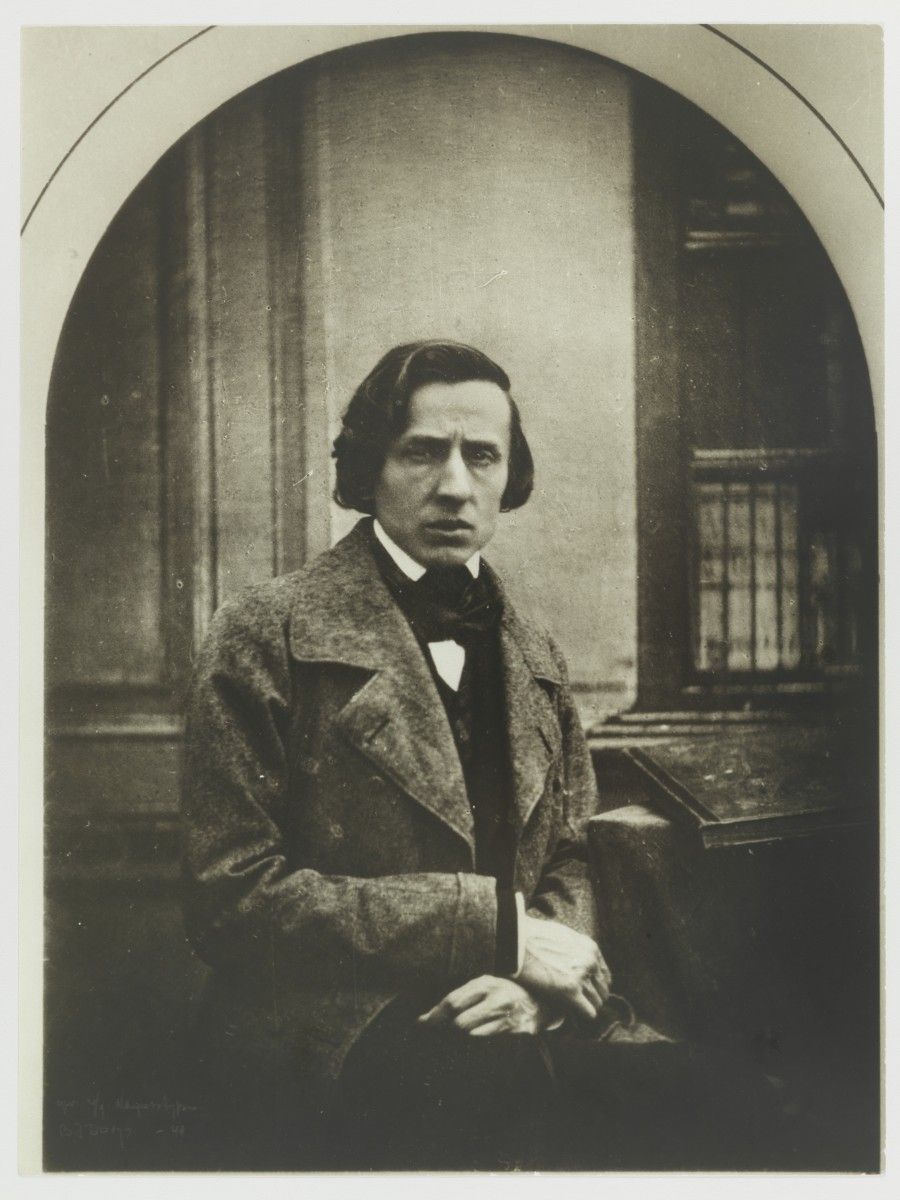
Born in Żelazowa Wola on the 1st of March, 1810, Chopin died on the 17th of October, 1849 in Paris. He spent his earliest years in Żelazowa Wola in central Poland with his parents, a French-Polish couple.
Chopin's opus is, for many reasons, a major step in the history of music and a milestone on its development path. This often extremely buoyant chromatics produced Wagner (Tristan and Isolde). Chopin's unusual modulations and surprising turns of tone in the middle of phrases (to mention, for instance, the introductory part of the Fantasia in F minor) challenge the principles laid down in harmonium textbooks. The new scales Chopin introduced in the Mazurkas and in other works, such as the Etude in F minor Opus 10, Nocturne in G minor Opus 15 andNocturne in B major Opus 62 abolish the undivided rule of the major-minor system and open up the window to other, broader worlds of sound.
Likewise, Chopin seems to have divided the music of the past 300 years into two different parts with regard to expression, phrasing and the structure of a piece of music. Starting from late Romanticism, the art of composing takes a different form, throws itself into a new, turbulent adventure, drills into new layers of extraordinary expression, and this change is most palpable in the works of the one who composed Ballads, Scherzos, Sonata in B flat minor and the Polonaise-Fantasia.
The commemorative concert on the 17th of October, 2011 takes place at the Basilica of the Sacred Cross in Warsaw (ul. Krakowskie Przedmieście 3), performed by the Podlaskie Philharmonic and Choir, and the Polish Radio Orchestra.
For more information on the concert, chopin.nifc.pl
See the full biography of Fryderyk Chopin