Warsaw-style
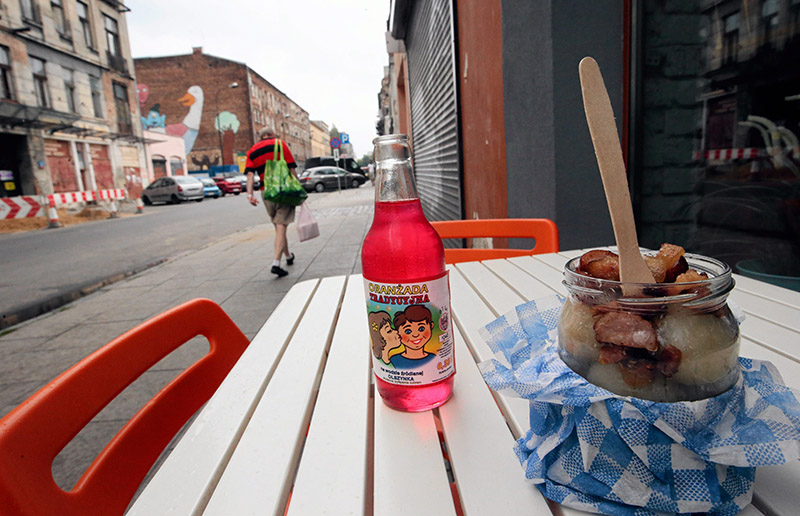
The interior of Pyzy i Flaki Gorące, Warsaw, photo: Kuba Atys / AG
If you’ve spent any time in Warsaw and not tried the local cuisine, you’ve definitely missed out. While it’s not so easy to find mouth-watering pyzy (knodel dumplings), delicate cynaderki (kidneys), or flavoursome flaczki (tripe), it’s worth the effort to find them. The best ones, both in terms of the original pre-war taste and affordable price, are served by stalls in the Praga district, just next to Różycki Marketplace.
According to respected Warsaw gourmet and food critic Maciej Nowak, all groups of tourists on their sightseeing tours of Warsaw should stop for lunch at Pyzy i Flaki Gorące. In his review, Nowak pointed out that if he could, he would turn the place into his private haven and invite only his best friends to accompany him to lunch there, but since he is paid to inform the public of the best restaurants in Warsaw, he must do his job and promote the eatery to all those hungry for good food. Flaki is served at the place just as described by legendary cookbook author Lucyna Ćwierciakiewiczowa, that is, with meatballs and grated cheese. All types of kluski, namely pyzy, kopytka, przecieraki, and kluski śląskie, are made by hand and smothered with chopped bacon or kiełbasa. And how about liver with raspberries and plums? All dishes are served in jars, as in the olden days at the marketplace, and all of them for the same, low price – just 12zl!
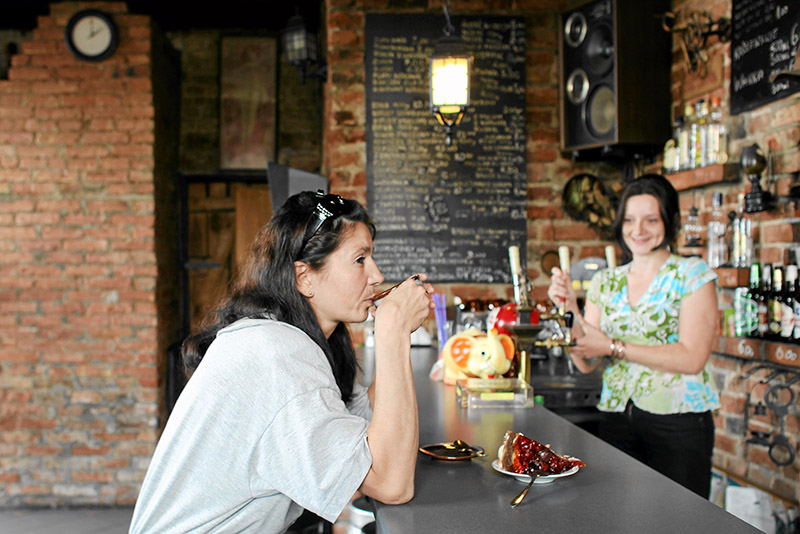
The interior of Mistrz i Małgorzatka, Warsaw, photo: Bartosz Bobkowski / AG
Mistrz i Małgorzatka in Czerniakowska street has been feeding gourmets for over four decades. When describing the atmosphere of the pre-war district, Maciej Nowak adds that ‘Czerniaków plays an exceptional role in the history and the present of the Warsaw catering industry. Before WWII this was a night-life district full of gin mills (...) which were the ultimate destination of the Warsaw Café Society tired of all-night city-centre ‘clubbing’, where the rich party-goers could savour the folklore of the “marauders’ district”.’ At Małgorzatka, apart from the Polish classic lunch (clear soup, sour soup, breaded pork cutlet, and a rissole), the menu includes a variety of offal. For more less 10zl one can enjoy dudki, i.e. veal lungs in sour soup, as well as such delicacies as cynaderki (kidneys) in sauce, pickled pork tongues, beef tripe, and chicken gizzards. Despite the changing eating styles throughout the 21st century and afterwards, offal gourmets have not given up their eating habits.
Anyone who wants to experience the atmosphere of Warsaw as it was 40 years ago, but has no time to go to Praga or Czerniaków, should visit the legendary Lotos Restaurant and get lunch for 17zl. The eatery, located along the Royal Route (on the corner of Belwederska and Chełmska) has been open for over half a century now; its two rooms are designed in the ‘nostalgic style of the 1970s’ and let you taste the herring, clear soup, and breaded pork cutlet all at once immediately upon entering the place. We hope that recommending Lotos for lunch, rather than for a seta i galareta (a shot and a snack), will not be an affront to the place.
Jaś i Małgosia, one of the best known Warsaw eateries of the 1970s, reopened in 2014 on Jana Pawła II Avenue. Here, one can enjoy both food and entertainment, as the place is famous for hosting cultural events on a regular basis. And to Poles, the food here tastes like home. The menu, which was designed in collaboration with renowned chef Aleksander Baron, combines 1970s nostalgia (pickled cucumber soup and cube steaks) with contemporary dining fashion (cream of mushroom soup and cod fillet with lemon and coriander sauce). In this cosy and cheerful setting, a two-course lunch can be had for just 20zl.
Milk bars and other eateries

Bar Prasowy, Warsaw, photo: Franciszek Mazur / AG
Milk bars must be mentioned in such an article, as in Warsaw they are as popular as in any other Polish town and city, and with good reason: a two-course vegetarian lunch costs less than 10zl. At Bar Prasowy on Marszałkowska, a lunch of soup for 3zl and beans in tomato sauce for 5zl is enjoyed by people of various ages and professions – from students, through white collar workers, to civil servants employed at the nearby Ministry of Foreign Affairs.
Meanwhile, Bar Familijny on Nowy Świat is known as one of the cheapest and best milk bars in the city. Clients might even be lucky enough to have their food served on vintage PSS Społem plates. If you are really broke, you can have a proper two-course lunch of tomato soup with noodles and pancakes with sweet curd cheese for a mere 7zl. For similar amount one can dine at the small Rusałka (Water nymph) milk bar – a cult eatery located in a pavilion in Praga, on Floriańska Street. Its interior design carries you back to the previous epoch: wood panelling on the walls, square tables with glass tops, apron-clad ladies at the cash-register, and flickering fluorescent lights.
Another milk bar which is seemingly from a bygone era is Bar Sady in the Żoliborz district – its decor (and often the staff) would not seem out of place in 1960s Warsaw. In addition, it's a great place to do some people-watching, as it attracts all sorts of local character. Time has also stopped in Ochota at the Biedronka milk bar, but despite that fact, it still attracts people of all ages. Bambino Bar on Krucza Street, which boasts more modern interiors, has been operating since the 1960s. And Złota Kurka (The Golden Hen) on Marszałkowska has been feeding the Warsaw population for even longer time – since 1952. One often has to wait for a table in order to eat there. Złota Kurka even has a website and menu in English and accepts credit cards! Despite the fact that the bar is ahead of most milk bars in terms of modern payment methods and virtual advertisement tools, its interior is strongly reminiscent of the time when computers and smartphones could only be found in science fiction.
Leniwa Gospodyni (The Lazy Housewife) bar on Nowowiejska Street, which opened in 1994, also has its faithful fans. It specialises in Polish cuisine but … cooked according to the traditional Chinese Five Elements theory of cooking. The menu is more modern than that of your typical milk bar.
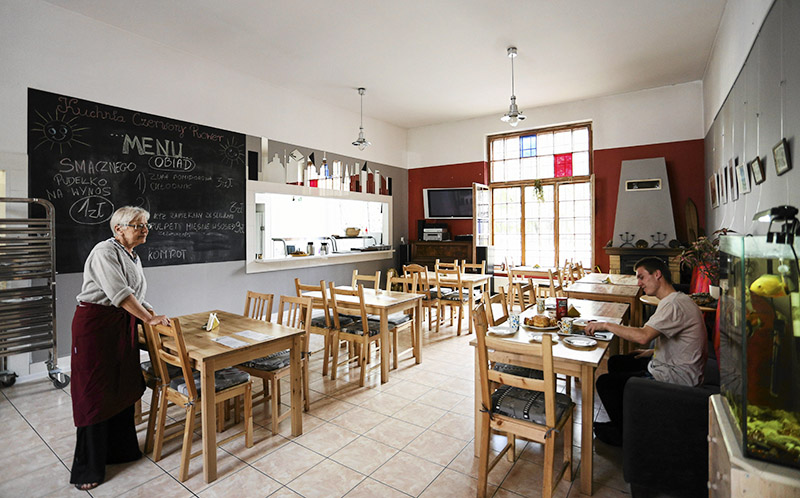
Czerwony Rower, Warszawa, photo. Adam Stępień / AG
Czerwony Rower (Red Bicycle) in Targowa (Praga district) deserves a mention. Apart from traditional milk bar dishes, some quite extraordinary meals can sometimes be found there, such as Jerusalem artichoke soup with chicken and kale, pigtail soup, or rabbit in cream sauce – each of them for no more than 12 zloty. The Red Bicycle was established as an extended version of a former soup kitchen run by the Open Door Association. The interior is simple but cheerful. Simple home meals without artificial flavourings are cooked by the socially excluded themselves in this social project, combining rehabilitation with education through work. The profit from sales of food is intended to support those who need help.
Pierogi from around the world
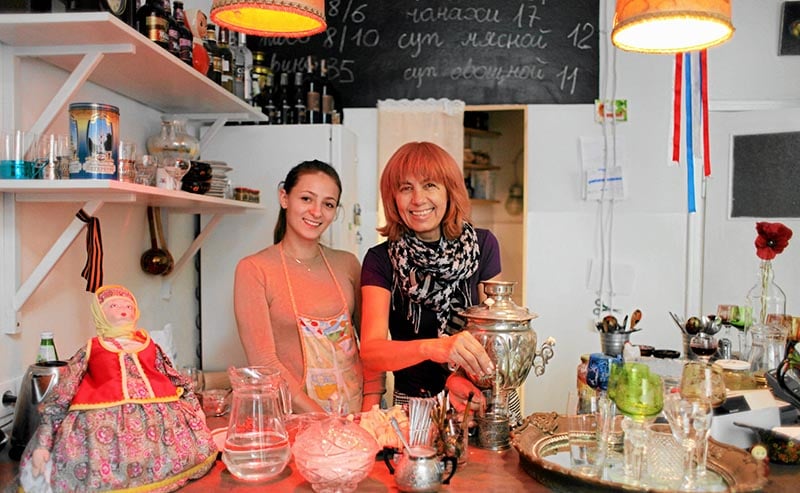
Skamiejka and its owner Tamara Skamiejka, photo: Sławomir Kamiński / AG
Pierogi is one of the favourite Polish comfort foods, partly because the market offers much more than the standards known by everyone. For example, Asian restaurants serve a different sort of dumpling in various parts of the city, for a taste of the exotic for a budget price. At ToTu (Saska Kępa, Kabaty, Żoliborz, and Gocław) a portion of Chinese jiaozi served in a bamboo basket costs a bit more than 10zl. Parnik has become a successful chain with a few establishments in Warsaw, e.g. on Chmielna Street. Their dumplings are made from a very thin dough, with more than a dozen fillings. A portion costs between 13 and 14zl, and you can wash it down with a hot and bitter soup for around 5zl, but be prepared to queue. Similar food at similar prices is offered at Parowóz on Krucza Street.
Manty is the name of a type of steamed dumpling from Central Asia, as well as the name of an Uzbek restaurant on Elektoralna Street, which specialises in the dish. It’s a good place for a quick lunch – a big portion of dumplings accompanied by a salad is served within a few minutes. Not far away from Manti, at Tsong Kha Momo on Jana Pawła II Avenue, one can taste Nepali momo dumplings, which are also steamed and cost a little over 12 zloty per portion.
Skamiejka, a restaurant in Praga run by Mrs Tamara, is worth spending some time in. It’s the perfect place for an intimate lunch in an eastern atmosphere with Russian music in the background. For 20zl, one can eat a plate of hot Russian pielmeni served with cream and vinegar or Georgian chinkali. All the dumplings are handmade. Apart from dumplings one can also try filling solianka soup or Ukrainian vareniki.
Vegetarian feasts

Tel Aviv Food & Wine Bar, photo: Jacek Marczewski / AG
Those who prefer vegetables or gluten-free dishes can satisfy their tastes at Vegemiasto on Solidarności Avenue. The food is tasty and interesting, with a lunch menu for around 25zl. The servings are big and the flavour combinations are very original, well-balanced and mouth-watering, and it’s no surprise that it’s often said to be the best vegetarian place in the city. Further into the city centre, there is the small Vegan Bistro on Krucza Street, which serves home-made vegetarian dishes. For example, one can order vegetarian cutlet or ‘chicken’ broth. Some dishes are also gluten-free. Vegan risotto costs around 20zl, and for a similar price one can have buckwheat cutlets with roasted vegetables (carrots, parsley) and sauerkraut.
Another vegetarian eatery – Tel Aviv Food & Wine on Poznańska Street – has been around for a few years. Its owners were inspired by Israeli street food and Tel Aviv itself – which is why the walls of the restaurant are full of pictures of the Israeli capital. It’s a place which promotes health awareness and a sustainable lifestyle. And although the restaurant aspires to vegan fine dining, at lunch one can get a two-course meal for 24.90zl. The menu includes vegetarian, gluten-free, and sugar-free meals.
And how about a vegan burger? At Krowarzywa, it’s not uncommon to queue for one of their burgers made of vegetables or grains instead of meat. Mayonnaise and cheese are replaced with vegan substitutes. Mango Vegan Street Food, which has four locations around Warsaw, is another great place for a budget vegan lunch. Its menu features falafels, burgers, and hummus, as well as Belgian chips.
Middle East
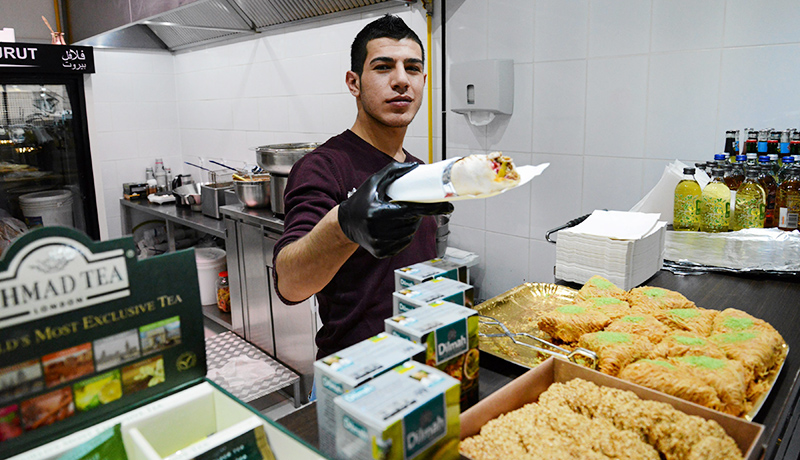
Bejrut Falafel, Warsaw, photo: Franciszek Mazur / AG
Those who’d rather eat a Middle Eastern lunch can try Shipudei Berek on Jasna St. The place also specialises in Israeli cuisine, and Monday through Friday there are special lunches for healthy eaters for less than 20zl: selected starter, main course, a side dish, and a dessert. Hummus, Israeli pizza, lamb shipud, grilled vegetables – ample servings of simple and mouth-watering dishes for a low price. At Beirut on Poznańska Street, one can savour Arab flavours, e.g. tajine, falafel, shakshuka, or kofta. One of better falafels at a very affordable price is served at Bejrut Falafel on Moliera and Nowolipki. Each dish smells of fresh coriander, parsley, mint, and tahini sauce. For ten years tasty kebabs have been made at Amrit Kebab, a popular chain restaurant. While their menu also includes other larger meals, a large portion of chicken or beef wrapped in a pita will cost you a bit more than 10zl.
Far East
The times when the only opportunity for an Asian lunch was a Chinese takeaway are long gone by. The number of places serving Far East cuisine has been steadily growing in Warsaw, and that’s why for a decent price you can have much more than coconut chicken in sweet and sour sauce. One can choose between authentic Vietnamese, Thai, Japanese, and lately Korean, often for extremely low prices.
In Saska Kępa one can enjoy lunch at Viet Street Food Bistro, which was previously associated with a very popular food truck serving Vietnamese bahn mi baguettes. The tiny bistro has just a few tables, a homely atmosphere spiced up with Asian design, delicious food, and low prices. Apart from the above mentioned bánh mi baguettes with crunchy bacon, Vietnamese pâté, or fried tofu, the menu includes bánh gio, i.e. steamed Vietnamese rice dumplings stuffed with pork and cloud ear fungus. Banh gio with sides costs 12zl, and wok dishes are also below 20zl. Similar prices apply to banh mi or pho bo soup.
Du-za Mi-ha (Giant Bowl) is a network of Asian fast-food bars serving very cheap food. You don’t have to splash out more than 20zl in order to get a large portion of pho soup in one of your favourite variants – from beef, through pork, chicken, duck, to sea-food, or wonton. They also specialise in wok-fried noodles. On a menu of several dozen items, the most expensive one is still below 20zl.
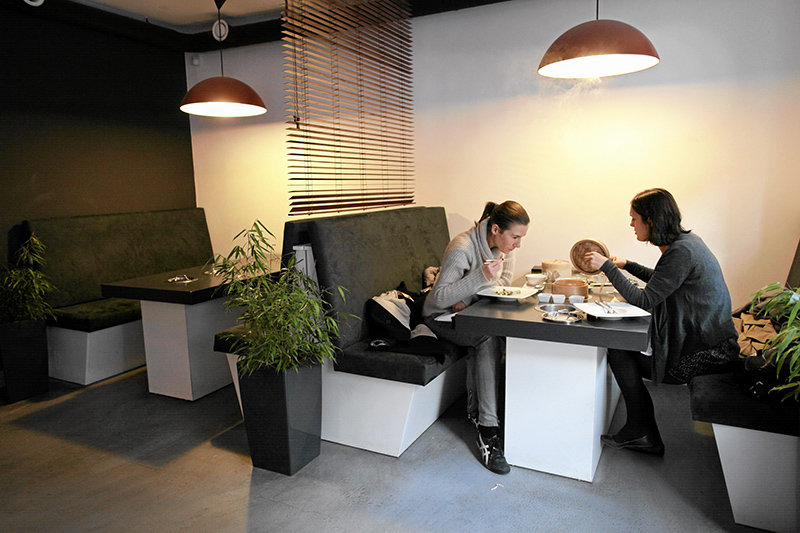
Shabu Shabu, Warsaw, photo: Agata Grzybowska / AG
Shabu Shabu, on the other hand, is a hot pot type of eatery, where you can practically prepare your food by yourself. Every guest is given a pot with broth, and is invited to select other ingredients to add to make it into a meal. The owner of the place is a daughter of Vietnamese immigrants who was raised in Warsaw. A pot of broth is 5zl, and the price of additional ingredients ranges from 1 to 5zl. You can eat your fill for less than 20zl. It is better to visit the place in a group, because the pot filling routine of the place is a great way to spend time with friends on eating and chatting.
Omami is a place on Krucza Street which specialises in Japanese food. The menu includes ramenami and hirata buns (steamed buns stuffed with e.g. duck, shrimp, bacon, Chinese shiitake mushrooms. At lunch, one can get a two-course Asian fusion meal of soup and curry, or a stir-fry from the wok. Prices range from 20 to 25zl.
Have we missed something? Feel free to post your comments below!
Originally written in Polish, November 2016; translated by IS, map & updates by Matt Davies, Feb 2017