Mickiewicz didn’t arrive in Istanbul as a tourist.
When I was writing Oko świata (The Eye of the World), I analysed the things that Mickiewicz’s contemporaries wrote from Constantinople – Chateaubriand, LaMartine, Amicis, and also Polish authors like Sienkiewicz. The letters of our Bard are not the descriptions of a tourist – he went there in order to work. That is why we also invited Janek Simon to take part in the project – when he travelled to India or to Nigeria and ran actions such as the Polish Year in Madagascar, he touched upon the problems of colonialism and an exotic perception of places. He travelled to these places in order to work, and that changes one’s perspective. If you come to a place and you want to make money, you are forced to make contact with people, to make deals with them, and to accept them. A tourist with a lot of time on his hands who only watches things takes on the role of a distanced observer. Mickiewicz does not take on this role because the Istanbul streets reminded him of his family hometown.
What was the reaction of Turkish artists to the figure of Mickiewicz?
When they found out that he was a poet in the 19th century who first took to forming an Italian legion, and then a Jewish one, and who also published a newspaper, then they thought that his idea of abandoning art in order to act was very pertinent to the contemporary situation. Especially in the Turkish context, where we have to deal with very sharp political conflicts. Many Turkish artists face the same problem today – because what is the meaning of exhibiting at a gallery when such strong art forms are created in the streets, forms that are entirely performative. It was interesting for them – and it was then that we were sure that this was the kind of Mickiewicz that could be of interest to the Turks as well as to us.
Who did you invite from Turkey?
The aforementioned Vahit Tuna and Ozgur Demirci, who know the area well. That was important to us – we wouldn’t take an artist from Warsaw’s Zbawiciela square and have him work, say, in the Praga district. Istanbul has 13 million inhabitants and it’s easy to act with such a colonialist approach. Someone who lives on the other side of the boulevard will look onto Tarlabasi 'from across the border'. We took those artists who are actors but also the victims of these processes. They are creating gentrification but they are also aware of its process.
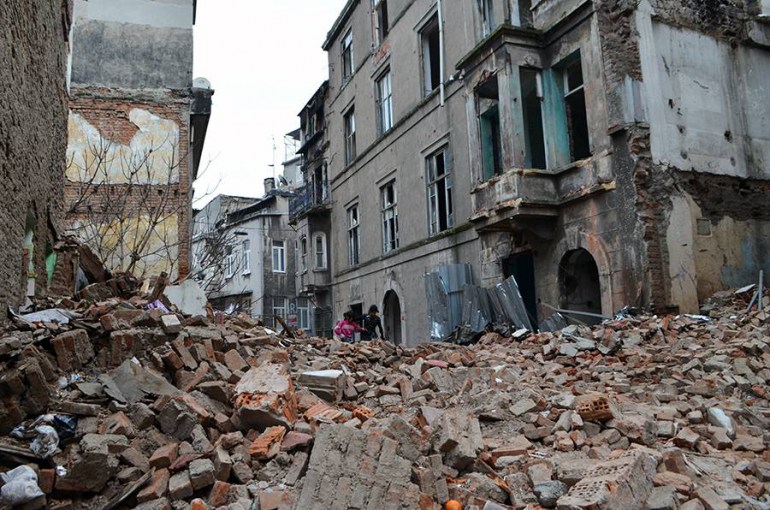
Both artists have prepared films which, at first glance, resemble social work. Vahit Tuna focuses on the change in rent prices in the district, but his starting points are the "Rubajjata" of Omar Chajjam, a mathematician and astronomer and also a mystic and poet. Ozgur Demirci juxtaposes Tsarlabasi with Society of The Spectacle by Guy Debord. There is also the film by Wojtek Doroszuk, with a concrete protagonist. The three films are a means of making the district present at the heart of the museum.
I suppose that not every resident of Istanbul knows that there is a Mickiewicz Museum in their city, located in the house where the poet once lived and then died.
Up till now, the museum was annually visited by about 300 people. Even the new permanent exhibit prepared by the Warsaw-based Museum of Literature will not alter this significantly. A Turkish friend and an urban planner told us that the museum has an excellent address and that an "Art and Research Centre" should be raised there. The point is to create a place that’s alive, a space for reflection, research and action. In this way, it can attract more people and it can truly become a Polish cultural venue.
One of the events which has already taken place was a performative interview with the Slavs and Tatars duo, which dealt with the issue of Slavic orientalism.
Mickiewicz was a friend and peer of an entire generation of Poles who became oriental studies specialists in the Russian Empire. Aleksander Chodźko, Józef Julian Sękowski – they were both Poles from Mickiewicz’s circle. Lelewel, whom we tend to perceive from the patriotic side, was an inspiration for these studies at the time. It was in a letter to Lelewel that Mickiewicz stated he may in the end take up studying the languages of the East.
At present, I am writing a book about Bronisław Grąbczewski, a 19th-century traveller in Russian service, a Pole who worked in Asia. When one compares Grąbczewksi with the English, whom he brushed shoulders with at the time, and when one compares Oriental scholars from Vilnius with the British orientalists – the difference between Russian and English colonialism is apparent straight away. The English made a spatial leap and a sense of strangeness was produced straight away. Things looked completely different when a colonial expansion progressed slowly, step by step. If Vilnius had Tatar Muslims, Jews, and Christians, all this variety, this multicultural aspect seemed completely natural. Without going into the excessive Kapuściński interpretation (the borderlands shaped me, the tolerance of the borderlands), we can still surely assume that this generates an entirely different approach. This kind of reflection is still underdeveloped.
Thus, for me, apart from the emigrant-activist motif and the Jewish one, Mickiewicz is also a model worth imitating as a positive possibility of "Polish orientalism" but not in the Said sense which mostly associates orientalism with power. Polish orientalists were, of course, servants of the Empire, but this aspect of power was not crucial for them. For me, this is an ideal model for approaching other cultures. And that is why I think that this multiculturalism was something obvious for Mickiewicz, and I suppose he would have felt better in Istanbul than in Paris.
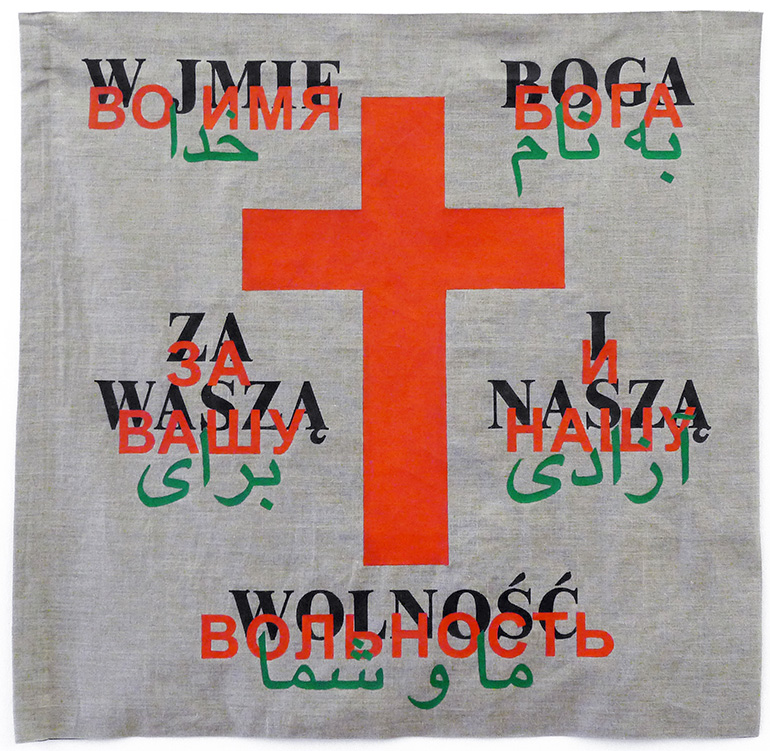
A source inspiration for Slavs and Tatars' project in Istanbul was formed by the theme "Za wolność waszą i naszą" (For Your and Our Liberty), attributed to Joachim Lelewel.
And how did he feel in Paris?
In Paris, Polish emigrants were those strangers followed by the police, censored, watched, and considered to be dangerous public enemies. They were political refugees in France, and this is how they were treated. They were a bit like the present-day refugees in camps in Calais who try to make it through to Denmark. Although there were many intellectuals among them, generally, in a symbolic sense, they were still someone like the present-day political refugees in contemporary Europe. And just like nowadays, each Muslim emigrant from the East is a potential jihadist, back then they were also perceived as a threat. They were the democrats of the Spring of the Peoples, the "red", and people feared that they would start some kind of a revolution or riot. And just like the refugees of today, they sit in these camps, which is well shown in the book by Gyorgy Spiro – and everyone is really afraid of them, because they are a germ of anarchy, revolution, an unknown threat. Even this Polish Catholicism of theirs was something radical, like the perception of Islam today.
These are moments in history that we have gotten accustomed to perceiving in one predetermined way. But if we look at them from a different perspective, it may turn out that they are something completely different – something interesting and pertinent to our time.
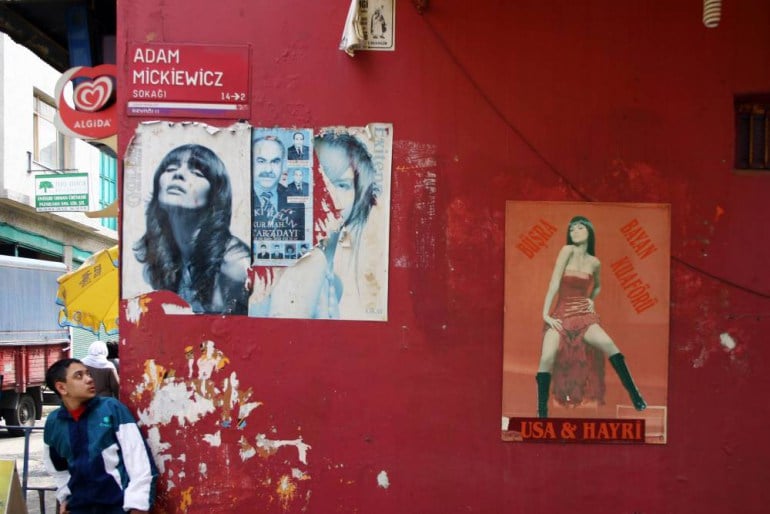
Mickiewicza street in Tarlabasi, Istanbul, photo: Justyna Chmielewska
The interview was conducted on October 14th, 2014.
The Migrating University of Adam Mickiewicz takes place from the 18th through to the 26th of October, 2014, at the Mickiewicz Museum in Istanbul. The events are organised by the Adam Mickiewicz Institute.
Edited by Mikołaj Gliński, translated by Paulina Schlosser, 20/10/2014