Katowice: Imagined Borders
The travel accounts of experienced pathfinder and city expert Natalya Konradova – part three. Underfoot the city of Katowice, under the magnifying glass – the identity of this phenomenal place and its inhabitants.
Łukasz is looking forward to our visit to Katowice. 'It is a completely different story,' he says to me, referring to our previous trips to Warsaw and Gdańsk, because Silesia has only been a part of Poland since 1921.
A city of miners and metalworkers greets us with big highways, an extensive industrial zone and rows of unsightly apartment blocks. It is definitely worth making the trip to the very centre of Katowice, as the old German city opens before you if only just a few blocks jammed between the railroad tracks and the highway. The railway station divides the city into two parts: if you go through the tunnel to the other side of the railroad tracks, the German architecture of the 19th century abruptly changes to Polish modernism of the 1920s.
In the architectural competitions of the 1920s there was always one stipulation: don’t use the Gothic style, says architect Anna Syska, with whom we are walking around the 'Polish' part of Katowice, Gothic elements were considered to be German, and after being incorporated into Poland, they began to search for a national style. In the course of our excursion it becomes clear that Katowice’s architecture is an ideal illustration of the history of the region, with its alternating periods of struggle and synthesis of German and Polish.
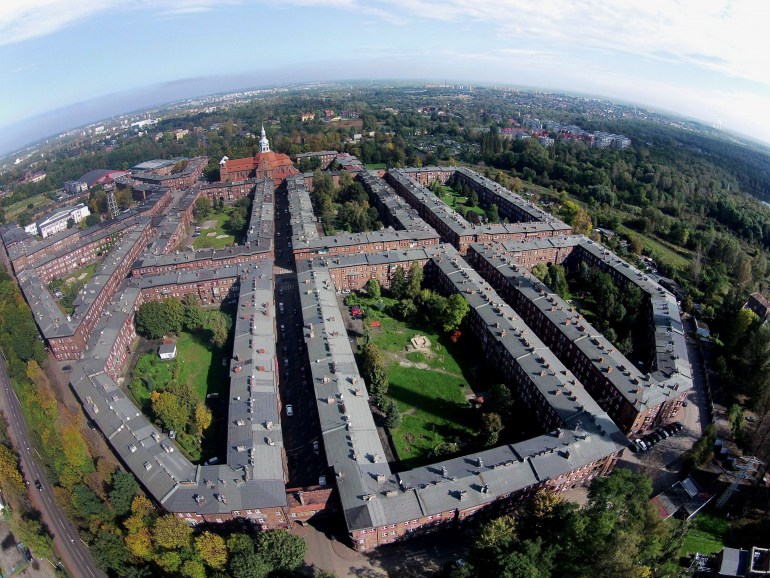
Katowice, Nikiszowiec from a bird’s eye view, photo: Daniel Petryga/Foto Gość/Forum
After the First World War, both Germany and Poland claimed Silesia. These territories had been German for a span of several hundred years, but they had belonged to Poland during the Middle Ages. This ancient historical bond proved to be more important the critical moment than the established economy and everyday life: Silesians organized an armed resistance against the German regime, hoping to join the new state independent Poland. In 1921, the League of Nations held a referendum where 60% of people voted to stay in Germany and only 40% to join Poland. But the supporters of Polonization led yet another uprising, and part of Silesia along with Katowice left for the Second Republic of Poland.
From this moment, the main task of the central government in the region was assimilating Silesia into Poland. One of the important mechanisms for this was the rapid construction of new, Polish-style community and residential buildings. However, no unique Polish style existed at that time Germany was much more fortunate with its Gothic. And so, Polish modernism came about: architecture of new forms and materials, filled with pragmatism and ideological substance a local variant of Bauhaus. Rounded corners of buildings, big windows, a variety of geometric shapes and sizes. Anna Syska and I walk along a special route on which we have some time to study the idea of Polishness. At a local radio station, a flagpole is still visible all the new buildings in the 1920s were fitted with Polish flags. The avant-garde form of the garrison church doesn’t contain a single hint of Gothicism. One of the first high-rise buildings in the city and in all of Poland is a demonstration by the local owner of a metalworks plant of how its products can be used, a clever attempt to capture new sales markets.
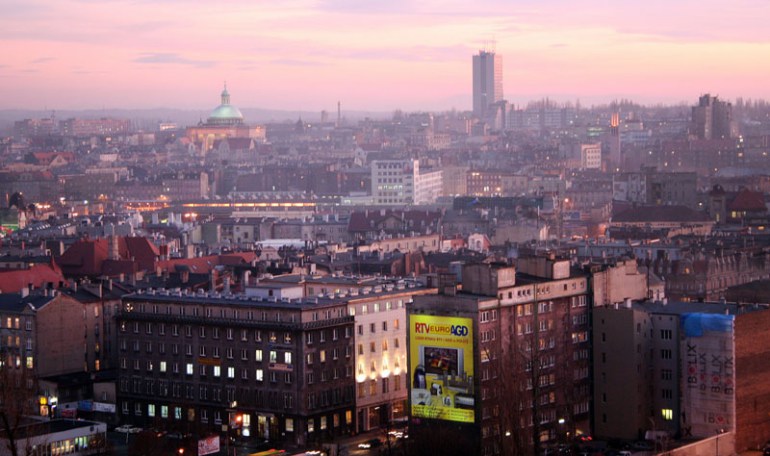
Evening panorama of the city, Katowice, photo: Jerzy Pawleta/Forum
The Poles strayed from the principles of their new architecture twice. The first time was when the cathedral was built. After being incorporated into Poland, the all-German episcopate remained on German territory: the local religious authorities had changed, and the city of Katowice had to build everything anew. When a competition was arranged, the church authorities ignored the decision of the committee and chose its own project: a solemn, false antique with a dome and columns. The second time Silesians turned off the track of modernism was when the project for the parliament building was selected. It probably seemed to them, like the majority of other young states in world history, that Roman architectural elements emphasized the seriousness of the new government’s intentions. The story turned into tragic comedy: when the Germans captured Silesia in 1939, it turned out that the building fully measured up to their serious state intentions. It remained only to have all Polish symbols stripped from the stucco frieze, swastikas hung up in their place, to replace the Polish eagles with German ones and have the Germans gladly use the building for the needs of its own administration.
However, this loss turned out to be recoverable: after the war, the swastikas and German eagles were once again changed back to Polish symbolism, and the parliament building has sat in this place ever since. The Silesians themselves had it much worse: during and after the war, they found themselves between two fires. The occupying Germans forcibly the young people to the Wehrmacht, and after the region was liberated, the new socialist authorities executed those who cooperated with the Nazis, even if they against their will.
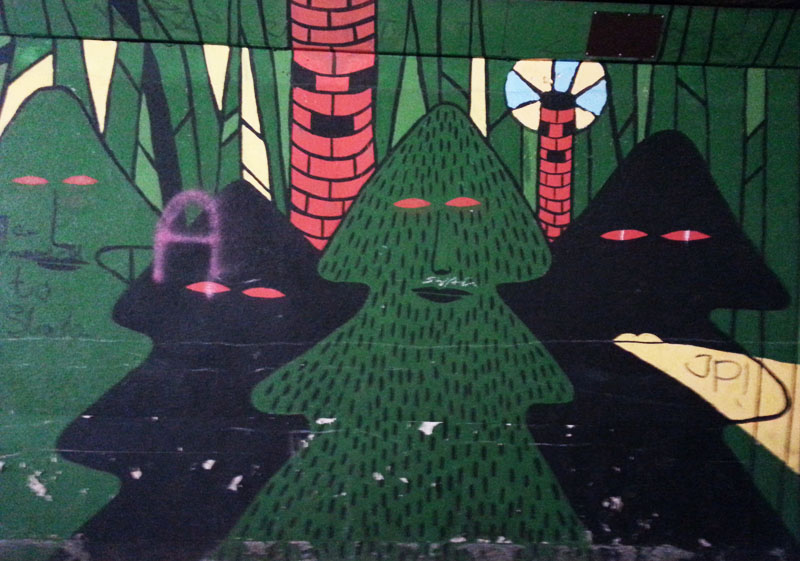
Graffiti in Katowice, photo: Natalya Konradova
The walls and fences in Katowice are speckled with the names of Silesia’s two main football clubs: Ruch and GKS. If you take a closer look, it will become clear that this is not simply graffiti: a war of information is playing out before our eyes. GKS fans 'hang' the logo of Ruch on an illustrated gallows, flip it upside down, cross it out vandalize it in all conceivable ways. Ruch supporters proudly write near their logo the year their club was founded: 1920. GKS repeats this move, but theirs is not so impressive: 1964. Łukasz and I go deeper into the history of the matter, which he is very familiar with. In fact, behind this sports rivalry is once again the history of the country. GKS Katowice, or Górniczy Klub Sportowy Katowice is a product of the socialist regime in Poland and a result of a confluence of several local clubs and sports organizations into one. Ruch was one of the first football teams in free Poland, and the Polonization of Silesia is connected to it. The club was created by Poles in 1920 right during the Silesian revolts, with which Ruch was associated with afterwards. The club became one of the weighty arguments in Silesia’s choice between Germany and Poland.
There is still no local museum here. The building has already been built one of the abandoned mines not far from the city centre was designated for these goals, on its surface vintage copper and large transparent cubes.
Mirosław Rusecki is a local activist, producer, and organizer of big street concerts and other activities in the city. We meet up with him next to graffiti, cover the majority of the firewalls in the city centre a result of international festival of street art which has been announced by the city authorities. Mirosław unexpectedly proposes we go out of the city and climb up a large hill. We quickly agree.
Rail station in Katowice, photo: Krzysztof Szewczyk/Forum
The artificial hill is made up of coal mining waste, and from it perfect view of the entire province. For instance, from here it is very clear that Silesia is a mining region. Many of the mines are still functioning: to the very horizon pit frames rise, wheels spin and smoke billows. Łukasz recalls how in kindergarten he cut out (carved) figures of miners, and on St. Barbara’s Day, the patron saint of miners, the central news reported about a visit from the head of state to Katowice to celebrate Miner’s Day as St. Barbara’s Day was called in Poland during the communist regime.
'My grandfather is German, and my grandmother is a Pole,' says Mirosław. All the time he used to go to see her in Wrocław on his bicycle, and then he got tired of it. And so, they moved to Katowice. Having found a native Silesian, Łukasz and I try to discuss with him the local identity how does he feel about Germans, what does he think about the region, does he often use the Silesian dialect? Mirosław has no problem with identity, therefore he answers our questions simply: he gets along well with Germans, he speaks Silesian. What does it mean to be a Silesian? In response, Mirosław recalls the story of the German football player Łukasz Podolski, a native of Silesia. During a match against Poland, he scored a goal, but he was not able to enjoy the victory along with the rest of Germany: after scoring against the Poles, Podolski wept.
