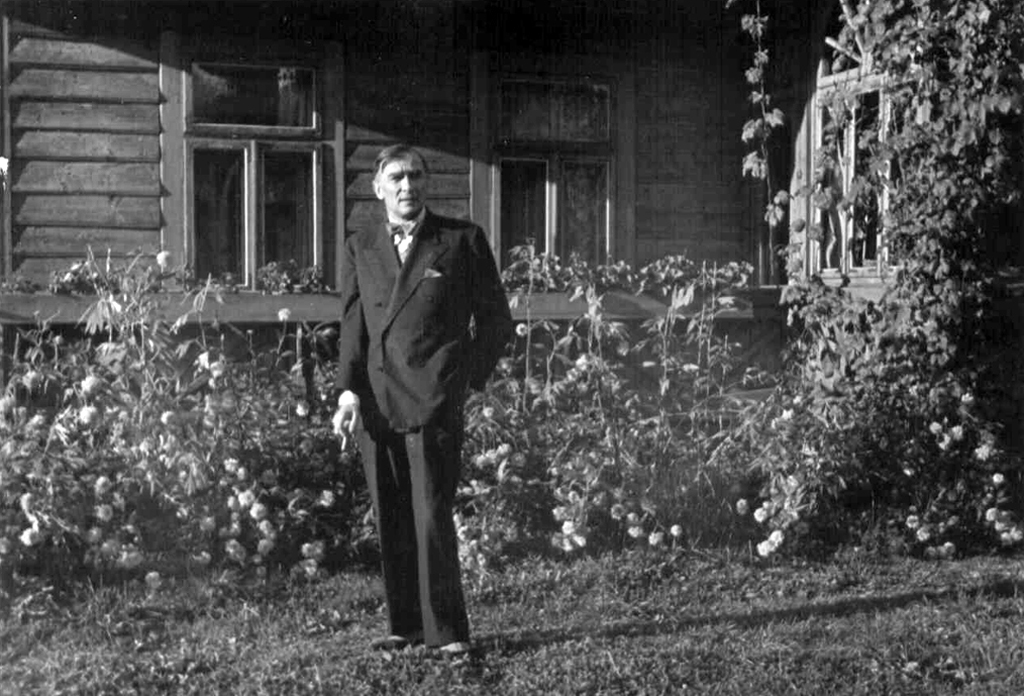
Karol Szymanowski in Zakopane
Composer, born October 3, 1882 in Tymoszówka, died March 29, 1937 in Lausanne
Karol Szymanowski spent his childhood years on an estate in Tymoszówka, Ukraine. His musical, wealthy family was one of the many to relocate there after the partitions of Poland. In 1889, with his father as his teacher, he started to learn the piano. He later studied under Gustaw Neuhaus in the Elizawetgrad School of Music, and was then taught in Warsaw by Marek Zawirski (harmony) and Zygmunt Noskowski (counterpoint and composition) between 1901-05. During this time, Szymanowski met and befriended Pawel Kochański, Artur Rubinstein, Grzegorz Fitelberg, Stefan Żeromski, and acclaimed Polish writer and painter, Stanisław Ignacy Witkiewicz ("Witkacy"). In 1905, accompanied by Witkacy, he travelled to Italy for the first time. That same year he set up the "Company of Young Polish Composers" together with Grzegorz Fitelberg, Ludomir Różycki and Apolinary Szeluto. Operating under the patronage of Władysław Lubomirski, the Company promoted works by contemporary Polish composers. It soon became known as "Young Poland" and its members arranged concerts in Warsaw and Berlin in 1906. Szymanowski spent much time abroad and from 1906-07, he made several trips to Berlin and Leipzig, returning to Italy in 1908. Having settled in Vienna in 1912, he established contact with the music publisher, Universal Edition, and signed a ten-year contract. In 1914, Szymanowski travelled to Italy and Sicily, and also ventured to South Africa, Paris and London. In 1915-16, he visited Kiev, Moscow and St Petersburg.
The October Bolshevik Revolution of 1917 forced Szymanowski to leave Tymoszówka. The family estate was destroyed (the piano was thrown into the lake) and the composer never returned to the area. He moved to Elizawetgrad and, in 1919, settled in Warsaw. In 1921, he travelled to the United States with friends Paweł Kochański and Artur Rubinstein, where his concerts were met with critical success. He spent a lot of time in Paris and gave a tremendously successful concert of his work there in May, 1922. That same year, in August, he travelled to Zakopane for the first time since the end of World War I, and thereafter made the mountain town his regular destination. Szymanowski's artistic interests began to focus more and more on Polish folk music, especially that of the Podhale and Kurpie regions. Declining the position of Director of the Cairo Conservatory in 1926, Szymanowski was appointed Master of the Warsaw Conservatory, a post he held from February 22, 1927 to August 31, 1929. Having declined the Egyptian appointment (where his ailing health would have no doubt benefited from the warm climate) he stayed in Poland with the aim of re-invigorating Polish musical education, which had been very much neglected following the partitions. He would later write a treatise entitled "The educational role of musical culture in society".
In 1926, the first performance of Szymanowski's operatic masterpiece, "King Roger", took place in Warsaw. Very much influenced by Euripides' play, "The Bacchae," it explores Dionysian themes in a medieval Sicilian setting. The original cast featured the composer's sister, the soprano Stanisława Korwin-Szymanowska.
Szymanowski's early orientalism is something that has been particularly explored by music scholars, although his influences were far-reaching. Aside from the inspiration he gained through his travels, and composers such as Chopin, (by whom he was inspired to compose twenty mazurkas) Wagner, Strauss, Brahms and Tchaikovsky, he also read widely and based many works on themes from Greek antiquity and Polish folklore. Compositions which were inspired by texts include 1906's "Salome," "Penthesilea," "Love Songs of Hafiz," "Songs of a Fairy-Tale Princess," "Songs of the Infatuated Muezzin" and 1933's "Litany of the Virgin". He also wrote a novel entitled "Efebos" (now lost) and dabbled in poetry. Four 'songs' were composed to the poems of Irish modernist, James Joyce and 'Twenty Children's Rhymes' were set to the poetry of K. Illakowich. Later he became particularly fascinated by the regional music of the Polish Tatras. In an article entitled "About Górale Music" he wrote: "My discovery of the essential beauty of Górale [Polish Highlander] music, dance and architecture is a very personal one; much of this beauty I have absorbed into my innermost soul."
In 1929, he went for treatment to a sanatorium in Edlach, Austria, and then on to Davos, Switzerland. He was the Master of the Higher School of Music in Warsaw (renamed the Fryderyk Chopin Academy of Music) from September 1, 1930 to April 30, 1932. From 1930, he resided in Zakopane, in Villa Atma. Concerts of his work took him regularly to France from 1933-36. The only meeting between Szymanowski and Witold Lutosławski, Poland's other great twentieth-century composer, took place in 1935. In November that year, Szymanowski left Villa Atma. Throughout 1937 he stayed at a sanatorium in Grasse, France. In March 1937, he arrived at a sanatorium in Lausanne, where he later died from tuberculosis.
Karol Szymanowski was awarded the following distinctions: The Officer Cross of the Polonia Restituta Order; The Officer Order of the Italian Crown; The Commander Order of the Italian Crown; The Honorary Plaque of Reggia Accademia di Santa Cecilia; The Commander Cross of the Polonia Restituta Order; The Academic Golden Laurel of the Polish Academy of Literature. He was also a Doctor Honoris Causa of the Jagiellonian University, Cracow and an honorary member of the Ceske Akademie Ved a Umeni, the Latvian Conservatory of Music in Riga, the St Cecilia Royal Academy in Rome, the Royal Academy of Music in Belgrade, and the International Contemporary Music Society. In 1935, he was awarded the National Prize for Music.
In 1994, EMI launched a recording of three compositions by Szymanowski: "Litania do Marii Panny / Litany to Virgin Mary", "Stabat Mater" and "III Symfonii / Symphony no. 3" with Elżbieta Szmytka, Florence Quivar, John Connell, Jon Garrison and the City of Birmingham Symphony Orchestra and Choir. The conductor was Simon Rattle, whose worldwide career was just beginning. Asked about Szymanowski's music, Rattle said:
"I cannot talk objectively about Szymanowski, for you cannot expect objectivity or reason from someone in love. And reason is out of place where his music is concerned, anyway. My first meeting with Szymanowski took place some fifteen years ago. I was having lunch with my friend Paul Crossley, the English pianist. Paul was a man whose advice I acted on unscrupulously. We would often meet, and he would put a score in front of me and say, 'You should have a look'. But that night he said, 'I've got something special for you', then he sat at the piano and played an excerpt of a piece. I had no idea what it was, but it got me very excited after just a few strokes and I knew it was love at first sight. It was the last part of the 'Stabat Mater' that Paul had played.
The "Stabat Mater" was in the repertoire for one of my first concerts with the City of Birmingham Symphony Orchestra. I must admit with shame that the choir sang in Latin. We knew, though, that a Polish language version would need to be prepared. And we struggled with that difficult language. Only Finnish and Hungarian are said to be more difficult, and there is not too much similarity between the Birmingham dialect and the Polish language. Only ten letters are pronounced the same in English and in Polish. So it was a character building experience for us on all counts. It took a year to work with the choir, but apparently sopranos can now be understood. I suppose that if Poles tried to sing in Welsh, they would understand our problems. We reached a point where language started to impact the sound of music, its rhythm. For instance, the holding out of the vowels and the proper start of the consonants has lent this music a specific pulse. The choir was no longer a group of English singers feeling aloof about a strange, obscure composition. They began to penetrate the music. It was an extraordinary trip. Szymanowski's music brought the ensemble, the choir and the orchestra together. We played the 'Stabat Mater' many times, then moved on to 'Symphony No. 3'...
I think we got our timing right with this music. The world was not ready to take it until now. Szymanowski's religious works, such as the "Stabat Mater" or the "Litany to the Virgin Mary", respond to the ever more pronounced need for spirituality. Moreover, this music is so splendidly colourful and extremely emotional. The English were at first unable to accept its highly intense and direct emotionality, they had to grow up to it. Now we are ready for it. It has always amazed me why the violinists of the world do not play at least one of Szymanowski's concertos and why the pianists do not play his "Symphony concertante". These compositions could have enriched the global repertoire a long time ago. Nowadays it is very important not to limit yourself to twenty or thirty compositions recorded by Toscanini. The public is open to new repertoire. Witness the success of Górecki. Górecki has been successful not only with the traditional philharmonic audience. He has a new audience in England, one that did not listen to serious music before. I believe it could be the same with Szymanowski.
I owe the discovery of Szymanowski's "Symphony No. 3" to Witold Lutosławski. He said that he had lived in something like a trance for several weeks after he had heard it. It was this music which prompted Lutosławski to decide he wanted to be a composer. "Symphony No. 3" is a wonderful, mystical work revealing a fascination with the Orient. Its climate meets the needs of contemporary listeners. Yet I believe that it is Szymanowski's later works, when he addresses the Polish heritage, reaches down to the Slavonic roots, makes a sort of reference to Mussorgsky, which are even more valuable for our culture at present. At the end of the twentieth century the rest of the world should discover what you have always known: that Szymanowski is one of the greatest composers of this century". ("Studio" 1994 No. 10)
Another world-famous director, Charles Dutoit, recorded both of Szymanowski's violin concertos with his Orchestre Symphonique de Montreal, featuring Chantal Juillet, the Canadian violinist. The recording was launched by Decca in 1994. Dutoit commented that:
"We are very fond of Szymanowski's music. It is so extraordinarily vivid, full of wonderful colours and, in this sense, seems rather unlike Central European music. I think we play it quite well. We have already performed a number of works by Szymanowski, not only the violin concertos with Madame Juillet. We take this music all over the world, have played it in places like Buenos Aires and Tokyo. We have also played 'Symphony No.3' and ‘No.4’, the 'Concert Overture', the 'Stabat Mater'. There are not many orchestra pieces left. This music may not be very popular, but its time is coming. It has fascinated me for a long time. I have performed works by Szymanowski with all the major American orchestras, including the New York Philharmonic, the Boston Symphony Orchestra, and the Philadelphia Orchestra. As a violinist, I used to play the 'Fountain of Arethusa' from the 'Myths'. It is a piece every violinist should play. The 'Violin sonata' is magnificent. I also like the two quartets. I am also familiar with some of Szymanowski's piano music". ("Studio" 1994 No. 9)
Today, Szymanowski's music is undergoing something of a revival. "King Roger" debuted at 2008's Edinburgh Festival; "Stabat Mater" appeared in the London Proms in 2009. Last year, Wigmore Hall hosted a Szymanowski festival. The recognition is mainly driven by "Król Roger / King Roger", which remains one of the most popular Polish operas of all time. Composed to a libretto by Jarosław Iwaszkiewicz in 1918-24, it was written when Szymanowski had already moved beyond his fascination with German neo-Romanticism and was looking for new inspiration. In 1914, Szymanowski travelled to Italy, Sicily and Northern Africa. It was a trip of major importance to his artistic development. Stopping in Paris on the way back, he heard compositions by Debussy and Ravel, and his subsequent work was to be much influenced by impressionism and the exotic and ancient world. He introduced elements of styling, and his sound became impressionistic. He simplified the texture of his compositions and renounced the thick, polyphonic tangle of numerous melodic motifs. However, he did not do away with the melody, but set it against a background of consonants. Such consonants are characteristic of impressionism, which, emphasizing the value of the impression of sounds, brings harmony to the fore and plays down the significance of the melody. Szymanowski combined the impact of harmony with the melody to give his "impressionism" an individual mark, one that distinguished him from other European composers. All these qualities of Szymanowski's musical language manifest themselves most clearly in "King Roger" and, together with the subject-matter of the libretto, they make this work truly unique. "King Roger" includes elements of both musical drama, with its leitmotifs, and of an opera. It also echoes Greek tragedies with its choirs placed outside the dramatic developments. It is fair to say that with "King Roger", Szymanowski created an original kind of stage-and-music performance, although much of his work is unique among European compositions of the time.
Compositions:
- Dziewięć preludiów / Nine Preludes op. 1 for piano (1899-1900)
- Sześć pieśni / Six Songs op. 2 to poems of Kazimierz Tetmajer for voice and piano (1900-02)
- Cztery etiudy / Four Studies op. 4 for piano (1900-02)
- Wariacje na polski temat ludowy h-moll / Variations on a Polish folk theme in B minor op. 10 for piano (1900-04)
- Wariacje b-moll / Variations in B flat minor op. 3 for piano (1901-03)
- Trzy fragmenty z poematów Jana Kasprowicza / Three Songs to the poems of Jan Kasprowicz op. 5 for voice and piano (1902)
- Sonata fortepianowa nr 1 c-moll / Sonata No. 1 in C minor op. 8 (1903-04)
- Salome op. 6, song with lyrics of Jan Kasprowicz, for soprano and orchestra (1904)
- Łabędź / The Swan op. 7, song to words of Wacław Berent for voice and piano (1904)
- Sonata d-moll na skrzypce i fortepian / Sonata in D minor for violin and piano op. 9 (1904)
- Cztery pieśni / Four Songs op. 11 to poems of Tadeusz Micinski for voice and piano (1904-05)
- Uwertura koncertowa E-dur / Concert Overture in E major op. 12 for symphonic orchestra (1904-05)
- Fantazja / Fantasia op. 14 in C major for piano (1905)
- Pięć pieśni / Five Songs op. 13 to German Poems (R. Dehmel, F. Bodenstedt, O.J. Bierbaum) for voice and piano (1905-07)
- Preludium i Fuga cis-moll / Prelude and Fugue in C sharp minor for piano (1905-09)
- I Symfonia f-moll / Symphony No. 1 in F minor op. 15 (1906-07)
- Trio op. 16 for piano, violin and cello (1907)
- Dwanaście pieśni / Twelve Songs op. 17 for voice and piano (1907)
- Penthesilea op. 18 for soprano and orchestra to text from Stanisław Wyspiański's Achilles (1908)
- Loteria na mężów , czyli Narzeczony nr 69. / The Lottery for Men, operetta in 3 acts by Julian Krzewinski-Maszynski (1908-09)
- Sześć pieśni / Six Songs op. 20 to poems of Tadeusz Miciński's cycle, In the twilight of the stars for voice and piano (1909)
- II symfonia B-dur / Symphony No. 2 in B flat major op. 19 (1909-10)
- Barwne pieśni / "Bunte Lieder" op. 22 for voice and piano (1910)
- Romans D-dur / Romance in D major op. 23 for violin and piano (1910)
- Sonata fortepianowa nr 2 A-dur / Sonata No. 2 in A major op. 21 (1910-11)
- Pieśni milosne Hafiza / Love Songs of Hafiz op. 24, six songs for voice and piano, Hans Bethge's paraphrase of Arabian texts of Hafiz (1911)
- Hagith op. 25, opera in 1 act by Felix Dörmann (1912-13)
- Pieśni miłosne Hafiza / Love Songs of Hafiz op. 26 for voice and orchestra (1914)
- 3 Symfonia "Piesń o nocy" / Symphony No. 3 "Song of the Night" op. 27 for tenor or soprano solo, mixed chorus and orchestra (1914-16)
- Nokturn i Tarantela / Nocturne and Tarantella op. 28 for violin and piano (1915)
- Metopy / Metopes op. 29, three poems for piano (1915)
- Mity / Mythes op. 30, three poems for violin and piano (1915)
- Pieśni księżniczki z baśni / Songs of the Fairy-tale Princess op. 31 for voice and piano (1915)
- Trzy pieśni / Three Songs op. 32 to poems of Dmitri Dawydow for voice and piano (1915)
- Maski / Masques op. 34, three pieces for piano (1915-16)
- Dwanaście etiud / Twelve Studies op. 33 for piano (1916)
- Koncert skrzypcowy nr 1 / Violin Concerto No. 1 op. 35 (1916)
- Sonata fortepianowa nr 3 / Sonata No. 3 op. 36 (1917)
- Kwartet smyczkowy nr 1 C-dur / String Quartet No. 1 in C major op. 37 (1917)
- Demeter op. 37 bis, cantata for alto solo, female choir and orchestra to poems of Z. Szymanowska (1917)
- Agawe / Agave op. 38, cantata for alto solo, female choir and orchestra to text by Z. Szymanowska (1917)
- Trzy Kaprysy Paganiniego / Three Paganini Caprices op. 40 for violin and piano (1918)
- Cztery pieśni / Four Songs op. 41 to text of Rabindranath Tagore from his cycle The Gardener for voice and piano (1918)
- Pieśni Muezina Szalonego / Songs of the Infatuated Muezzin op. 42for soprano and piano (1918)
- Król Roger / King Roger op. 46, opera in 3 acts (1918-24)
- Mandragora op. 43, pantomime in 3 scenes (1920)
- Marsz uroczysty / Festive march for orchestra (1920)
- Słopiewnie op. 46 bis, five songs to words of Julian Tuwim for voice and piano (1921)
- Trzy Kołysanki / Three Lullabies op. 48 to words by Jarosław Iwaszkiewicz for voice and piano (1922)
- Rymy Dziecięce / Twenty Children's Rhymes op. 49, 20 songs to poems of Kazimiera Iłłakowiczówna for voice and piano (1922-23)
- Harnasie op. 55, ballet-pantomime in 3 acts for tenor solo, mixed choir and orchestra (1923-31)
- Idom se siuhaje dolu, spiewajecy... (Piesn Siuhajow), highlander song for voice and piano (1924)
- Dwadziescia mazurków / Twenty Mazurkas Op. 50 for piano (1924-25)
- Dwie pieśni baskijskie / Two Basque Songs op. 44 to folksong texts for voice and piano (1925)
- Kniaź Patiomkin op. 51 music to the 5th act of Tadusz Micinski's drama (1925)
- Kołysanka / Lullaby (La berceuse d'Aitacho Enia) op. 52 for violin and piano (1925)
- Stabat Mater op. 53 for solo voices , mixed choir and orchestra (1925-26)
- Cztery pieśni / Four Songs op. 54 to poems of James Joyce for voice and piano (1926)
- Kwartet smyczkowy nr 2 / String Quartet No. 2 op. 56 (1927)
- Vocalise-Etude for voice and piano (1928)
- Sześć pieśni kurpiowskich / Kurpie Songs for mixed choir a cappella (1928-29)
- Veni Creator op. 57 for soprano solo, mixed chorus, organ and orchestra to text of Stanislaw Wyspianski (1930)
- Pieśni kurpiowskie / Kurpie Songs op. 58, twelve songs for voice and piano (1930-32)
- Litania do Marii Panny / Litany to the Virgin Mary op. 59, two fragments for soprano, female chorus and orchestra (1930-33)
- IV Symfonia / Symphony No. 4 (Symphonie concertante) op. 60 for piano and orchestra (1932)
- Koncert skrzypcowy nr 2 / Violin Concerto No. 2 op. 61 (1932-33)
- Dwa mazurki / Two Mazurkas op. 62 for piano (1933-34)
Source: www.polmic.pl
For more information on Karol Szymanowski, see: www.karolszymanowski.pl