From the outset, much controversy accompanied Zvyagintsev's film. It is also because the director did not attempt to avoid provocation. By deliberately showing a portrait of the president in his film, he accused Vladimir Putin in an almost direct manner – as the real principal behind the corrupt and cruel system depicted in the film. In spite of this, the film seemed the natural Russian candidate for the Oscar. This is mostly due to the fact that Zvyagintsev – the director of films such as The Return and Elena – has earned his reputation as one of the most outstanding worldwide artists of his generation. And for the Russian authorities, the mere fact of this film’s entry to the Oscars is proof of the artistic freedom allowed in contemporary Russia.
But in the last few months, the atmosphere surrounding the picture has grown more tense. Russian Minister of Culture Vladimir Miedinsky attacked Zvyagintsev in a January interview published in the Izvyestiya journal,
"What and whom Zvyagintsev despised is pretty clear. But who does he love? Fame, red carpets, and statuettes”.
Although the film was distributed in Russian cinemas, its showings were not uninterrupted. Drawing on a bill passed in July, 2014, the authorities censored Zvyagintsev’s film and the moments when actors say vulgar words have been silenced, thus making them mute (as they move their lips) for minutes in the film. Further protests followed. A group of outraged viewers forwarded a letter to the authorities, demanding punishment for Valeryi Grishko. Grishko, a director of the Drama Theatre in Samara, plays the part of a corrupt priest in Leviathan – thus offending the image of Russian authorities and the holy Orthodox Church.
As the controversies cumulated, so did the interest in the film, which seemed to gradually increase among the media and audiences in the West. The geopolitical events of the last months were not without meaning – notably, of course, the war in Ukraine, of which Russia is the main catalyst and player. The appreciation of Zvyagintsev’s artistic level seems to frequently run hand-in-hand with journalistic support of his attacks against the Russian political class.
It thus came as no surprise that in January 2015, Leviathan garnered the Golden Globe award for the best non-English language film of the past year. All the more, in that award is presented by an exclusive circle of some 90 journalists, all of whom are accredited in Hollywood.
Will the Russian film beat Ida in the fight for the Oscar? Not necessarily. For members of the American Film Academy, who include representatives of various professions in the cinematographic industry, a 70-minute road film may be much more accessible than a three-hour-long, and much more difficult, tale of a Russian Job.
Another factor speaks in Ida’s favour: the highly prestigious Academy Award nomination for Łukasz Żal’s and Ryszard Lenczewski’s cinematography. Such a token of recognition proved that the candidate is held in high esteemed, as in the last decade nominations for non-English speaking cinematographers have been a rarity. Previous nominees include only Paweł Edelman (for his work on Polanski’s The Pianist), Christain Berger for Michael Haneke’s White Ribbon, and Guillermo Navarro for Pan’s Labyrinth. It must also be noted that in 2014 Łukasz Żal and Ryszard Lenczewski were also presented with the Spotlight Award, distributed by the American Society of Cinematographers.
Timbuktu – Against Religious Radicals
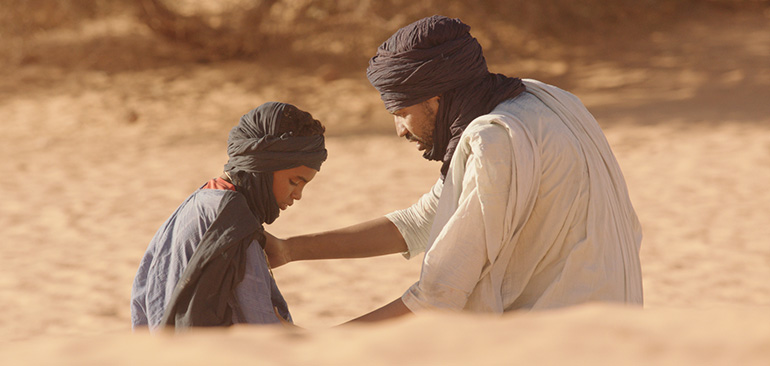
A scene from Timbuktu, photo: press release
Listening to the deliberations of film critics about the eventual winner of the Oscars contest, one could get the impression that the battle for best non-English speaking film will be played out solely between Ida and Leviathan. In fact, behind the forefront rivarly of the two titles, another film may well turn out to be a black horse of the battle. It is Timbuktu, a beautiful drama from the Mauretian director Abderrahman Sissako, who has already marked his presence on the cinematic scene with the films Heremakono and Bamako.
His newest picture tells the story of bloody riots that took place in Mali in 2011. The Berber tribe of Tuaregs fought the national army, and Islamic extremists took control over a few of the country’s cities, launching a bloody rule of terror across these lands. While depicting the story of the dictatorship of Islamist radicals, Sissako does not get involved in any political debate, nor does he sketch out a grand national panoramic view of society. He is rather interested in the individual fates of the inhabitants of Timbuktu, fates of those who have to make their life anew under a new, oppressive power. The film is made with Sofiane El Fani’s painterly cinematography (El Fani was also responsible for shooting Kechiche’s Blue is the Warmest Color) through which we witness the beauty of the desert landscapes. Sissako builds up a story of the need for openness and tolerance as he shows that Islam posses more than just the face of murderous jihadists, but it is also a means of spiritual searching.
Today, it is Timbuktu that seems to be a black horse in the race for the Oscars. Other films that are competing in the Foreign Language Film category include Zaza Urushadze’s pacifist Tangerines (which tells the story of the Georgian-Abhasian conflict), and Damián Szifrón’s Wild Tales – a crazy black comedy-drama about an evil that keeps on coming back. Which one of the films will be presented with the statuette on the 22nd February – that is hard to predict today. One can nonetheless presume that the choice of a winning picture will not only be an artistic but also a political one.
The Oscars and Politics
It is known that the temperature of international events has an impact on the Oscar results. Strong themes and engaged authors matter especially when the academy is awarding the Best Foreign Language film. It is enough to recall the year 2004, when the golden statuette went to Denys Arcand for The Barbarian Invasions, and a year later the the Best Foreign Language Film title was given to Alejandro Amenábar’s The Sea Inside. These pictures touched upon the theme of euthanasia, speaking of it as a means of defending human dignity.
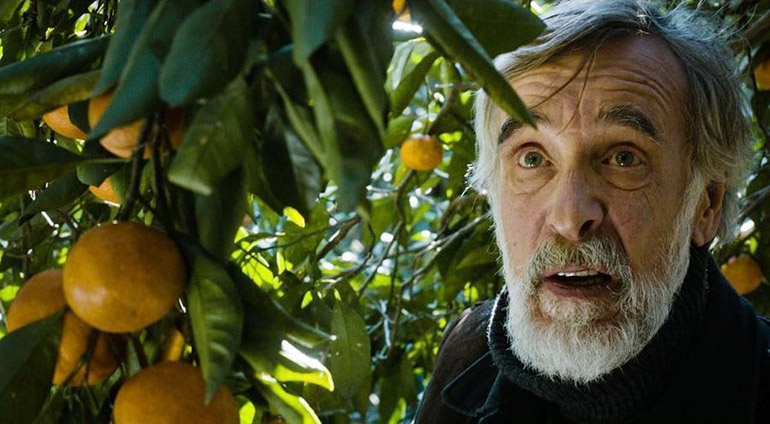
A scene from the film Tangerines, photo: press materials.
In 2006 the Oscar went to Tsotsi by Gavin Hood – a dark tale of economic exclusion and the divided society in South Africa. In 2011 the Danish In a Better World by Susanne Bier depicted how poor Africa collides with the Scandinavian welfare state. In 2010, the Israeli Ajami of Scandar Copti and Yaron Sahni fought for the Oscar. Ajami, which told the story of clashes and meetings between Judaism, Christianity, and Islam lost to The Secret of Their Eyes. A year earlier, as many as three "political" titles fought for the prize. They were Laurent Cantet’s The Class, The Baader-Meinhof Complex by U. Edel and Waltz with Bashir by Ari Folman. That year, all the directors eventually lost to a Japanese drama entitled Farewells by Yôjirô Takita. Political contexts also played an important part in the case of huge Oscar successes such as the excellent Separation by Asghar Farhadi (a 2012 Oscar-winner) and Florian Henckel von Donnersmarck’s The Lives of Others (presented with an Oscar in 2007).
For the American Film Academy, the pictures that compete in the Best Foreign Language Film category are meant to be windows onto the world. They are to speak of its pains, its most pressing problems and most interesting phenomena. Such an intense presence of politics in this Oscar category is no coincidence. It shows that the American Academy members believe it is important for the cinema to tell the story of the world that its creators live in.
This year’s nominations show that we are living in highly politicised times, and five out of the nominated films can almost be read as political statements: about the Holocaust, about Putin’s Russia, about Islam, and about the need for peace. Let us hope that politics will not overshadow what is most important about the silver screen – its emotional power and the dormant truth it carries. Perhaps the Oscar will then go to the best, and not necessarily the most controversial film.
Author: Bartosz Staszczyszyn 2015, translated by Paulina Schlosser 19/02/2015
Sources: Hollywood Reporter, Empire, own materials,
