When Pokémon GO mania started, I rock-solidly decided not to get involved. As alive as my nostalgia for the Gameboy® Pokémon games still was, I just couldn’t imagine myself running all over the place with my nose glued to my smartphone, chasing virtual monsters. I didn’t install the app, and was quite judgemental about the omnipresent Pokémon hunters, bumping into lampposts or risking their lives jaywalking the city's busiest roads. So, imagine my pure joy when Culture.pl’s editor-in-chief asked me to write a piece about the cultural aspects of the game…
Trying to figure out what could I have done to the universe to deserve this, I downloaded the app and left the office to start my unwanted Pokémon GO adventure.
First I installed Pokémon GO not knowing what to expect
Getting into the details of the game seems pointless (I presume you either know it or you’re not at all interested) but a brief introduction for those who are not familiar with the app seems indispensable to get a good understanding of my experiment.
Pokémon GO players venture around the real world, looking for virtual Pokémon. They use an in-app interactive map to navigate. It works more or less like Google Maps, the difference being that you can’t zoom out too much (you only see a radius of a kilometre or so) and the streets are not named. Moreover (and here comes the most interesting part), the map is full of Pokéstops – real world places you have to visit to be able to continue the game. By tapping them, you’ll see a real world picture helping direct you where to go. Surprisingly, they are almost always stationed at cultural spots such as statues, commemorative plaques, murals and public buildings, but not only…
Soon, Pokéstops became my favourite part of the game and I started running from one to another, realising how little I knew about the city I had been born and raised in. Why?
I discovered beautiful streets I'd never bothered to visit
My first Pokémon discovery was that after living in the city for a long time, I had developed a very definite web of paths – my well-proven methods of commuting from one place to another. For example, if there was a main street linking two districts, I wouldn’t usually bother to look for other options. But when the location of Pokéstops started diverting my footsteps, I began visiting places I’d never been to, located only several metres from paths I used to walk everyday!
Previously, my tunnel vision had made me overlook several beautiful backyards, a few tiny local cafés, and a lot of calm, charming corners in the otherwise roaring city of Warsaw. It had also made me miss the fact that one of my favourite authors (Witold Gombrowicz) lived in a house a few streets from Culture.pl’s office, or that everyday I would walk under a beautiful sculpture of an angel ‘holding up’ a balcony.
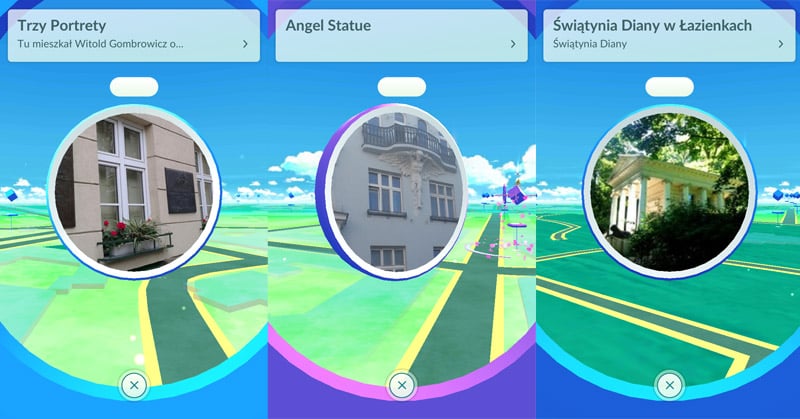
Witold Gombrowicz's house/ A statue of an angel holding up a balcony / a classicist Diana's Temple in Łazienki Park, photos: Pokémon GO gameplay screenshots
The last discovery turned out to be also the first of a new category:
I found out Warsaw has many strange statues and sculptures
If you had asked me how many statues there are in Warsaw before I started Poké-walking, I probably would've started counting the biggest, most exposed monuments and give a number as wrong as 50 or so. Meanwhile, the right answer is ‘loads more’, and I just hadn’t been paying attention. Thanks to Pokéstops being very often stationed on random statues, I discovered that, at least in the older parts of the city, every fountain, gate, little square, well, garden and park is full of statues and sculptures of different types and sizes. Some of them are truly beautiful, some are shockingly ugly, and others are purely mind-boggling.
The strangest one I found was hidden deep within Łazienki Park. After a long walk and a bit of a climb, I found myself standing at the top of a hill, face to face with the ‘Memorial of an Eagle’. No further description was provided, no information if this eagle is the one that inspired the emblem of Poland or if it had any other praiseworthy qualities. Just a medium-sized eagle, on a high pedestal, because why not?
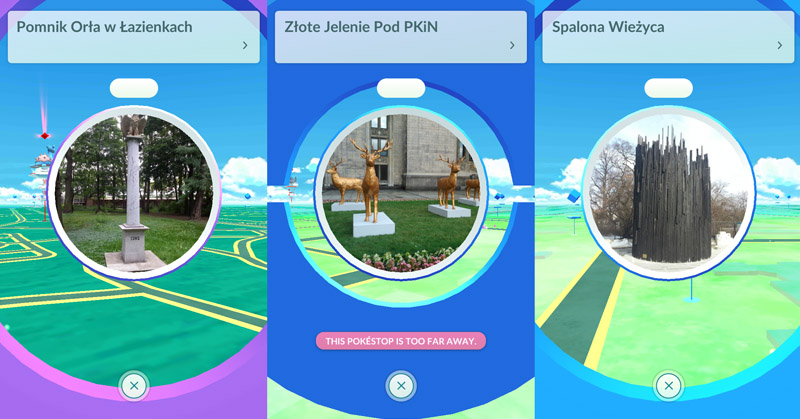
The statue of an eagle / Sculptures of golden deers / Statue of a pillaged tower, photos: Pokémon GO gameplay screenshots
I got to know the city's murals and mosaics
The same applies to murals. As much as I like them and know where the best are located, I discovered that there are many more, scattered around under-visited neighbourhoods. For example, I just couldn’t believe that there's one devoted to L.L. Zamenhoff (the Polish-Jewish creator of the Esperanto language) in the gate of a tenement house I walk by everyday! And it’s a really great one, with some of the best-known quotes from literature translated into Esperanto.
Another that turned out to be just around the corner from where I live, on the inner wall of the University of Warsaw's Faculty of Psychology building, was a mural commemorating Hermann Rorschach – the inventor of the Rorschach inkblot psychiatric test, the one which asks patients to interpret inkblots.
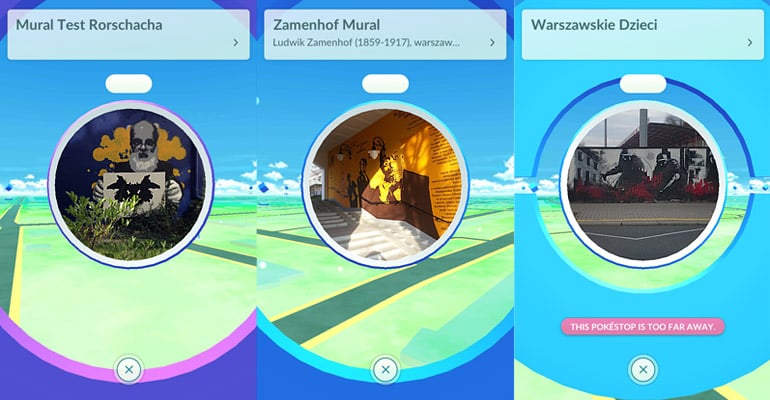
Rorschach's mural / Zamenhoff's mural / Warsaw Uprising mural, photos: Pokémon GO gameplay screenshots
These discoveries made me realise that even though I'd read a book or two about the history of my district, Muranów, there must have been much more to learn. It made me decide to check every single Pokéstop in a radius of a few kilometres from my home. Again, it turned out to be a jackpot because…
I was reminded of my neighbourhood’s dark history
I live in Muranów, a little sub-district of the city centre, which, for the most part, is built on the ashes of the Warsaw Ghetto. There are commemorative plaques and stones everywhere, the Museum of the History of Polish Jews is my closest neighbour, and I really thought my knowledge about the history of this place was decent, to say the least. The last thing I had expected is that I could learn something more from an app as frivolous as Pokémon GO. I was wrong.
With almost all the Pokéstops being related to the ghetto's history, I acquired a consciousness of its topography. I learned where its borders would fall in the present day, and how cramped it was. After a few hours moving from one commemorative plaque to another, from steel signs showing the former ghetto’s gates, to the only remnant of the ghetto – a few metres of the original wall – I completely forgot about playing the game and just used its map to deeply immerse myself in the dark past of the district.

Zygielbojm memorial/ Original Ghetto's wall / Umschlag Platz, photos: Pokémon GO gameplay screenshots
To be honest, it felt kind of silly. Did I really need a Pokémon game to take a thorough walk into my neighbourhood’s history? Why didn’t I do it before? The answer is quite simple – there doesn't appear to be any other interactive map that gives you such a detailed tour around Muranów, and none of the books I read list as many places to see.
Besides, when you’re not a tourist, do you ‘go sightseeing’ in your own neighbourhood?
I became aware of how fast Warsaw is changing
Eventually, I also noticed that many of the objects represented by Pokéstops themselves no longer exist, and that their disappearance had escaped my attention. Some of them were meant to be temporary (such as the reindeer sculptures scattered around Warsaw for Christmas), others vanished for no obvious reason (I never found out what happened to the 8-bit UFO mural pictured below), a few moved elsewhere (just like Marek Edelman’s mural, which travelled from one side of Muranów to the other), and at least one will be very much missed (a beautiful cube mural on the front wall of Nowy Theatre).
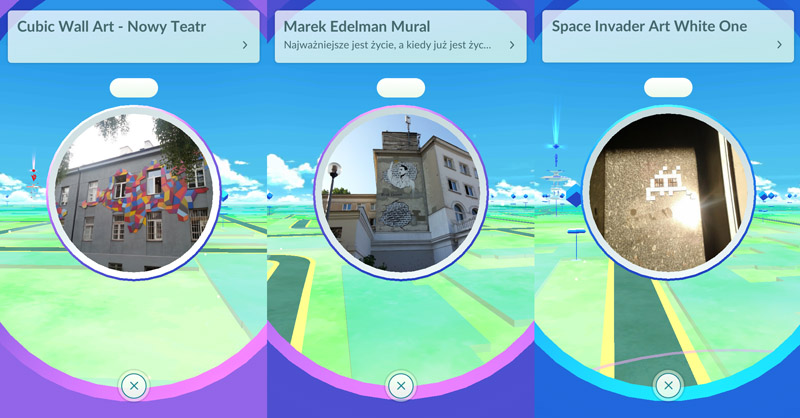
A cubicle mural on the front of Nowy Theatre / Marek Edelman's mural in its initial location / 8-bit UFO mural, photos: Pokémon GO gameplay screenshots
Given that the game premièred only a few months ago, the fact that many photos already did not match reality showed how the city is changing everyday, and that walking the same streets is only boring when you don't pay attention to the details.
Did I fall in love with Pokémon GO?
The answer is ambiguous. Catching, hatching, evolving and chasing Pokémon bored me after a day or two and I gradually started ignoring them. That's just me though; the widespread mania speaks for itself and so it’s nothing against the game, I just didn’t get hooked.
On the other hand, the process of unexpectedly rediscovering my own city was totally fascinating and turned the whole thing into a great few days of adventure, probably changing my ‘urban habits’ forever.
Hence, I’ll no longer mock Pokémon GO players and the insanity around it, and I’ll even be recommending the app to people who want to take a fresh look at things they think they know by heart.
Pokémon GO Warsaw tips
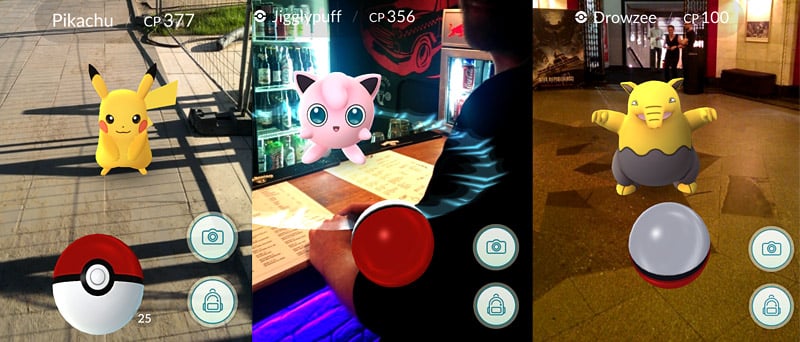
Pokémon captured by Culture.pl editors, photos: Pokémon GO gameplay screenshots
Finally, if you've ever wanted to give Pokémon GO a shot in Warsaw, here’s a handful of tips, compiled for you by Culture.pl's editors.
- Rare Pinsirs can be found in Łazienki Park. We caught one near Diana Temple but reportedly they appear in different spots within the park.
- High CP Hypnos and Raticates can be found at Spokojna Street / Muranów.
- We caught a Jynx at the Multimedia Park Fountain.
- People often install lure modules at the Old Town and New Town squares as well as near The Museum of the History of Polish Jews.
- We caught a Weezing while crossing Niepodległości outside Racławicka station.
- We caught a Voltorb in Morskie Oko park.
- The Palace of Culture is drowning in Drowzees (I caught three in quick succession as I was going into the famous Kinoteka cinema). It’s a good place to start anyway, as its crowded with Pokémon.
- We found an Abra outside Polskie Radio headquarters.
- Last but not least, PIKACHU can be found in the area of Warszawianka sports centre!