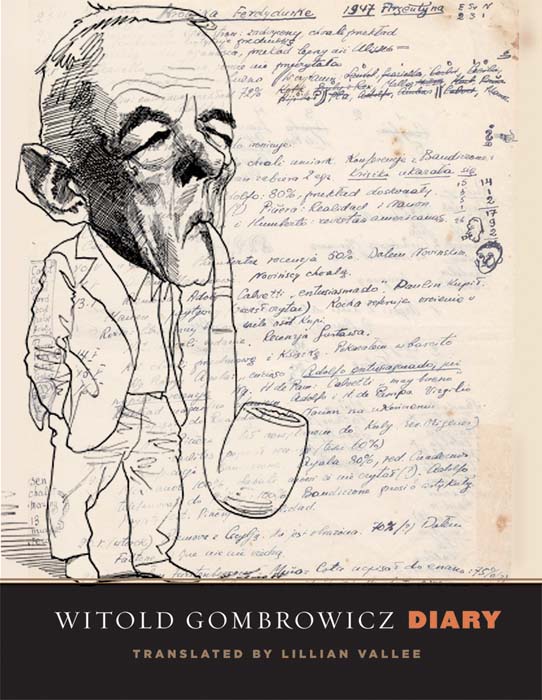
Cover of Witold Gombrowicz Diary, published by Yale Books
Long out of print in English, Gombrowicz's Diary finally returns to the world literary stage in a single, complete volume brought to life in an immaculate translation by Lillian Vallee
"If ever a life demanded a diary, this was one."
- Paul West, Washington Post
Witold Gombrowicz famously begins his Diary with a half-week of entries that simply declare, "Monday. Me. Tuesday. Me. Wednesday. Me. Thursday. Me". In the first volume Gombrowicz explains that in in his diary he "would like to set out to openly construct a talent" for himself because he has a desire to "reveal himself", to reveal the complexity of his ideas and his spirit. And yet from the very start it is clear it is not only about Gombrowicz himself, but all Poles, because Gombrowicz recognised that the state of Polish culture in the world reflected immediately upon him as a Pole in exile. In effect, it is about all of mankind, whose masks Gombrowicz wishes to snatch as he calls out "You pretend that you know who you are".
Gombrowicz is highly defensive about his own Polishness, adamant to prove he is not the primitive, inferior being the world would have him be. He speaks of an intellectual crisis among Poles of the time and lashes out heated opinions about the arts and artistis, especially Polish artists, whom he bashes for their "lax" attitude to artistic matters and lack of originality in imitating Europe, rather than drawing upon their own "Polishness" for inspiration. He rebukes them for stoking the old Masters, the long-dead poets of Romanticism, instead of creating a new poetry. His tone is passionate to the point of aggression, yet as he avers,
Furthermore, by suggesting, somewhat in the way of a proposition, certain problems, more of less linked to me, I pull myself into them and they lead me to other secrets still unknown to me. To travel as far as possible into the virgin territory of culture, into its still half-wild, and so indecent, places, while exciting you to extremes, to excite myself... I want to meet you in that jungle, bind myself to you in a way that is the most difficult and uncomfortable, for you and for me. Don't I have to distinguish myself from current European thought? Aren't my enemies the currents and doctrines to which I am similar? I have to attack them in order to force myself into contradistinction and I have to force you to confirm it. I want to uncover my present moment and tie myself to you in our todayness.
As Ruth Franklin writes in her review of the new edition of the Diary in The New Yorker,
Gombrowicz sought in the diary to revive Polish culture from the near-fatal blows dealt to it over the twentieth century. But he was equally concerned with saving himself. In the diary, Gombrowicz describes himself as "Terribly Polish and terribly rebellious against Poland." Gombrowicz rebellion was primarily targeted at what he came to call "form." Gombrowicz’s quest to save Polish culture from its own admirers becomes a favorite theme of the diary. His exhibitionism begins in mild form, with an almost sheepish account of his daily routine. But soon the diarist moves into the darker corners of his personality. As soon as Gombrowicz had resigned himself to a life of obscurity, his reputation caught up with him. "Ferdydurke" became a best-seller in Poland. His final novel, "Cosmos," appeared to great acclaim. In the final diary entry, he was still railing against the provincialism of literary Poland. "My entire life I have fought not to be a ‘Polish writer’ but myself, Gombrowicz," he wrote. He nearly succeeded.
Gombrowicz was eternally looking towards the self and "one's own truth" as the source of ideas, not the outside world. He describes the battle between the writer and his worth, painting a sincere picture of that painstaking process of creating a work of art, music or literature. As Rita Gombrowicz writes in the introduction to the edition, these writings can be understood by the modern reader as Gombrowicz's answer to the blog, of course before the idea of a blog even existed, a way of engaging the reader and other writers in a dialogue about the task of writing and the role of culture.
Translator Lillian Vallee remarks on the task of carrying the intensity of the words and ideas of this superior Polish thinker into English,
In the course of translating Diary I have watched many reviewers break their pens (just as I have broken all of my translator's teeth) trying to get Gombrowicz right. He has been called a "crank," "enfant terrible," "scourge," "prophet," "bad boy," "hermit," "demythologizer," "cunning child," "the anti-intellectuals' intellectual," and "classy heel," just to begin the list.
Vallee herself sees Gombrowicz as a "Socratic or Voltairean gadfly, egging on the lagging old mare of Polish culture or sinking its teeth into the backside of complacent intellectuals". There is one Pole, one poet, who is granted some respite from Gombrowicz's scathing pen. He is Czesław Miłosz, another of Poland's greatest writers-in-exile, whose craft he most clearly admires above all of his contemporaries, save the suggestion that "one must be careful that the life beneath our pen not become transformed into politics, philosophy or aesthetics". And still he finds Miłosz's A Captive Mind "immeasurably instructive, stimulating, and shocking reading for all of us Polish literati", calling the writer and poet "a first-rate force" and "a writer with a clearly defined purpose, called to quicken our pulse so that we can keep up with the epoch". Miłosz himself wrote of the diaries in the New York Times that "Having this book in my hands, I felt a joy at the thought that strong personalities, like that of Gombrowicz, sooner or later find recognition thanks to the sheer intensity of their existence."
Grombrowicz had lived in exile in Argentina since 1939, when he embarked on a diplomatic voyage to the country with other writers just as Germany invaded Poland and World War II broke out across Europe. He ended up staying in Argentina for two decades, later discouraged from returning to Soviet-occupied Poland and the hostile communist regime. His works, which had not drawn very much attention before the war, were entirely banned in Poland for the writer's inimical stance towards the regime. It would be many years before his 1937 novel Ferdydurke would grant him real fame among readers in critics in his native Poland and abroad. And yet Gombrowicz had so much he felt he needed to say about Poland, Poles and the world. In 1952, inspired by the Journals of Andre Gide, he began to keep his own diary. Jerzy Giedroyc, the founder and director of Kultura, the prestigious Polish-language émigré journal based in Paris since 1947, gave him an outlet for his writings. Gombrowicz began contributing to Kultura in 1953 and the diary is essentially the body of work he had amassed for the publication up until his death in 1969. The first volumes of the diary were published in the late 1950s through the late 1960s.
The new edition of Gombrowicz's Diary brings together three volumes that were previously published separately by Northwestern University Press in the United States between 1988-1993, along with some previously unpublished writings originating in 1966-1969. This vast collection is ultimately a complete collection of Gombrowicz's diary entries arranged in their original chronological order, supplemented by an index compiled by Professor Allen Kuharski and Richard Lowe to help readers navigate the wide compendium of topics that Gombrowicz delves into, such as communism, exile, the arts and even Catholicism. Rita Gombrowicz's thorough, insightful introduction leads the reader gently into the buzzing, bustling, dynamic jungle of her late husband's most profound musings - musings that still ring quite relevant with regard to the question of the state of Polish culture, and literature in particular, in the world today.
Witold Gombrowicz (1904–1969) is the author of Ferdydurke, Trans-Atlantyk, Cosmos, and Pornografia, the first three available from Yale University Press. These, along with his plays and his Diary, have been translated into more than thirty languages.
Lillian Vallee is a scholar, writer, and translator of literature from the Polish, who served an apprenticeship with Polish poet Czeslaw Milosz. Among her works are over 130 translations, articles, reviews, and poems. She is the author of three chapbooks - Vision at Orestimba, Erratics and Handful of Snow.
Diary
by Witold Gombrowicz
Translated by Lillian Vallee
Publisher: Yale Books, Yale University Press, New Haven, CT and London, 3 July 2012
Format & dimensions: Paperback, 197 x 127 x 53mm, 800 pages
ISBN: 9780300118063
ePub: ISBN: 9780300183399
The edition is part of Yale Books' Margellos World Republic of Letters series.
Selected reviews:
"Ferdydurke is certainly a spontaneous work, but the Diary is even more so, and . . . even more rewarding."
- John Bayley, New York Review of Books
"Widely considered the Polish author’s masterpiece . . . the Diary lacks for nothing: history, politics, philosophy, literature, art, music, love, death, humor, communism, Poland, Europe, writing - everything is there."
- Paris Review Daily
For more information and excerpts of the Diary, see the Yale Books official blog or amazon.com.
For more information on Gombrowicz, see the official website dedicated to his life and works established by Rita Gombrowicz: www.gombrowicz.net. The site also features entries from the Diary.
Author: Agnieszka Le Nart, August 2012