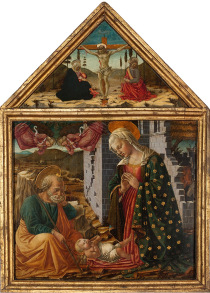
Fra Diamante, "Adoration of the Child and Crucifixion", ca. 1470, oil on wood, dimensions: 45,7 x 52,5; frame: 25 x 49 cm, collection of the National Museum in Warsaw, source: MNW
The beliefs of the early Christians shaped the visual tradition for depicting the Nativity, set down in the Bible and the Apocryphal Gospel. Matthew writes of the three wise men who travelled from the East to pay heed to the Child and present gifts to him. Luke describes the Annunciation before a community of shepherds. The Nativity is described with the greatest detail in the writings of Jacob, which originated sometime around the 2nd Century, and of Pseudo-Matthew of the 7th Century. It is here we find out that Christ was born in a cave and it was first the animals who paid heed to the Child in the cradle - an ox and a donkey - and later the Three Wise Men arrived. The miraculous virgin birth was confirmed by two midwives.
These words, later absorbed mainly from texts from the late Middle Ages, such as Jacobus da Voragine's Golden Legend (1298), directly influenced the depiction of Christmas in the centres which shaped the representation of Christmas in the art of early Christianity. When these texts arrived in Poland, these visual traditions had already been firmly established, however they did undergo some modification over time.
The many works of art across the ages originated in Poland or were brought to Poland at various points in time reflect the range of literary and pictorial sources. The earliest way of depicting Christmas shows Mary laying on a blanket beside the Child's cradle. They are often accompanied by Joseph, an ox and a donkey. This compositional scheme for Christian art was probably derived from the Pagan Antiquity - from representations of Dionysis' mother Semele resting after a difficult birth, for example. The oldest painting of Christmas came about in the 5th Century from Christian lands in the east. They began spreading westwards up until the latter half of the Middle Ages.
Some examples of this type of representation have been preserved in Poland. The oldest is a full-page miniature that illustrates a manuscript of the Golden Gospel, likely to have been written up in a monastery in the south of Germany, prepared especially for the coronation of Boleslaw II the Generous at the Cathedral in Gniezno on December 25, 1076 (Gniezno, Archdiocese Archive). The central part of the composition is occupied by the child in the cradle, with the ox and donkey standing in the background. These themes remain intact with regard to both the canonical and apocryphal texts. However, an extraneous element that is not derived from any literary source appears in the gesture and pose of the child - with head and hand raised, he appears to confirm the message that he is indeed the Messiah. Other discreet clues as to the mission of the Saviour are also dispersed - such as the construction of the cradle out of stone, giving it a tomb-like appearance that foreshadows the suffering and death to come. In the same way, the blanket surrounding the child is reminiscent of a death shroud.
The Saviour's earthly parents stand by the sides of the cradle, Mary resting on a blanket on the ground and Joseph on the left. The hands of both have their hands turned towards the Child in a gesture of offering. The Child appears to bless the pair, along with the horizon above the cradle, which takes up a third of the composition. A single star with ten points shines out of the sky - presumably this is the star that led the Wise Men from the east and appeared to the Shepherds in the Gospel according to Pseudo-Matthew, shining larger and brighter than any other. The figures of nine angels are also depicted paying heed to the King of Kings. One of the angels travels down to earth to spread the good news to the shepherds - in the lower part of the miniature that scene too has been deftly included into the composition. One of the two shepherds guarding the flock blows a horn to spread the news about the miraculous birth across the world.
A similar formula for representing the Nativity is followed by other Romanesque works that were later brought to Poland, such as a section of the bronze doors constructed in Magdeburg in ca. 1152-1154 for the cathedral in Płock (which remained there until the second half of the 13th Century until they were brought to Novogrod in what is today Russia) or an etched goblet made in the late 12th Century in South Germany for a monastery in Trzemeszno (today part of the Archdiocese Museum collection in Gniezno). In both representations Mary is depicted as lying below the cradle with the Child, who is being warmed with the breaths of "calves". In the section of the door, Mary is resting, perhaps sleeping, while Joseph watches over his family. He supports his head with his hand in a common gesture of worry as if he were sensing a bloody portent of sacrifice that Christ will face, depicted in other scenes of the Passion on those same doors. The Mary of the goblet faces her son, reaching her hands towards him as if wishing to pick him up. This detailed gesture of maternal tenderness indicates a clear shift in how the birth of Christ is depicted at the cusp of the Gothic era: an increasingly emotional link between the Mother and Son.
Both interpretations are prevalent in works of art created in Poland itself. One of these is full-page miniature in the manuscript of the Psalterium nocturnum, originating in ca. 1240, used as the basis for the private prayers of the wife of Henry I the Bearded - Jadwiga of Andechs-Meran, a future saint (Wrocław, University Library, sygn. IF 440, fol. 3v). The scene has been expanded, enriched with rooftops and towers, the ox and donkey are joined by two angels holding a banner with a latin inscription of the beginning of the hymn "Glora". The three-leaf construction of the arcade ushers in the new Gothic style, yet it also symbolises the triforium structure of the basilica, which transforms the stable in Bethlehem into a house of worship. This is supported by the representation of Christ's body in the consecrated host wafer at every service. The cradle itself emphasises the link between the Nativity and the Eucharist: it isn't a cradle as much as an altar onto which the Saviour is offered. This sacrifice of Mary's son is foreshadowed and her awareness of what is to come is expressed in her distraught gaze. In terms of proportion, Mary's figure is given particular consideration and her important role as the Mother of God is highlighted as the beginning of a crucial act of salvation.
Such traditional representations of the Nativity can also be found in a number of works originating at the beginning of the 13th Century through the end of the 14th - from the Romanesque through the Gothic. While they are not as detailed in content as the ones described above, they are significant in terms of the context in which they originated. The birth of Christ is strictly tied in with the Passion and the Resurrection of Christ as the beginning and the end of the act of salvation. They can be found in the sculptural reliefs decorating the doorways of (no longer existing) St. Vincent Church in Wrocław, originating in ca. 1200 (today it is part of the south wall at the St. Mary Magdalene Church in the same city), as well as that in the Saint Nicholas Church in Wysocice, believed to have originated in the first quarter of the 13th Century in the Norbertine Church in nearby Imbramowice in the Małopolska region of Poland. In Wrocław, the Nativity is depicted on one of the archivolts, while the relief in Wysocice is accompanied by a depiction of the kneeling St. John the Bishop with his acolytes and a depiction of the resurrection. The relief seems to communicate the message that the immaculate birth of the Saviour ties in directly with the "immaculate" tomb of the resurrected.
The idea of maternal tenderness can be identified on several Gothic representations of the 16th Century. A Silesian tetraptych in tempera on wood originating in the second half of the 14th Century in the Convent of St. Clara in Wrocław (today part of the collection of the National Museum in Warsaw), is particularly touching. Here Mary picks her son up out of the cradle and cuddles the naked child in her arms, while he reaches out to touch his mother's face. Of course, Christ expresses the child's need for tenderness with this gesture, but also a loving tenderness that foreshadows the child's future connection with the Church, represented in the child's connection with his mother. Joseph is a witness to the scene, his head covered with a pointy hat that was typically used in depictions of Jews. An ox appears above Joseph, who is sitting, here a symbol of Judaism, while the donkey that accompanies Mary and Jesus is a donkey - a pagan symbol. The two animals feed from the same trough, representing the union between the two. The Eucharistic dimension of the birth of Christ and the Mass offering is represented, emphasised by the depiction of the resurrection just above the Nativity scene.
The four-paneled altar in Wrocław undoubtedly served for private prayers, as did the remarkable depiction in wood of the Nativity in the St. Peter and Paul Church on Hel on Poland's Baltic coast (today in the collection of the National Museum in Gdańsk). The piece comes from roughly the second half of the 14th Century, brought from Cologne. It depicts solely the figures of Mary and Jesus. The mother is in a half-reclining position, holds the Child on her lap, emphasising the tenderness between them, while also presenting him as the "fruit of her loins". This type of representation, in which only the Mother and Child are depicted, is quite rare and it's tied in with an increasingly individual stance towards religion that the late Middle Ages gave rise to - as the praying community narrowed, so did the depiction of individuals significant to the Nativity.
This new depiction of the Nativity increased in popularity over the second half of the 14th Century and was rapidly reflected in the art created in the area that is now Poland. One of the earliest - and most beautiful - examples is a panel of the painted wooden Polyptych called the Grudziądz Altar (today in the collection of the National Museum in Warsaw). It comes from the chapel of the Castle of the Teutonic Monastery in Grudziądz (on the Vistula), originating in ca. 1390-1400 and most likely painted by artists from the Czech region. The panel is composed of a girlish Mary painted in shining, intense colours on a golden background, kneeling and adoring her newborn son. The Child appears to be hovering just above the ground, surrounded by a halo of light. This scene illustrate the vision of mystics who reach back into the apocryphal texts that speak of the supernatural light radiating from the child, symbolising the Child's miraculous birth and his godlike nature, retained in spite of his human birth. This type of depiction takes place in a stable, whence the holy family travelled a few days after Christ was born in a cave.
This new formula was called the Adoration of the Child quickly replaced most earlier representations and was adopted into many late Medieval works of art in Poland. They are characterised by a limited number of details and themes, with Joseph usually absent, such as in the engraved, gold-plated silver plate which was probably made at the request of King Jogaila (1377-1434) or the painting of Mary in the Pauline Monastery in Częstochowa, which was restored after its theft in 1430. Joseph is also missing from a panel of the painted wooden altar (St. Mary's altar - Ołtarz Mariacki) from the Church in Ptaszkowa (today in the collection of the Diocese Museum in Tarnów), which originated ca. 1440 in Kraków. This abbreviated formula was often used to decorate Liturgical books and manuscripts, such as the manuscript of the 19th Jasnogórska Mass (ca. 1505-1510, Kraków, today in the collection of the Pauline Monastery Library in Częstochowa).
These depictions tended to be quite complex, with meanings layered upon one another, dividing the canvas up into precise geometric fragments, each representing a different aspect of the miraculous birth. The most easy to understand for those who were not so well versed in theology was the representation of the Nativity and the Crucifixion, such as the central panel of renaissance painter Fra Diamente's (1430-1492) altar (oil on wood, today in the collection of the National Museum in Warsaw). Both scenes (with the Nativity on the larger bottom section and the Crucifixion above) composed an ideological clasp that completes Christ's mission of salvation - its beginning and its end. Some elements spill over onto one another as a foreshadowing of the Passion and suffering that is to come - the landscape in the background of the Nativity scene is reminiscent of the cliffs of Calvary.

Wit Stwosz, St. Mary's Altar (detail). Photo: Paweł Migasiewicz
Similarly, the Altarpiece of Veit Stoss (Ołtarz Mariacki Wita Stwosza), created between 1477-1489, showing Christ born in the ruins of Bethlehem's Palace of David, emphasises his roots in the royal bloodline of Israel, while making possible references to the tearing down of the Old Covenant in favour of the new, with Christ as the cornerstone of the new Church following his birth, death and resurrection. Today, the piece stands as part of the majestic main altar of St. Mary's Church in Kraków.
Later depictions of the Nativity were devoted to the adoration of the child by the people. In Polish art the most lyrical and beautiful example is Herman Han's (1574-1627) oil painting, which comes from the Pomeranian region of Gdańsk. Dated 1618, The Sherherds' Bow can be found in the predella of the Altar of St. Mary's Ascension at the Church in Silesia's Nysa Śląska. The composition, based on medieval representations creates a unified depiction of the Annunciation on the right and their journey to the stable in Bethlehem towards the left, ending with Madonna's adoration of the Child in the midst of angels singing and playing instruments. The entire scene takes place in the night, with light shining from all the figures - with the greatest radiance coming from the Child.
Of all the works of foreign origin in Poland's collection, José Antolinez's (1639-1676) oil painting is of most considerable note. The Spanish painter from Seville worked mainly in Madrid, where the painting was purchased in 1852 by the Polish Count Atanazy Raczyński, an avid art collector. Today it is part of the collection of the National Museum in Poznań. It depicts the Shepherd's adoration of the Child in a winter setting, in which Christ shines brighter than any other figure, right in the centre of the painting.
The subject of the Nativity has rarely come up in modern and contemporary art, having been shifted out of focus in favour of other topics. However, many great works of the interwar period in Poland were based on folk inspirations, which included religious themes. The Poznań-based artist Władysław Roguski (1890-1940) painted several depictions of Madonna and Child, based on traditional folk paintings on glass. Tadeusz Makowski (1882-1932), a Polish artist mainly based in Paris, designed an illustration for Tytus Czyżewski's (1880-1945) book of carols, making a reference to traditional Christmas woodcuts.
Yet, the most significant of all these works is the work of the sculptor Jan Szczepkowski (1878-1964). His altar-shrine created for the International Exhibition of Modern Industrial and Decorative Arts in Paris 1925 depicts the Madonna and Child adored by a chorus of angels just after the birth, indicated by the sign: The Word Became Flesh and Made His Dwelling Among Us.

Jan Szczepkowski, Nativity Shrine, pinewood (1925). Source: MNW
The work made of crudely chopped pinewood brilliantly links the craftsmanship and inspirations of folk art and the modern geometric style, rhythm and simplicity of the early 20th Century. Awarded a Gold Medal at the exhibition, the shrine has taken on the symbolism of Polish art déco. Today it is part of the altar at the Polish Church in Dourges in the north of France. The artist, nonetheless, created a replica of the piece, which is today part of the collection of the National Museum in Warsaw.
Author: Paweł Freus, December 2010. Translated by Agnieszka Le Nart, December 2010.