No women allowed
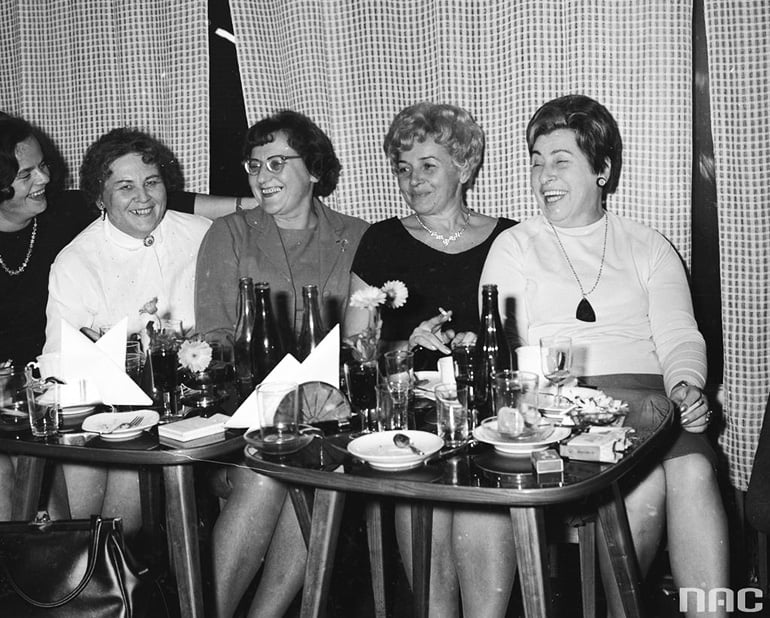
Women in Hawana Café in Warsaw, 1968, photo by Grażyna Rutowska / National Digital Archive / www.audiovis.nac.gov.pl
When cafés first opened, they were only visited by men and served only by male waiters. The arrival of women spelled not only a transition in interior design but also an expansion of the menu. Benches gave way to comfortable armchairs, napkins and flowers appeared on tables and mirrors on the walls. Pastry chefs began to make more cakes and cookies and gave them female names: Helena cake, stefanka, warszawianka. Cafés and pastry shops were thrust into a new era with the appearance of gas lighting in the 19th century. Up to then, they were lit by oil lamps, then candles and kerosene lamps. Perhaps it was the dim light or the hustle and bustle of cafés and pastry shops that made them ideal venues for business meetings.
Cafés serving alcohol
Deals were made over punch. Baldi's pastry shop on Dluga street was famous for its punch. It was served in large glasses and made with a generous quantity of araq. While in Italy, Great Britain, Spain and France, coffee began to be drank in the 17th century, before it settled in Poland for good, the morning drink was wine broth (wine, water, almonds, raisins, powdered sugar and yolks) or beer broth. Other typically masculine drinks included a drink made of ground almonds boiled with milk (orszada), strong coffee with sugar syrup and a spoonful of rum or spirit and ice cubes (mazagran), or pomegranate juice with sugar syrup (grenadino). Coffee lemonade and oranżada (a fizzy drink with water, sugar and orange juice) appeared on the menu with the arrival of women. In order to please his female clients, Baldi kept a dozen canaries in his shop. They were trained to sing Italian arias.
Edible flowers and other sweets
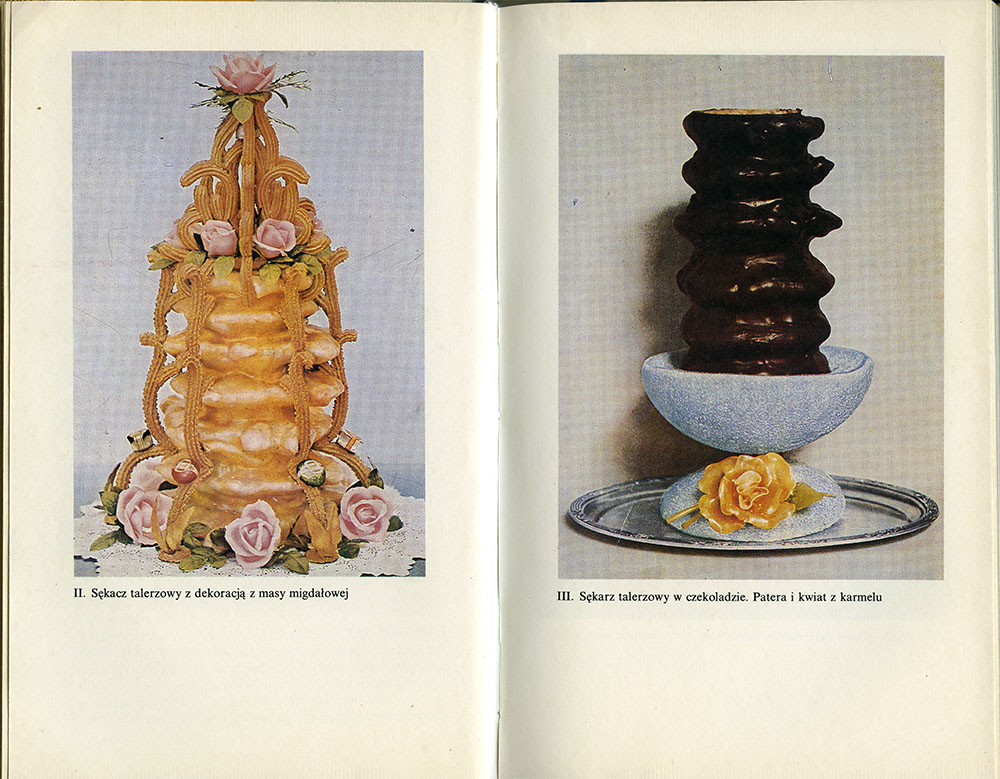
Examples of traditional Polish cakes with decoration, photo from Wojciech Herbaczyński's book, scan by Culture.pl
Tiny singing creatures were not the only way owners would attract clients. Advertisements would tout the health benefits of coffee: "drinking coffee deters apoplexy" or "drinking tea adds shine to your eyes" and shop windows would lure clients. Warsaw's most famous shop window was that of Kacper Semadeni, an immigrant from Switzerland. It would always be hidden behind a crowd of gawking school kids. There were caramelised fruits on big platters - pears halves, apples, plums, apricots, edible chestnuts, pineapple pieces cooked in syrup and covered with a thin layer of icing; cornucopias with gold coins, small coloured vases, mazurki, baumkuchen and other cakes and cookies, and, finally, edible art: baskets with edible flowers and a layered cake, often in the shape of a pyramid, a tower or palace with chocolate, caramel, marzipan or tragacanth decoration. The sophistication of the ornaments confirms that confectionery manufacturers were craftsmen with a sense of the fine arts. Legend has it that when the Romanian royal couple came to Warsaw in 1923, they and other dinner guests were asked to distinguish real elderflowers from their sugar imitation without touching them. In an atmosphere of laughs and cheers, they failed miserably.
Well-groomed pastry chefs
Semadeni had seven sons and trained all of them to be pastry chefs. There was a strict hierarchy in the profession and the apprenticeship period under a master chef lasted ten years: five years in Poland and five abroad. In the days before the invention of motors and electric machines, a long stick with an egg beater was used to prepare the dough. Nuts and cocao beans were ground in massive quern-stones. The profession was not only physically demanding but also varied – there was no division of labour. Pastry chefs would work in the back kitchen and serve customers at the counter, and had to be short-haired and immaculately dressed in a white shirt with a clean collar. To make sure the apprentices were well-groomed, Semadeni had a hairdresser come to his establishment every fortnight to cut the youngsters' hair.
Cut diamonds at the theatre
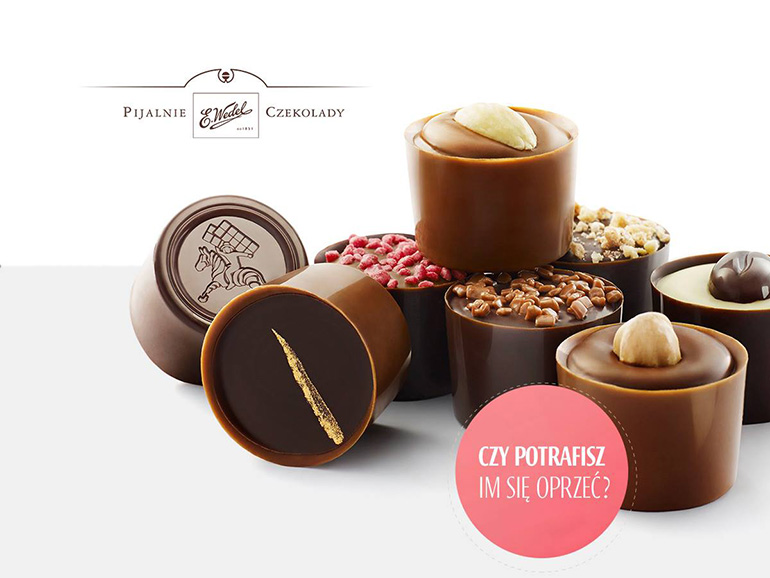
Example of modern cut diamond chocolates by Wedel, "Can you resist them?" photo: Wedel's press release
Semadeni and his sons managed a number of establishments (pastry shops and theatre buffets) in Poland and Ukraine. His most famous business was in the building of the Grand Theatre. Picture a big room, with sturdy dark furniture covered in plush fabric, dark drapes tied by ropes on both sides of the door, marble tabletops, an antique clock, a big mirror in a black frame on the wall, and the owner – Laurent Lourse – not long before his death. It was gloomy but always lively. A passage from the theatre to the shop made it possible for gentlemen to buy boxes of chocolate for their dates during the intermission. A theatre show and a box of chocolates from a man? I truly regret that that custom didn't stick. The most luxurious chocolates were called "cut diamonds" – brylanty in Polish.
Commemorative cakes
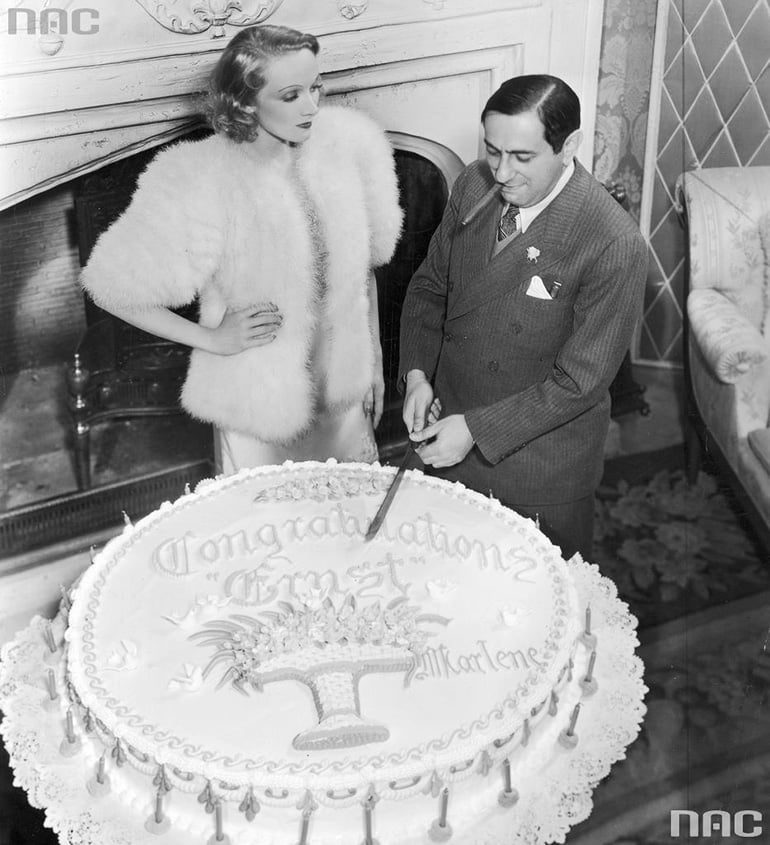
Example of commemorative cake from relatively recently – Marlena Dietrich and Ernst Lubitsch celebrating the 25th anniversary of their first movie, photo: National Digital Archive / www.audiovis.nac.gov.pl
Confectioners, their pastry shops and products were intricately linked with then-current political events. When Poland regained independence after World War I, Semadeni made a cake to commemorate the event. It was far superior to today's personalised commemorative cakes – it was a full-blown work of art. Set against chocolate Carpathian mountains, white eagles (the symbol of Poland) made of tragacanth with authentic white bird feathers chained to caramel border checkpoints are breaking free from cuffs of imprisonment. The sculpture brought people to tears. Teachers would bring their students to see it. Semadeni's pastry shop and the Grand Theatre (Pod Filarami) burned down in World War II. When the theatre was rebuilt in 1965, there was no room for a pastry shop inside.
Plotting an uprising over a coffee
Cafés were places of meeting in the aftermath of as well as the run-up to big historical events. At poorly lit tables, Poles plotted national uprisings. Despite permanent vigilance by police and infiltration by spies, the November Uprising (1830-31) against the Russian Empire was planned in a café. The uprising began when young Polish officers from the local Army of Congress Poland's military academy, led by Lieutenant Piotr Wysocki, revolted against the Russian Empire's occupation. They were soon joined by large segments of Polish society.
Despite some local successes, the uprising was eventually crushed by the numerically superior Imperial Russian Army. In the run-up to the insurgence, cafés were public places open to everyone at every time of the day. This is where like-minded students, teachers, civil servants, and journalists would meet to discuss politics and literature. Warsaw had a couple of "pre-Uprising" cafés. Among them were Baldi's café on Dluga street and a café on Kozia street owned by Mrs Brzezinska. The small café on Kozia street had a wide selection of newspapers and good coffee. There was an atmosphere of respect for those who came here to read. This is also where Frederic Chopin said goodbye to his compatriots before leaving for France. In his book Literary Cafe in Warsaw, Wladyslaw Wojcicki writes, "On the eve of his departure he went for a coffee at Brzezinska's, and in the evening he attended the National Theatre on Krasinski square, that is when I saw him last".
Chopin's belongings
Thankfully, the memory of Chopin is preserved in his music because his belongings, kept safe by his younger sister Izabela Barcinska in the Zamoyski Palace on Nowy Swiat, were destroyed by Russian soldiers in 1863. The raid took place after a bomb aimed at Count Teodor Berg, the viceroy of the Tsar in the Kingdom of Poland, was thrown from the palace's window. Soldiers entered the premises and destroyed everything inside, including a portrait of Chopin, his coffee set, correspondence, couch, carpets and the most significantly - his piano. Everything was stacked and burned. On a side note, the Zamoyski Palace was once home to a café owned by one of the apprentices of Lessel mentioned earlier.
Many cafés were destroyed during the war, others were made exclusive to Germans, and some were homes to the underground resistance movement. Post-war outfits helped rebuild ties between a shattered people. Today, Warsaw and Krakow have a vibrant cultural life. There are places which offer themselves up for political debates and support political parties.


