Archimapa (a play on words, combining 'archi' from architecture and 'mapa', the word for map in Polish) presents the seven most interesting, albeit frequently unknown topics related to Warsaw’s 20th-century architecture. Each of these is also a thematic proposition for touring the city. Agnieszka Szulejewska, head of the Projects Section of the Stefan Starzyński Institute (a section of the Warsaw Uprising Museum) explains,
It is addressed to those who do not regularly find the time to participate in lectures on the architecture of Warsaw, but are nonetheless interested in the city, its builders, and its architecture – there will always be time to peek at the phone on one’s way to work, or whilst shopping.
Thanks to the app, everyone can freely plan an interesting route for sightseeing, excursions, or simply in order to take a walk while also learning about architecture, designers, and the history of over 400 sites. Archimapa also provides information about the places’ availability. The geographic mapping helps users find places which are frequently hidden, and inspires them to move around more freely within the urban landscape. The abundance of visual material is another factor that facilitates identifying sites and monuments marked on the map.
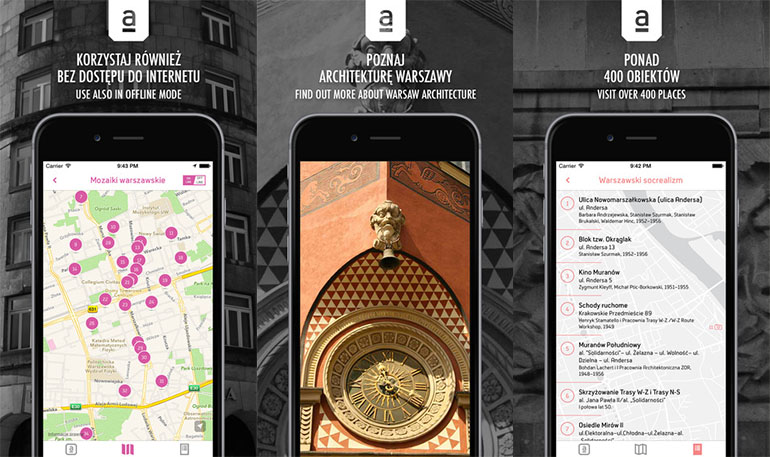
The Archimapa application visuals, image: press materials of the Warsaw Uprising Museum and Moiseum
Szulejewska adds:
Transferring physical publications into the language of an application is not only part of the ongoing process of digitalization, but also a way of reaching out to the needs and basic comfort of the users. We promote knowledge about Warsaw and we want to share this knowledge with the largest possible number of recipients. We make them the ones who decide about the time and place within which they will discover Warsaw.
Trail descriptions have been authored by: Grzegorz Piątek, Jarosław Trybuś (Warszawa niezaistniała / A non-existent Warsaw 1944, Architecture of interwar Warsaw 1918-1939, Warsaw's socialist realism 1949-1956); Maria Sołtys, Marek Kuciński (The Heritage of Warsaw's architecture 1945-1989); Beata Chomątowska (Jewish heritage. Warsaw, Falenica, Otwock); Sylwia Chutnik (Ancymapa. Warsaw for children) and Paweł Giergoń (Warsaw mozaics).
Zuzanna Stańska, owner of Moiseum company who have produced Archimapa, adds:
Archimapa is probably the first example in Poland where an originally printed project is transferred onto a mobile application, employing all the possibilities provided by these devices. It is also an exceptional occasion that the museun has decided to make its product available for all of the leading mobile platforms, enabling the majority of smartphone users to access the application.