Piece by piece, they form a bitter, tragic story about an artist who, in every political and social system, was marginalised as a weirdo and outcast because his works and life choices defied unambiguous interpretation. In describing Bellmer’s life, Turek repeatedly pays homage to his own expressionist and surrealist idols, hiding allusions to numerous works of that era in his frames. Suddenly Bellmer himself turns out to resemble one of the characters populating the pages of Turek’s earlier comics, such as Fastnachtspiel, a mysterious being on the border between reality and hallucination.
Disfigured frames 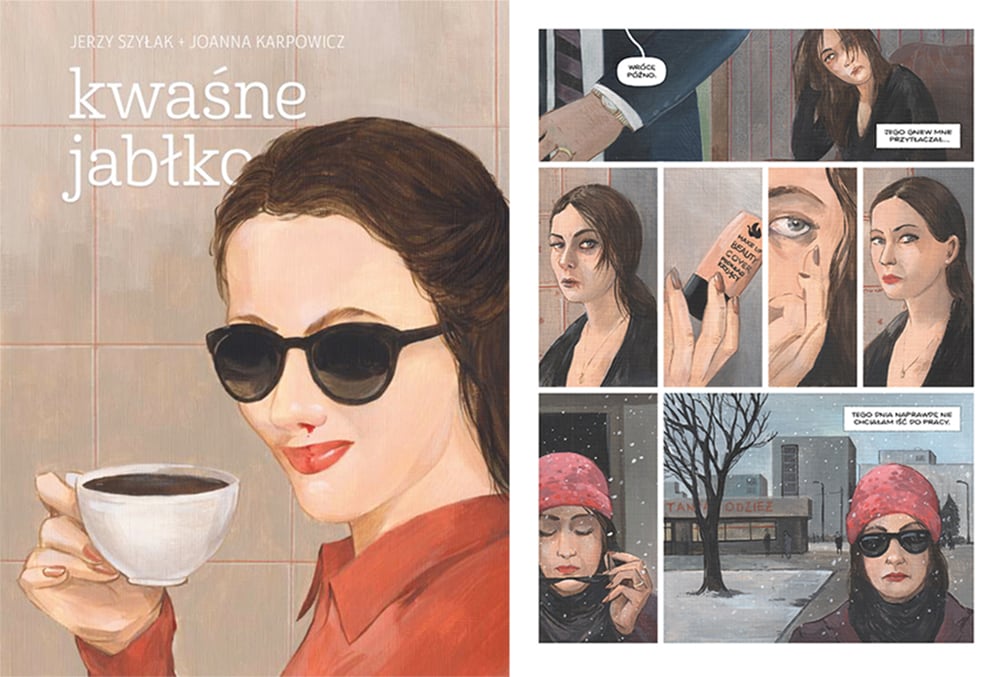
‘Kwaśne Jabłko’ (Sour Apple) by Jerzy Szyłak (script) & Joanna Karpowicz (artwork), published by Timof i Cisi Wspólnicy, photo: press materials
Joanna Karpowicz and Jerzy Szyłak's Kwaśne Jabłko (Sour Apple, published by Timof i Cisi Wspólnicy) is a comic that satisfied all the needs of lovers of realistic graphics and realistic narratives. This short but poignant story about domestic violence is primarily a showcase of the artist’s painting talent. Using classic techniques, her art transports us into the cramped interior of a young married couple's flat and forces us to look behind a mask of petty bourgeois rituals and drawn curtains at the catastrophic breakdown of their relationship. Kwaśne Jabłko consists of motionless film frames, moments of high tension frozen before the reader’s eyes, ruthlessly depicting a tragedy that befalls hundreds of thousands of Polish women every year.
About Poland
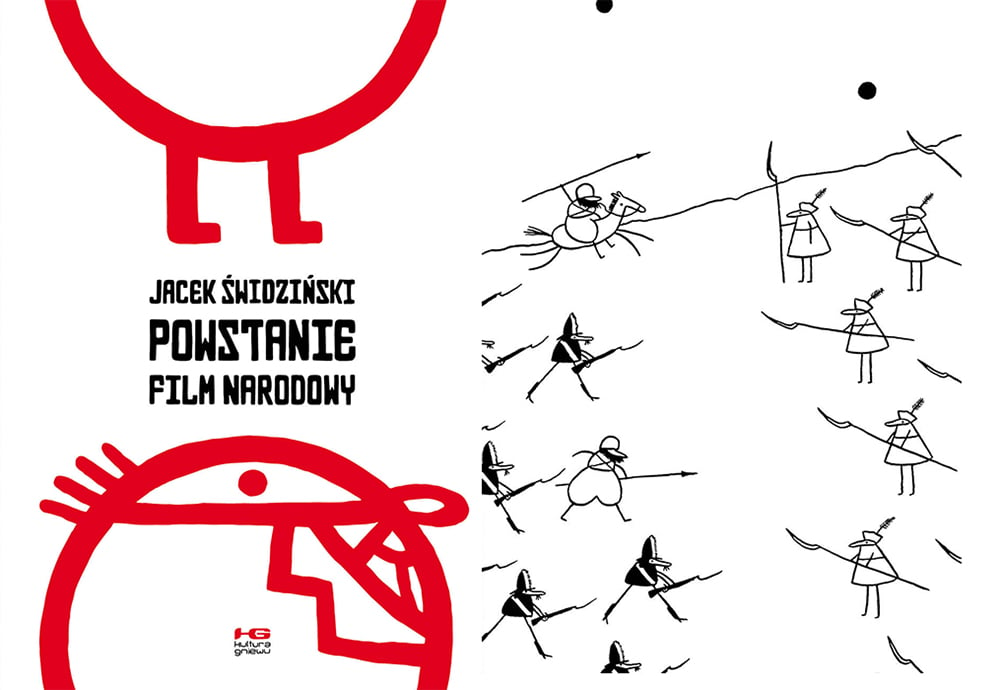
‘Powstanie: Film Narodowy’ (Uprising: The National Film) by Jacek Świdziński (script & drawings), published by Kultura Gniewu, photo: press materials
Several Polish comic works offer sharp criticism of Polish social issues. Two satirical comics are excellent examples of this: Powstanie: Film Narodowy (Uprising: The National Film) by Jacek Świdziński (published by Kultura Gniewu), and Tam, Gdzie Rosły Mirabelki (Where the Mirabelle Plums Grew) by Jan Mazur (published by Wydawnictwo Komiksowe).
The first of these comics is a multi-layered minimalist story from the set of the most expensive film in the history of Polish cinema, which turns out to be a total disaster driven by political and personal interests. Świdziński spares no one, mocking the absurdities that can arise at the intersection of politics and culture. At the same time, he brings his graphic style to perfection, showing once again how to tell funny, absurd stories using the most simplified means possible.
The extent to which his earlier works inspire subsequent Polish artists can be seen, among others, in Tam, Gdzie Rosły Mirabelki (Where the Mirabelle Plums Grew) by Jan Mazur – a comic book which uses a few anthropomorphised geometric figures to tell the story of the life of a typical ‘apartment block gang’. Although comics devoted to the lives of chavs have a long and rich tradition in Poland, this one brings a breath of fresh air to the genre, not only thanks to its simplified form, but also because it is not a simple classist satire about the victims of the economic crisis in medium-sized towns. At the same time, it’s also difficult to call it an apologist story about ‘street ethics’. Mazur finds a lot of understanding for his characters and their situation, and is also able to accurately identify the sources of their political sympathies.
Melon, hedgehogs & Adam Mickiewicz
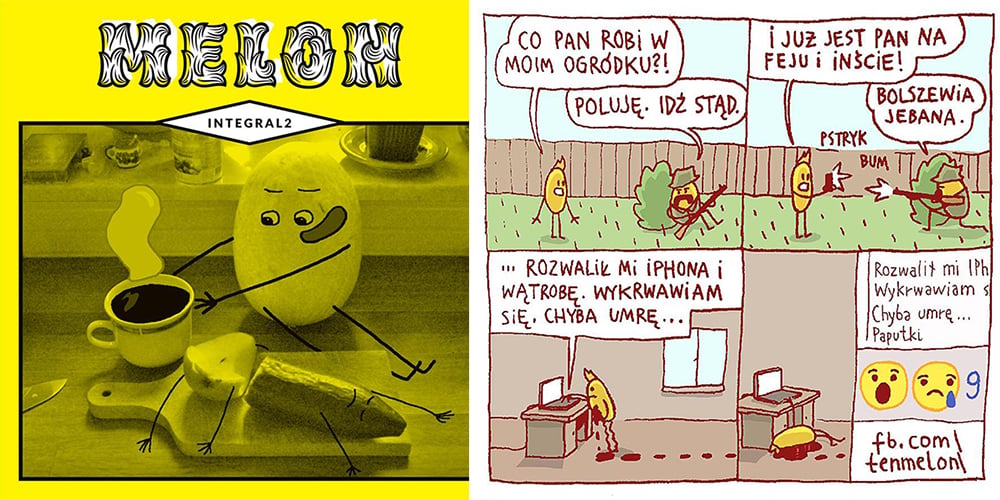
‘Melon – Integral 2’, published by Niezależne, photo: press materials
Polishness in all its forms is the bread and butter of Polish Internet comics, which comment on current events as they happen. These have increasingly crossed the digital barrier and found their way into readers' hands in paper form.
Among the most interesting publications is the second collection documenting the adventures of Melon. It is a collection of short, mostly four-frame jokes, often taking Polish flaws and vices to the point of absurdity.


