What is the link between the popular and the modular?
 Nicolas Grospierre, Yellow from the Kolorbloki series, 2009
Grospierre's Kolorbloki / Colorblocks elevates the status of modernist-era architecture to the iconic, focusing on residential buildings across Poland built according to a modular process and covered in colourful emalite glass. He's taken the modular aspect further, manipulating the images to juxtapose several buildings in an even panel of similar proportions, each of a different colour. The buildings are run-down, worn - and yet hold a certain charm for the photographer and the viewer, as relics of the past and tributes to modernist regularity.
How does fiction meet fantasy in architecture?
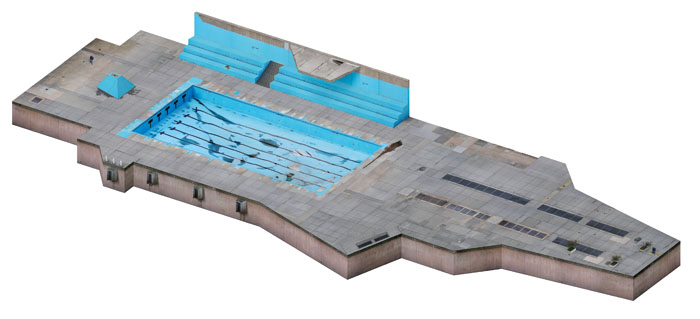 Nicolas Grospierre, K-Pool, 2011
Grospierre's K-Pool and Company project was inspired by Rem Koolhaas' Delirious New York, a story about a group of avant-garde Russian architects who build a floating swimming pool to transport them selves to New York City. The trip ultimately takes 40 years and they arrive to find the architectural modernism they had been striving for long dead. Upon discovering the swimming pool in Brooklyn, designed by Morris Lapidus in the late 1950s, Grospierre revived Koolhas' fantasy, juxtaposing the unusual geometric planes of that pool with images of the most unusual achievements of Soviet-era.
How far can architectural liberalism reach?
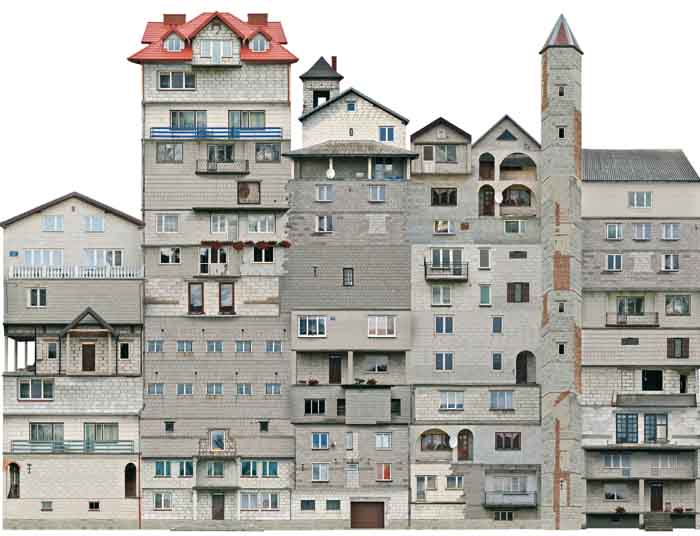 Nicolas Grospierre, The House which Grows, 2012
The project is a tongue-in-cheek commentary on architectural chaos that reigns through the Polish countryside, with little governmental regulation of the urban-planning sort. Homeowners launch home construction then halt just shy of finishing their dream house - then years later they add on rooms, then again a few years later. The House which Grows plays with this convention, starting with a basic single-family home and adding on in post-production as many wings, annexes, accents and additional abodes as the heart desires.
What has become of the Modernist Fantasy?
 The Museum of Archeology, Tibilisi, 2006
This image of the Museum of Archeology in Tibilisi is also part of Grospierre's K-Pool and Company. It is part of a series of stark images of far-out structures designed by some of the most ambitious architects of socialist-style modernism.
At what point do architecture and coercion intersect?
 Nicolas Grospierre, The Embassy, 2008
The image is part of a series of fiction photographs of no-longer-existing embassies of former socialist states in the Soviet bloc. The images are authentic, yet modified by Grospierre to create a sense of confusion in the viewer considering these empty, claustrophobic spaces of Cold War diplomacy. This sense of confusion is at the heart of manipulative tactics that lay at the heart of socialist propaganda.
What is the paradox between geometry and perspective?
 Nicolas Grospierre, Wolkenbrasil, Axonometry, 2012
Grospierre has taken the axonometric technique to create abstract views of socialist-style architecture. Their simplicity allows the viewer to appreciate pure, geometric planes of these structures. This image is inspired by the never-built "horizontal" housing estate designed by Russian avant-garde artist El Lissitzky in Moscow, based on structures in Brasilia. Once again, lofty fantasies of socialism face off with realities of modernist architecture around the world.
Wherein lies the beauty of infinity?
 Nicolas Grospierre, The Never-Ending Corridor of Books from The Library series, 2006
Grospierre's Library does not refer to a specific library per se, but rather to the idea of a library per Jorge Luis Borges' ficitonal The Library of Babel and the concept of infinite knowledge. This particular image, of an endless corridor of books, was created by simply placing two photographs of bookshelves into a lightbox fitted with mirrors. The image plays upon a very human tendency of revering books and knowledge, while at the same time representing how truly vast the store of knowledge contained within these books is - and how this knowledge continues to grow with each subsequent discovery, each relevant publication.
Can one expand an image without changing its size?
 Nicolas Grospierre, installation #536 from The Picture Which Grows series, 2011
Once again taking up the techniques of replication and manipulation to create an astounding, enigmatic, meaningful image, Grospierre's subject is the former workspace of photographer Tadeusz Sumiński. As Grospierre puts it, his method introduces chaos into the characteristic order of this space, "sowing the seeds of entropy in the motionless world of the archives of a late photographer: the order of a photographic archive overcome by photography itself".
Grospierre took hundreds of photographs of the studio, each time adding a new photograph (from Sumiński's archive or his own previous shots of the space) within the composition and expanding the picture ad infinitum. The result is a captivating image that is realistic yet full of abstraction.
How durable is the assumption of financial security?
 Nicolas Grospierre, The Safe from The Bank" series, 2009
In this series, images of bank vaults are presented as a metaphor for wealth and potential deceit inherent in the financial industry. This notion is particularly relevant in our times of fiscal crisis, when the imposing structures (architectural and procedural) of global financial institutions often hold little equity and are often riddled with debt. The intrigue of what is behind the vault door and the invitation to explore are at the heart of this installation, which plays with the viewer's curiosity and preconceived notions of security and well-being.
How much authenticity can a replica convey?
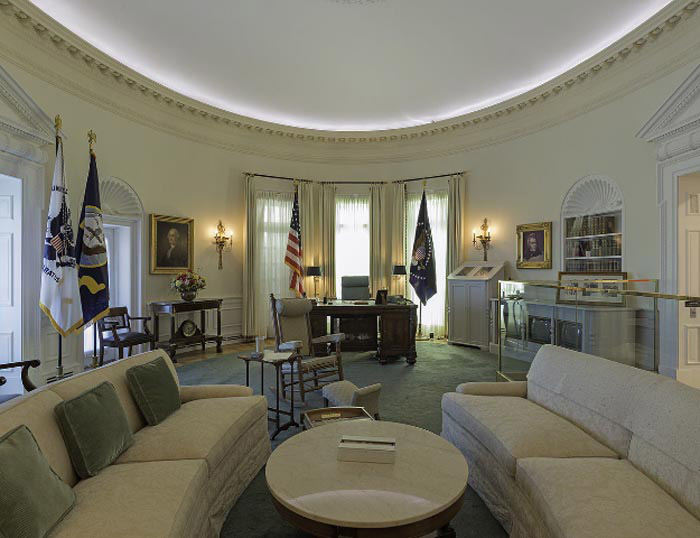 Nicolas Grospierre, photograph from the Oval Offices series, 2013. Lyndon B. Johnson Presidential Library and Museum, Austin, Texas
Grospierre takes Umberto Eco's Travels in Hyperreality as his guide in exploring the significance of the Oval Office for political culture in the U.S. To date, there have been 27 Oval Office replicas in the U.S. (5 have been destroyed, 1 is under construction), in addition to replicas created as film sets. Grospierre traveled around the U.S. snapping all varieties of these replicas to create a statement that subtly underscores the performative aspects of power in architecture and design through history - and the processes of replicating structures of presidential authority. At the same time it shows how a replica can also diminish the symbolic power of an iconic object, place or image.
Nicolas Grospierre is a photographer and experimental artist born in Geneva in 1975. He grew up in France and has been living in Poland since 1999. As a photographer he focuses on documentary projects, drawing out conceptual problematic aspects inherent in his subjects. His works often take up the issue of collective memory and utopoian aspirations - expired and existing.

Photographs 1-9 come from Open-Ended, an album of works by Nicolas Grospierre from 2004-2012, published in 2013 with supplementary texts by David Crowley, Adam Mazur and Tomasz Plata, courtesy of JOVIS publishers. For more on the publication, see: www.jovis.de
Photograph 10, the latest of Grospierre's works, was provided courtesy of the artist.
Editor: Agnes Monod-Gayraud
11.07.2013