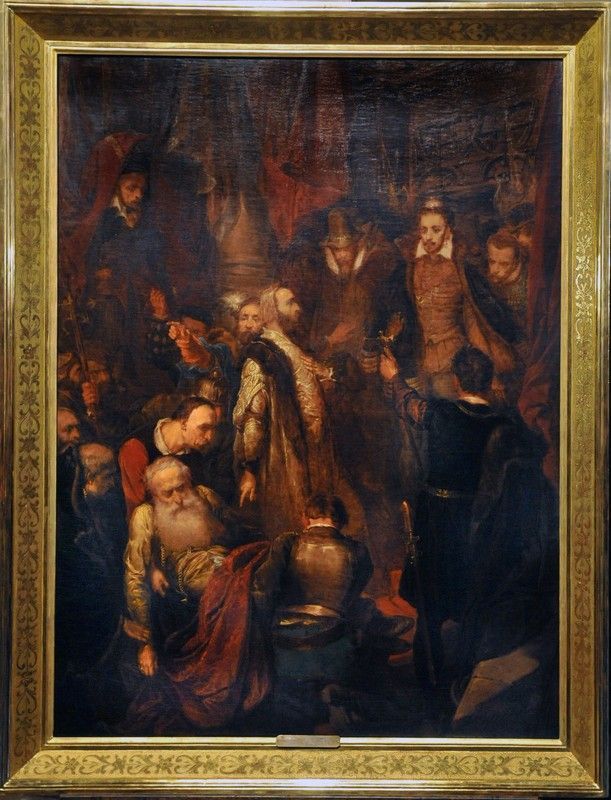
Wapowski’s Killing by Jan Matejko. 1861, oil on canvas,132 x 101 cm. Photo: Wacław Klag/REPORTER/East News
Wapowski’s Killing by Polish painter Jan Matejko was believed to have been lost without a trace until a private source recovered the work. After extensive restoration works, the painting is on display this month at the Royal Wawel Castle
The painting, which dates back to the artist’s early creative period, was recovered by the Connaisseur gallery in Kraków. They have not revealed how they came upon the work, only the fact that it was found abroad. The search for the painting, which was finished by Matejko in 1861, lasted several years. It has undergone restoration at the hands of specialists at the Royal Wawel Castle. Restoration works were led by Ewa Wilkojc, who explained that the process entailed removing the recoating and retouching the places in which the colour had faded. The edges of the painting were reinforced with belts. The painting’s face was retouched and treated with finishing varnish.
The 132cmX101cm oil painting portrays a scene which played out in one of the chambers of Wawel’s Royal Castle in 1574. The quarrel between Samuel Zborowski and Jan Teczynski, erupted amidst the tournament in honor of the coronation of Henryk Walezy. The castellan of Przemysl, Andrzej Wapowski who was accompanying Teczynski was stabbed in the head with a pickax by Zborowski. Castellan’s killer was banished and ten years later, during the reign of Stefan Batory, he was sentenced to death. He was executed on May 26th, 1584.
The painter portrays the moment during which the mortally wounded Wapowski is brought before the king. Visible in the foreground is a group with Wapowski. Pleading with the king for a just verdict in the center, stands Jan Teczynski, and to his right the perpetrator Samuel Zborowski wielding the pickax.
Matejko finished this painting at 23 years old, years before his most outstanding accomplishment, The Battle of Grunwald. Even in his youth, his contemporaries readily recognised the historical knowledge and his superb workmanship behind the work.
Agnieszka Janczyk, the curator of the painting department at the Wawel’s Royal Castle explains that
Overcrowding was the only sustained objection faced by the very young painter, which some reviews described as his making the most of the space of the canvas. Matejko was praised for great use of colour and successful portrayal of characters. The artist already paid great attention to detail in costumes and weapons, which was visible and admired in his later works.
Wapowski’s Killing during the Coronation of Henryk Walezy was first shown in 1861 at the Society for friends of Fine Arts in Kraków. The canvas was purchased by the president of the Society, Prince Wladyslaw Sanguszko. In 1883, the painting was on display at the Wawel Castle, during the Matejko’s anniversary exhibition. The last time audiences were able to view it was in 1894 at the Matejko’s Pavilion in Lviv.
If the painting finds sponsors willing to purchase it, it has a chance to make it to one of the Polish museums. According to the Director of Wawel’s Royal Castle, professor Jan K. Ostrowski, this work of art should either end up at Kraków's Jan Matejko House (a division of the city's National Museum), to another institution with a collection of works by the artist, or to a smaller museum which could build its collection around this work of art.
Wapowski’s Killing during the Crowning of Henryk Walezy is on display at Wawel Royal Castle from January 10th until January 22nd 2012.
Zamek Królewski na Wawelu - Państwowe Zbiory Sztuki
ul. Wawel 5
31-001 Kraków
Tel: (+48 12) 422 51 55
Fax: (+48 12) 422 19 50
www.wawel.krakow.pl
Source: PAP