Bruszewski also constructed objects and installations that reacted to sounds or images. At the open air in Osieki in 1972 he gave a lecture in a room, which was lighted with only one light bulb. It reacted to the volume of the speaker's voice – silence meant darkness, shouting – maximum brightness (When I Speak). Television Hen (1979) was a device that generated a hen's cackle. The animal's sound changed depending on the content of the image shown by the television screen.
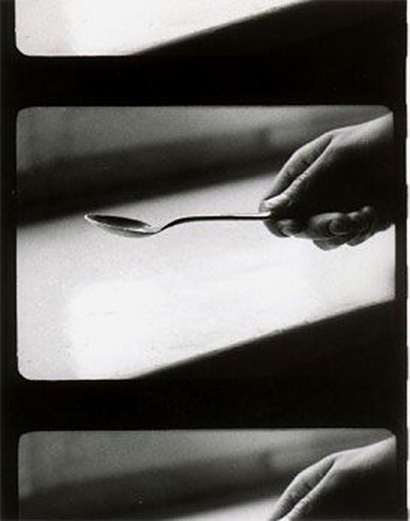
Wojciech Bruszewski, Łyżeczka / Teaspoon, photo courtesy of the artist
Since the seventies Bruszewski also researched the relations between objects and their representations, creating "images in images". The Installation for the Labyrinth Gallery (1976) and the film Glasses (1982) (photographs) were such realisations. In Glasses the artist registered knocking on glasses and knocking on the television screen, which showed their image. Bruszewski also analyzed the photographic medium. Photographs on Canvas (1979) (photograph) are an example of this analysis - the piece is made of prints of photographs of a canvas stretched across a frame, made on photographic canvas, also stretched across a frame.
One of the most important motifs of Bruszewski's works was the problem of language as New Words a structure [YYAA 1973 (see photo)] and its material qualities [Text 1970 (see photo)]. In 1972 the artist created a simple, little machine from rotating blocks with letters, which enabled the creation of two hundred fifty six non-existing words (New Words 1972). A board built from fluorescent tubes, in which an electronic system systematically created rhymed poems from new words, worked on a similar principle [Poetical Machine 1982 (photographs)].
From the mid-eighties onwards Bruszewski began working with a computer (at first it was an Amiga), treating programming as one of the art forms. He was among the only Poles to do so. Continuing his earlier creative activities, in the nineties Bruszewski created a computer program that generated sonnets in an nonexistent language. The poems fulfilled all the necessary grammatical and formal requirements (Leipzig Sonnets 1992, Wrocław Sonnets 1993, Budapest Sonnets 1996). The artist emphasised that "Contrary to 'regular' poetry, which comprises a combinatorics of a limited amount of words, Sonnets are written in an absolute language, offering the reader a dazzling vocabulary".
In 1992 his Sonnets were published in eight consecutive volumes and in the year 2000 a recitation of one of them by Leon Niemczyk took place, which was documented by the artist.


