Table of contents:
Background | Maat Projekt Theatre | Oriental inspirations | Inderdisciplinarity | Solo practice
Tomasz Bazan is one of the versatile, extraordinarily active performative artists of the young generation. He combines an intense mastery of various movement techniques with literary erudition and theoretical awareness, which makes him not only a recognizable figure in the theatre and dance milieu, but also an influential animator of various artistic events.
Background
He graduated in Cultural Studies at the Maria Skłodowska Curie University in Lublin (specialization: critique and animation of visual arts events). For a year, he has been a student of Jean Marco, French painter and stage designer. He studied dance and movement techniques under renowned dancers and martial art masters, like Nam Hai Bui Ngoc, Yuri Pstrovski, Witold Jurewicz, Monika Tachman, Shizamitu Tienn, Łukasz Maziarczyk, Gabriell Daris, Atsushi Takenouchi, Sylwia Hanff. For years, he has studied and practices Asian martial-arts styles; he specializes in Lang and Vietnam Dao styles. His experience in theatre spans years - he collaborated with the Gardzienice Centre For Theatre Practices, Chorea Theatre Association, International Theatre Art of Now, Compagne le Sablier, Les Kurbas Theatre in Lviv, Dance Art Now in London and the Great Theatre in Warsaw. Aside from his own performances, he collaborates with distinguished theatre directors and actors - but it is widely understood that dance remains the main current of his activity.
Maat Projekt Theatre: Dance in flux
Since 2004, he has been directing the Maat Projekt Theatre, which is considered one of the most significant dance collectives in Poland. From 2009 Bazan has been the founder and curator of the International Experimental Dance and Movement Festival MAAT FESTIVAL which is to present the newest performances by the exceptional dancers. In the theatre he applies his own programme of physical training and cultural pursuits. The aim of the group's activities is "an attempt at finding pure body language and its limits through a syntesis of many qualities from the borderland of visual and performative arts, but applied to theatre," write group members.
We work with the human body and in it, we search an answer to questions asked in our actions and performances, using its entire complexity and all its limitations. We look for energies which move the bodily tissue - we distill and observe them; techniques becomes as important as secondary. While constellations of our group change, our performances emerge from a common experience of presence and closeness.
The artistic phenomenon of Bazan's theatre stems from a special combination of physical techniques with a pursuit of individual emotional expression. In group's performances, "intuitive dance" coexists with "searching an European context for Japanese butoh". The Maat Theatre, present at international festivals, continues an interdisciplinary and intercultural dialogue: as its creator says, the theatre's formula is based on group meetings and collaborations with people of culture, science and art.
Over the years, the formation created a number of projects including plays, happenings, collective installations, performances presented in prestigious venues in Poland and abroad, eg. in Germany, USA, Norway, France, Slovenia, UK, Belgium and Israel.
Oriental inspirations
Bazan declares that, despite his fascination with Eastern philosophy, he is aware of its inevitable foreignness to someone who was brought up in this part of the world.
This fascination is caused by a certain need to pause. It's an idyllic hideaway from everything our civilization brings and more of a dream than a settled adoption of a philosophy. Adopting Eastern philosophy fully is impossible in our culture. There, the space of artist's activity expands beyond the limits of art itself: aesthetics alone are empty. In my opinion, considering art from an aesthetic point of view is pointless. Form for its own sake doesn't bring anything new. I value everything which is true and fair, what emerges directly from the dancer's heart, and finds its form thanks to dancer's technique.
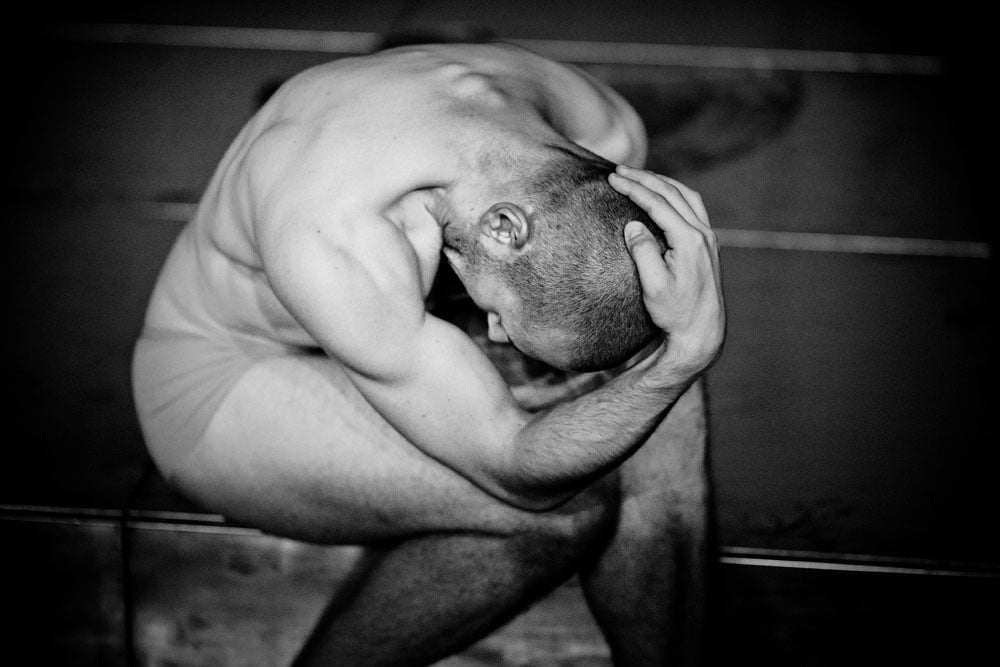
Tomasz Bazan in the performance Wyspy/Islands, photo: Tomasz Tyndyk/ Nowy Theatre
Eastern fascinations led him to an interest in Japanese theatre. The shortest definition of butoh dance includes everything that we can find in dance in general: remodeling oneself and turning one's own body into a metamorphosis. As Jadwiga Majewska wrote in Teatr magazine:
Possibilities and consequences of Polish-Asian inspirations are not an exception on the Polish scene; quite on the contrary, they seem to fit in the main current of the 'Polish theatre of metamorphosis' (according to Dariusz Kosiński) in which actions of the artist-performer cross the aesthetic horizon towards the human psyche, or even an intervention into its metaphysical root. The motif of death appears in butoh as often as in Słowacki's or Kantor's theatre. Death is a natural part of individual life as well as of the nation's historical memory. The Japanese have their wartime humiliation, the hecatomb of Hiroshima and Nagasaki. Poles celebrate failed uprisings, enslavement and bloodshed of war. Tomasz Bazan seems, through his practice of 'Japanese theatre' and Eastern 'carnal meditations' , to extract them from the deepest layers of Polish Romanticism, not paradoxically at all. Polish butoh dwells in the slightly abstract zone of a suffering spirit, in search of unity between body and mind (as consistently done by Sylwia Hanff), sometimes referring to Buddhist and Orthodox meditational practices (Tomasz Bazan), and through this, it somewhat instinctively approaches the Romantic roots of Polish theatre" . (Jadwiga Majewska, "Between the Rebellion of Reason and the Humility of Existence", Teatr, 12/2010).
Interdisciplinary links
Bodily expression's leading role is usually balanced in Bazan's works with erudite literary inspiration. Plays he created were based on themes from the works of Goethe, Beckett, Pinter, Kane, Białoszewski. Apart from that, one can notice an inspiration with Russian folklore and Orthodox spirituality, as well as returning echoes of the Holocaust and contemporary philosophy and popular culture references.
Inductions is one of the most recent works by the Maat Projekt Theatre. According to Bartłomiej Oleszek, it's an alternative hybrid: a performer acts alongside an actor, we watch a naked body and faces mediated via multimedia presentations; the viewer sits in the audience together with the camera operator, who wanders through theatrical actions, dance collides with word, movement with lack thereof. All these elements, despite escaping straightforwardness, created a homogenous and consistent performance. It eludes commentators - even those in possession of knowledge about Greek hesychia, which inspired the choreographic concept. Brian Raczynski adds that the performance breaks the limits of the classic dance theatre concept, finding a place between dance play, drama theatre and perfrormance art, happening here and now, with our involvement.
The characters in the play are two men - fictional figures as well as real performers; the fascinating personalities of Bazan the dancer and Jacek Poniedziałek, the dramatic actor, become involved a game of meanings taking place onstage. It soon emerges that both men represent two levels of the same personality. The former communicates with the viewer using words: he says his more or less important lines in a chaotic manner - he represents the 'outside'. The latter uses body language, expressing his tiredness, maladjustment, attempts at liberating himself from the conventional. He does it through dance, movement and complex, but perfectly mastered body position and hand gestures (even the fingers). He refers to the 'inside'. Marian Milczarewski in his review wrote about the performance:
This choreography constrained to minimal scope of movement compiled with a moving body focused in a process and crossing in the physical way, was an effect of a meeting of Tomasz Bazan and Honzu Takamoru. The artists spent several days improvising on the streets of Berlin and creating outline of a choreography focusing on observations: looking at what comes to live from the inside and what comes from the outside. A compilation of movement sequences has been established, resulting directly from the municipal space. By his re-adaptation, Tomasz Bazan (Hoznu Takamoru after and injury and long rehabilitation has not come back to dancing) creates a movement lab, which, by using conceptual model of choreography, touches issues of emptiness, loneliness, and identity. In the spectacle one can find influences from both classical ballet and butoh dance.
An earlier work of Bazan (as choreographer and dancer) developed a similar idea. In a play directed by Ewa Wyskoczyl, two actors represent two theatrical aesthetics: dramatic theatre (Piotr Trojan) and dance theatre (Bazan). Two texts, as different as Goethe's Romantic ballad The Elf King and Miron Białoszewski's prose Szumy, zlepy, ciągi (Rustlings, Lumps and Pathways). Literature works here as an inspiration, a reason to show how a human being can be enslaved by language, how little speech can matter and how devoid of meaning it can be - emptying also interpersonal relationships. These relationships, as shown in the play, become a competition for power and limits of one's own territory, creation of which makes it impossible to know another person. Relations emerging in such conditions are based on supremacy, and strength becomes the law.

