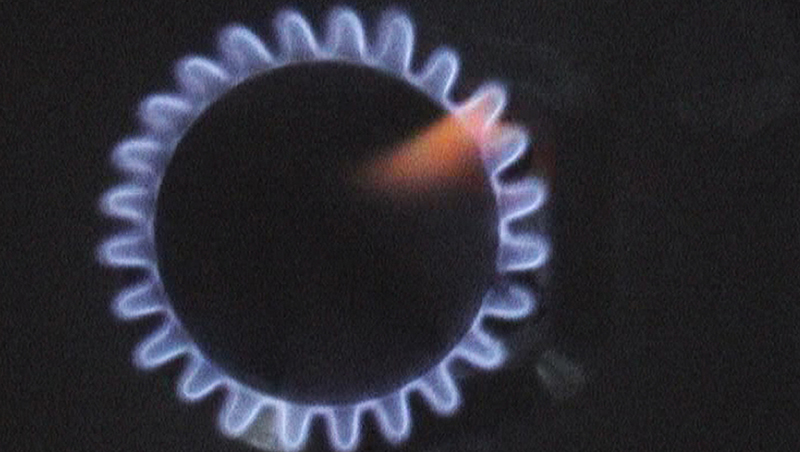
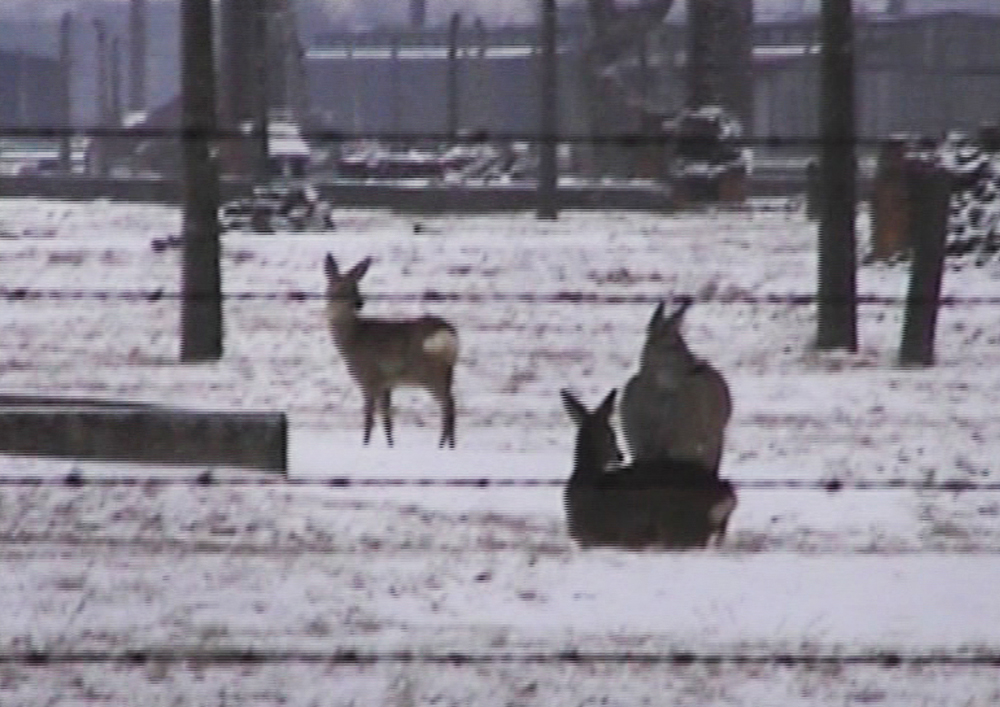
It was the first retrospective and comprehensive exhibition of Bałka's video work. It presented his film installations from the last twelve years of his career: from the oldest, made in 1998, to the latest, from 2010, presented for the first time to the public. The exhibition included the best-known films that have already become the classics of modern art, such as Winterreise (2003), Carrousel (2004), which was purchased in 2010 by the Tate Modern for its collection and BlueGasEyes (2004). The audience had a chance to see lesser - known works as well as entirely new creations, notably Bottom (1999/2003) Narayama (2002), Michelangelo Buonarotti Reading (2004), Flagellare A, B, C (2009), and Apple T. (2009/2010). All video installations were displayed in a dimly-lighted rooms carefully designed by the artist. The screens were mounted at different angles on the walls and floor. Some of the videos were screened on surfaces covered with salt. Bałka's short and minimalist film installations last from few to several seconds. The artist is reluctant to long and extensive film forms.
My understanding of art is closer to the essence of a haiku or to Białoszewskis' 'noises, patchworks, strings', and not, to Sienkiewicz. Video is like a vacuum that sucks in everything - he says.
The exhibition was also shown at the Akademie der Künste in Berlin (2011) and at the Centre for Contemporary Art Vinzavod in Moscow (2013). Due to the artist's announced departure from video art, the show can be seen as the summary of Bałka's work with this medium.
In 2015 Bałka’s works went on a show at the Art Museum in Łódź. The exhibition Mirosław Bałka: Nerve. Construction was the first extensive presentation of the artist’s works in Poland, which brought together works created over the period of three decades complemented by a selection of works on paper: drawings, sketches for sculptures, private notes many of which were presented to the public for the first time.
CROSSOVER/S is the first Italian retrospective of Bałka’s work. It opened at Pirelli Hangar Bicocca in Milan in 2017 and brought together a total of 18 sculptures, installations, and videos created by the artist throughout the last 20 years. CROSSOVER/S led visitors through an immersive journey full of physical, symbolic, and temporal intersections, where light and darkness took on a key role and where visitors were invited to experience the featured works with all their senses.
That same year Bałka’s fourth show opened in Galleria Raffaella Cortese’s three exhibition spaces. This coincided with a time of great attention towards the artistʼs work since the opening of his retrospective. The exhibition was conceived as a journey in stages, spanning across three decades of Bałka’s artistic production, from the works created in the 1990s to those realised specifically for the gallery’s venues. It’s no accident that the German title of the show, In Bezug Auf Die Zei, is based on the definition of acceleration in physics, which is the increment of velocity in relation to a time interval. However, the artist is only interested in the second part of the definition, the eponymous ‘in relation to time’.
While planning the itinerary of the exhibition, Bałka decided to give special attention to crucial moments in his research. This is why viewers could witness the artist’s transition from figurative to abstract, which characterises the group of works executed between the end of the 1980s and the 1990s. Among them, the artwork Blue Wave (1990) takes a special place – it’s Bałka’s first piece to feature salt as a component. Since then, salt has often been used in his sculptures for its symbolic meaning, as an extremely beautiful material that is also capable of inflicting pain upon touching an open wound.
The materials used by Mirosław Bałka – wood, salt, ash, iron, soap, and wine – reside on the thin line between everyday life and the space of rituals. The exposition in area no. 1 included three new pieces created by Bałka. They are based on a compilation of materials and objects which have been accompanying the artist for years – lying in the garden, on his desk, or hanging on walls. One of them, titled 250 x 14 x 13, consists of a glass tube filled with red wine resting on a granite pedestal. These works undoubtedly draw on a minimalistic perception of forms, but at the same time reveal attachment to gesture, significant combinations of materials – in this case granite and glass – and establishing physical contact with the viewer.
Bałka’s [(.;,:?! - ...)] (2017) is an installation created especially for the space of the central hall of the Silesian Museum, located 12 metres underground. The enormous sculpture made of trapezoidal sheets is actually a drawing developed into the third dimension. It represents an X-ray image of a chest with the exposed outline of its lungs. However, it is impossible to view this black-and-white negative photographic plate as a whole as windows spread along the three tall walls of the hall are covered with yellow panes allowing only a blurry outline of the work to be seen. It can glimpsed while walking along dark corridors of varied widths and temperatures. The installation refers to the place of its location – a post-mining area, hence the corridors resembling mining excavations. As with his previous work, Bałka directs viewers’ attention beyond the visual aspect of art. He focuses on the entire process of experiencing space, therefore, the sculpture consists in fact of several areas exposing the viewer to various sensations, freeing the imagination and providing opportunities for contemplation. The author referred to [(.;,:?! - ...)] as follows:
The area of my work is dedicated to feelings, senses, the sense of touch, smell. Vision is not the only instrument that informs us about the surrounding world. What is important in this work is moving around in its space.
Still, the sculpture left room for interpretation and reflection on the condition of the human body and the problems of the Silesian region, such as air pollution.