Małgorzata Sikorska-Miszczuk was born in Warsaw in 1964 and grew up in the People’s Republic of Poland (the PRL) under communism. She spent her early childhood in a small block of flats in a section of the Ochota neighborhood that was (at that time) on the edge of the city near a small lake that provided limitless opportunities for exploration and adventure.
When I was growing up, children were more or less allowed to run free. I was a tomboy, and loved to play rough games with boys, to curse, play soccer, build bonfires, and go on adventures in the surrounding countryside. One could really act without limits. I was free to run until my mother called me in for dinner. The city was more connected to nature than one might expect. There were constant encounters with wildlife including foxes, pheasants, hares, birds and other animals.
When she was seven years old, she discovered a nearby fur farm where minks were kept in cages. Together with a friend, they created an elaborate conspiracy to free the animals, but decided in the end that liberating them into the city would be a crueler fate than the one which already awaited them.
She left the wild edges of the city when she was nine, after her parents moved to an apartment in the center of Warsaw. There she could often be found walking her dog around the massive Stalinist Palace of Culture, or visiting the new Forum Hotel - 'The Big Chocolate Bar', or surreptitiously observing the prostitutes who worked the sidewalks on Wspólna Street. She began to read voraciously, Russian and Polish literature, but also books from America, and Western Europe.
I was aware that I lived in a different world - but for a child everything is normal. I read a lot, I understood that Western Europe was different, and that my school was a place for lying. I remember that I was obsessed at the time with Mario Puzo’s novel The Godfather.
Then, in 1975, when she was eleven years old, her father, who worked for a large state company, accepted a position in Moscow and brought his family to live with him. Małgorzata would spend the majority of her teen years there in the Soviet capital, in a block of flats reserved for foreigners while attending a special Polish high school where she learned Russian and studied literature.
My time in Moscow gave me a knowledge that was not comprehensible to my friends in Poland. I felt like I was always torn between two realities. Although everyone in Poland often said they were 'slaves groaning under the Russian boot' - they did not understand that Russia was a thousand times worse. Poland was, relatively, a country of laws, people could easily read foreign books and listen to Radio Free Europe, mostly without fear. In Russia, one could experience true totalitarianism - you felt it everywhere and personally. Everyone was brutal to each other, and to themselves. There was an energy of fear you could take in your hand. In Moscow, I learned that evil really exists, that people can do horrible things, and that poverty is not ennobling.
In between her studies, she often travelled home to Warsaw by train to visit family and friends and when she was older, was given the opportunity to travel by ship from Odessa through the Black Sea and on through to the Mediterranean to North Africa and Italy where she 'had a glimpse of the normal world.'
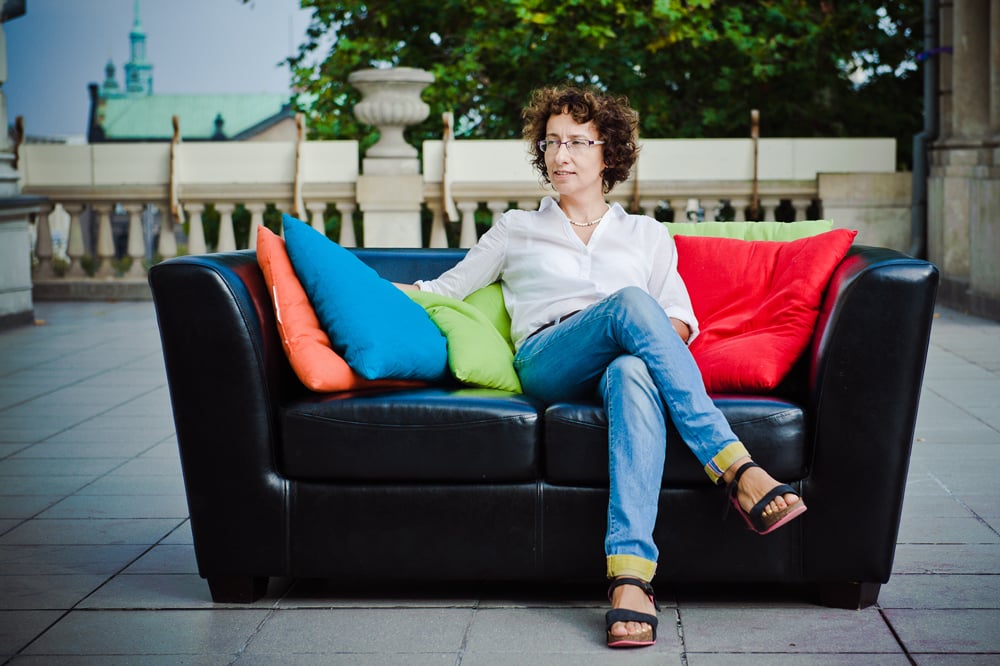
Małgorzata Sikorska-Miszczuk, photo: courtesy of the artist
After studying Journalism at Moscow University for a year, she returned to Warsaw to study Journalism at Warsaw University, just in time to witness the social upheaval of the solidarity movement and the implementation of Martial Law.
It was a dark time. I participated in demonstrations and attended meetings. Everyone was afraid of what might happen. I was also quite hated at times and was attacked for being the daughter of a 'red spider.' Although my father was a member of the party, he was not political, he simply wanted to have a stable life for his family. Later during martial law, many of my friends emigrated, often without even saying goodbye. It was a time of real despair, and I felt that only a miracle could change the situation.
When the unexpected miracle of 1989 came to pass, Małgorzata found herself in the brave new world of independent and capitalist Poland struggling to find a job in Poland’s chaotic new market economy. After graduation, she would pass through a rapid series of jobs, starting at the Ministry of Science editing a monthly journal, then on to a position as an editor at Egmont Ltd, a publisher of Disney cartoons, then as an account executive at the ITI Film Studio, and then to a series of advertising agencies where she settled down to a career writing advertising copy.
Through it all I understood that I was a writer. I was looking for a way to free my voice.
That opportunity came when she won a job writing for Polish Sesame Street. One of the head writers, Josh Selig, came from New York and trained the new Polish team on how to write for the program.
It was a formative experience. Josh was a brilliant teacher and had a way of finding gold out the rough material we created. He knew how to find a solution, and most importantly he gave me a method.
This opportunity gave Małgorzata confidence to pursue other writing opportunities. The first came with an animated film based on a graphic novel called Tytus, Romek and A’Tomek Among the Thieves of Dreams. Then on an impulse, she entered an open call for new writing from the theater TR Warszawa.
TR had an open call for new writers, but the age limit was thirty-five, and I was thirty-nine. I decided to enter anyway and wrote them a long and funny letter explaining that I was underdeveloped and that made me mentally much younger then I really was.
Małgorzata was accepted into the year-long program at a very fertile moment in the history of the theater. It would be the last year that both Grzegorz Jarzyna and Krzysztof Warlikowski would be working in the same theater at the same time. Writers and dramatists were brought in from the UK to mentor the Polish writers, and they were given time to rehearse and to work with the company of actors.
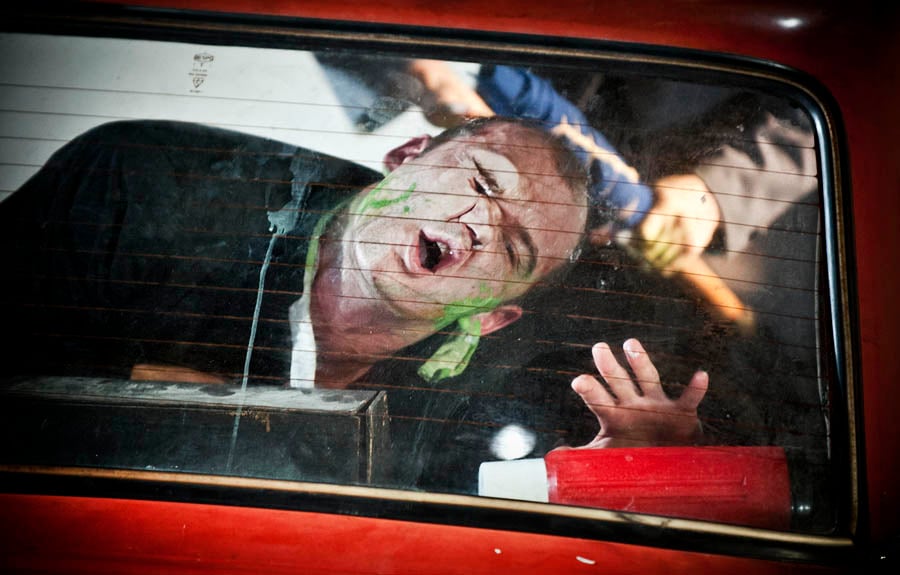
Photograph from the performance Popiełuszko by Małgorzata Sikorska-Miszczuk, directed by Paweł Łysak. Premiere: 9 June 2012 at Polski Thatre in Bydgoszcz.
This year of practice, classes, and criticism would give birth to her first fully realized play, The Death of the Squirrel Man, a piece about Ulrike Meinhof, the notorious left wing terrorist from the 1970’s Red Army Faction in Germany. The piece was financially supported by TR Warszawa and had a premiere directed by Marcin Liber at an off-theater in the Praga neighborhood of Warsaw. It would prove to be an important success, winning critical praise, traveling abroad to Germany and Romania, and launching her new career as a dramatist.
In The Squirrel Man I was interested in the person of Ulrike Meinhof, a woman who was able to completely transform her life - into an illegal life - to abandon her children and pursue a cause that I knew intimately from the other side of the wall.
This piece was followed in 2007 by Loose Screws, a darkly comic and surreal play that follows a pair of would be terrorists who seek to start a holy war in Poland by inspiring one of its smallest regional cultures to rise up and take over the nation. Peopled with ghosts of the victims of 9/11, a real expert of Polish dialects (Professor Bralczyk), and full of references to the Iraq war and Polish martyrology, this politically incorrect and comic play would have a successful premiere under the direction of Anna Trojanowska at the Laboratorium Dramatu and would later be translated and published in an anthology of plays in English under the same title.
I had discovered a new world - the theatre! and through it, discovered myself, and my voice.
During this time she became a regular participant in a yearly series of famous writing workshops held by the playwright Tadeusz Słobodzianek at his retreat in Wigry where playwrights, actors and directors would spend ten days in a workshop environment developing new material.
In 2009, she collaborated with the director Michał Zadara on a new play, Bruno Schulz, The Messiah, in Austria at the Schauspielhaus in Vienna. Written and then translated into German, this play would win critical praise and be honored with a prestigious Nestroy Award for the performance of the actor Max Mayer for his roles as Landau, Ficowski, and the Polish God.


