Between 1989 and 1994, Górna studied sculpture at the Fine Arts Academy in Warsaw in Professor Grzegorz Kowalski’s atelier. She lives and works in Warsaw.
Górna’s art is based on a female perspective on social reality and symbolical forms of the way a woman’s image functions in modern culture. The artist works with religious iconography and social stereotypes, sometimes empowering her protagonists. In her artistic output, which has deeply feminist roots, an evolution of thought is easy to notice, a passage from researching cultural symbols to a more precise, fighting, demanding demeanour. 'The woman’s gaze' is expressed not only as a reflection on the gender’s position but also as a deconstruction of the dominant masculinity. Górna chooses subjects that are difficult and often taboo.
The first works by Katarzyna Górna treated femininity very subtly. In 1993, together with Katarzyna Kozyra, she created the Kasie-niteczki (Kasie-threads) photo series, where both artists (called 'two Kasie from Warsaw' by Raster magazine) play naked while dying their hair. On one of the pictures they are connected with threads attached to their pubic hair. Kozyra was also a model in Górna’s untitled diploma in 1994. It was an installation made out of large photographs of a naked woman lighting a cigarette, hung in a circle and turned on the inside. The photos showed the next stages of her movement. Inside of the circle a sheet made of shaving foam was placed with a small gas flame. As Krzysztof Żwirblis wrote about this work:
Autotoxication and naked peace around a metaphorical peep-show.
Górna's later realizations turned more and more to feminist reflection. The photo installation Dziesięć panien (Ten Maidens, 1995) was composed of photographs of naked women. They had a private character, it was easy to notice that the models were ashamed of their naked bodies, the photos didn’t follow patterns known from advertisements or the erotic industry. Before the photographs the author put night gowns made out of paper – a symbol of innocence, purity, virginity made out of a material that could suggest a temporariness of that state. The work was completed by ultrasounds of all of the women, showing that half of them were pregnant. Górna didn’t give an answer to the question which maidens were wise and which were foolish.
In the work Aniołek, różyczka, rybka (Angel, rose, fish, 1995) the artist confronted black and white photos of women laying on their backs, girls during puberty and women’s genitals. They were formed into three five-sided columns. The title ironically referenced the erotic sphere – each of the words is used both as a pet name and as a term for women’s genitalia.
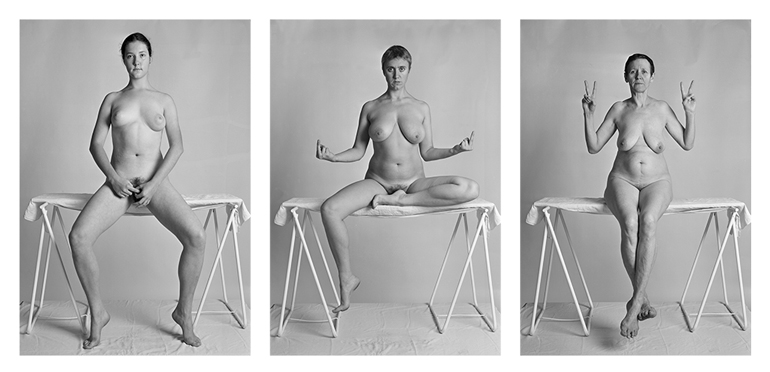
Katarzyna Górna, Fuck me, Fuck you, Peace, photo trilogy, source: MOCAK / www.mocak.pl
Górna’s most famous work is the MadonnY photo series (1996-2001), where the artist used iconographic schemes taken out of religious art. She confronted motifs from old paintings and sculptures with modern, naked protagonists, using a medium unusual for religious works of art. The most frequently exhibited and reproduced of these is the trilogy of photos referencing the Beautiful Madonna, Madonna with Child and Pieta. The first one shows a young woman in a pose reminiscent of Venus from Botticelli’s painting. Blood flows down her leg – by underlining carnality and physiology Górna breaks with the tradition of classical act. In the travesty of Pieta a woman holds in her arms the body of a smiling man with a visible erection. The couple can be interpreted both as lovers and as mother and son. In MadonnY Górna creates an image of womanhood absent from mainstream culture – a woman armed with a physical body, self-conscious, dominating. At the same time three iconographical motifs also reference three moments in a woman’s life. The same goes for the trilogy Fuck Me, Fuck You, Peace (2000), where models of different ages make the gestures mentioned in the title, as if the artist wanted to show changing needs but also changing sources of their force and motivation. The mere fact of underlining that women can make independent decisions is already meaningful.
In the film Sumo (2003) women in white underpants pose as competitors in this Japanese martial art, at the same time shouting sentences coming from a more or less radical feminist discourse. Some interpret this film as a claim for taking a firm position in the gender conflict and a story about female power, others, as showing the ambiguity of extreme positions.
We observe monsters, lost between symbols, losing contact both with what is weak and with what is strong.
– writes Maria Anna Potocka
If there are any men on Katarzyna Górna’s photos, they are usually weak and treated ironically (as on the series Portret męski z białym królikiem w ręku na tle pejzażu polskiego (A Man’s Portrait with a White Rabbit in Hand on a Polish Landscape, 1996). In the work 2,5 nosa w penisie (2.5 Noses in a Penis, 2001), the artist decided to scrutinize men and rate them the same way women are rated – through the sizes of their body parts, touching their weak points and complexes. In the series the artist measures penises and noses of the models, checking the authenticity of one of the prejudices about male organs. Górna doesn’t only make fun of men themselves (even though a role-swapping is obvious), but also of the discourse which places organ size as determinant in the hierarchy.
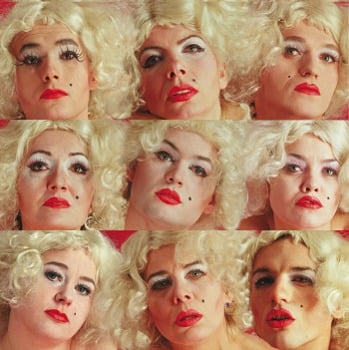
Katarzyna Górna, Marilyn
Katarzyna Górna’s works from the years 2004-2005 are very different. The artist started using colour photography and film, and also started her research on gender transgression and the phenomenon of gender as a performative act, usually using clichés and icons of popular culture. In the film Happy Birthday Mr. President (2004) men and women dressed up as Marilyn Monroe (it's not always possible to tell their real sex) sing a song, mimicking the original performance of the Hollywood star for President Kennedy. In Lille in 2004, the artist organized Warsztaty dla kobiet, które chciały być Freddiem Mercurym (Workshops for Women who Wanted to be Freddie Mercury). In both of these works the limits of gender stop being visible. Gender becomes a costume also in the series of photos Różowe (Pink, 2004), where a couple of ballet dancers prepares for the performance. The outfits and heavy make-up make them similar to each other. The film Barbie Bar (2005) was shot by Górna in a gay club. Nearly-naked men pole-dance and perform on stage, wearing gaudy accessories.
In 2006 during an exhibition in Kronika Gallery in Bytom, Katarzyna Górna presented Zdjęcia rodzinne (Family Pictures). In spite of modern outfits the pictures looked as if they were taken out of an old bourgeois album. The artist achieved this effect through specific framing and a way of portraying inspired by August Sander. Some of the works were collages of her own photos and the portraits by the famous German photographer. This way Górna revived memory about people who once lived in the building of the gallery.
All titles translated by the editors.
Author: Karol Sienkiewicz, November 2006, translated by N. Mętrak-Ruda, October 2015.
Selected solo exhibitions:
- 1994 - Instalacja / Installation, a.r.t. Gallery, Płock
- 1995 - 10 Panien / 10 Maidens, Przyjaciół A.R. Gallery, Warsaw; a.r.t. Gallery, Płock (1996);
- 1997 - MadonnY, Laboratorium Gallery, Centre for Contemporary Art at Ujazdowski Castle, Warsaw
- 2000 - Zestaw kobiet / A Set of Women, Wyspa Gallery, Gdańsk;
- 2004 - Happy Birthday, Bunkier Sztuki, Kraków; Arsenał City Gallery, Poznań (2005); Łaźnia Centre for Contemporary Art, Gdańsk (2005).
Selected group exhibitions:
- 1991 - Kardynał, Wieczerza / Cardinal, Supper, Dziekanka Gallery, Warsaw
- 1992 - Pracownia Jerzego Stajudy - rysunek / Jerzy Stajuda's Atelier - drawing, a.r.t. Gallery,Płock;
- 1995 - Transhumacja / Transhumation, Galeria Obrazów, Kaunas, Lithuania;
- 1996 - Ja i AIDS / Me and AIDS, Czereja Gallery, Warsaw; a.r.t. Gallery, Płock; Stowarzyszenie Artystyczne Wieża Ciśnień, Bydgoszcz; Wyspa Gallery, Gdańsk; A.R. Gallery, Warszawa; Xawery Dunikowski Museum, Królikarnia, Warsaw; Status quo, Centre for Polish Sculpture, Orońsko; National Museum, Warsaw;
- 1997 - Dreamlife, Artspace Gallery, New Heaven, USA; Fotografia '97 / Photography '97, Art Palace, Kraków; Nowe terytorium ekspresji / New Territory of Expression, Centre for Modern Art at Ujazdowski Castle, Warsaw;
- 1998 - Parteitag, a.r.t. Gallery, Płock; BWA Gallery, Katowice (1999);
- 1999 - Generacje. Sztuka polska końca/początku wieku / Generations. Polish art of the end/beginning of the century, Sankt Petersburg, Russia;
- 2000 - SEXXX, Academia Theatre, ul. Inżynierska 3, Warsaw, a.r.t. Gallery, Płock (2001);
- 2001 - Co widzi trupa wyszklona źrenica / What does the glazed pupil of the dead man see, Academia Theatre, Warsaw; Zachęta Gallery, Warszawa (2002); Leon Wyczułkowski Museum, Bydgoszcz (2003); Irreligia, Atelier 340, Brussels, Belgium; International Art Collection, "Międzynarodowa Kolekcja Sztuki", Centre for Modern Art at Ujazdowski Castle, Warsaw;
- 2002 - Polska / Poland, Academia Theatre, Warsaw; Aktuelle Fotokunst aus Polen, Fotohof Galerie, Salzburg, Austria; Sex, sztuka i kasety video / Sex, art and video tapes, Modelarnia, Gdańsk; Sposób na życie / A way of life, Łaźnia Centre for Contemporary Art, Gdańsk;
- 2003 - Integracja / Integration, Program Gallery, Warsaw; L'histoire d'une collection 1979-2003, Atelier 340, Brussels, Belgium; Biały Mazur / White Mazur, NBK, Berlin, Germany; Bunkier Sztuki, Kraków (2004);
- 2004 - Inc. sztuka wobec korporacyjnego przejmowania miejsc publicznej ekspresji (w Polsce) / Inc. art and the corporate taking over of the places of public expression (in Poland), XX1 Gallery, Program Gallery, Warsaw; National Museum in Szczecin, BWA, Zielona Góra (2005), BWA, Wrocław (2005); BWA, Bielsko-Biała (2005); Wyspa Art Institute, Gdańsk (2005); Rzeźbiarze fotografują / Sculptors take pictures, Xawery Dunikowski Museum, Warsaw; Revers Art and Engineering, Sculpturens Hus, Stokholm, Sweden; Prezentacja młodej kultury polskiej / Presentation of young Polish culture, Maison folie de Lille Moulins, Lille, France;
- 2005 - Miłość i demokracja / Love and democracy, Art Sale in Poznań, Łaźnia Centre for Contemporary Art, Gdańsk (2006); Polka. Medium. Cień. Wyobrażenie / Polish Woman. Medium. Shadow. Image, Centre for Modern Art at Ujazdowski Castle, Warsaw; Videozoom, Sala Uno, Rome, Italy; Prague Biennale 2, Prague, Czech Republic; Boys, Bunkier Sztuki, Kraków;
- 2006 - Architektura intymna, architektura porzucona / Intimate architecture, deserted architecture, Kronika Gallery, Bytom; Kolekcja Bunkra Sztuki / Bunkier Sztuki Collection, Bunkier Sztuki, Kraków.

