Patriotism, Martyrology, Messianism
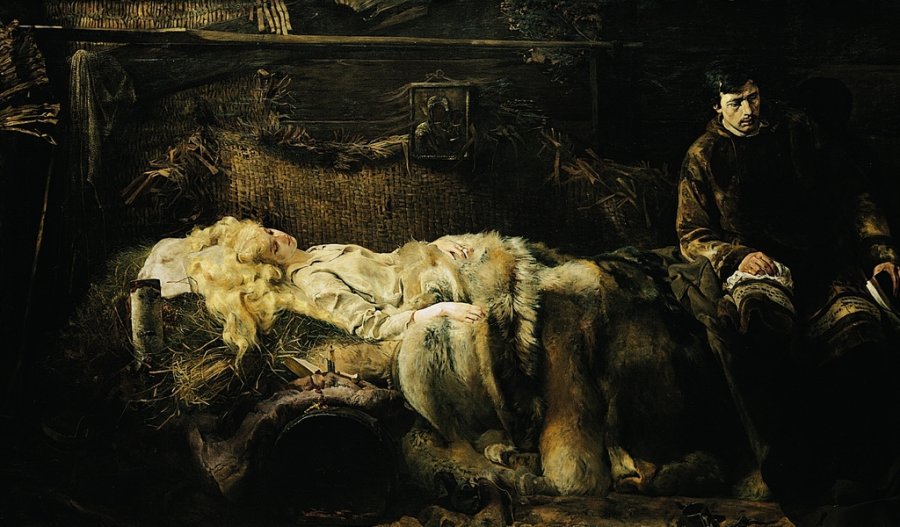
Jacek Malczewski, ‘Death of Ellenai’ , 1883, oil on canvas, photo: National Museum in Kraków
Malczewski's art concentrated on a few themes which were constantly developed, reshaped and interwoven. The artist's imagination circled around a few questions which he kept posing from different angles, exploring different aspects of the same matter; a matter which was as elusive as it was symbolic. The multiplicity of variants and nuances of a specific motif took part within a series and cycles of paintings devoted to it. Malczewski's oeuvre covers a few thematic series of a homogenous form, which coexisted and enriched one another by exchanging and interweaving its motifs.
It was as early as in the seventies, during the artist's stay in Paris, that the concept of a series of paintings on patriotism and martyrdom was born under inspiration of Juliusz Słowacki's poem Anhelli (1837). The artist developed this idea in a modified stylistic form in the early nineties. With a naturalistic precision and clear objectivism, the early works of these series displayed episodes from lives of the participants of national liberation uprisings, who were exiled to Siberia by the tsar's authorities such as: scenes of taking rests during exhausting marches, moments of prayerful concentration, memories and reflections, scenes at a wake for dead companions (Sunday in the Mine, 1882; Stage, 1883; Stage. Sybiraks, 1890; Sybiraks, 1891; Death at Stage, 1891). A limited palette dominated by browns, greys and greens contributed to the nostalgic tone of these crowded scenes which were characterised by fragmentary frames and a dramatic effect enriched by the use of light. In a few compositions, the artist's piercing eye of a realist melts inseparably with reminisces of religious iconography, while the coarse reality of the exiled achieves an eschatological dimension.
The mysticism and messianic belief in a future rebirth of the nation through sustained sufferings, which dominated Słowacki's literary works, is reflected in Malczewski's painting entitled Death of Ellenai (1883). The Ellenai motif, which corresponds directly with a poetic motif of Słowacki's Anhelli, kept returning in the artist's later works in a different composing set or stylistic approach. It turned crucial for a series of four paintings which were created between 1906-1908 under a common title Death of Ellenai. The Death of Ellenai series resonate with a bitter taste of loss of hope for the home country's rebirth, which was stirred in 1905 by the outbreak of the Japanese-Russian War.
The ideological settlement with the question of national liberation took on an optimistic overtone in monumental paintings characterised by expressive colouring, courageous shortening of a perspective and intensified illusionism of forms - Eloe with Ellenai (1908-1909), Eloe (1909) and Eloe raising Ellenai (1910). Here the body of the dead exile is carried into the eternity on rainbow wings of Eloe, one of the figures which frequently appeared in Malczewski's art, who remained fascinated by Słowacki.
Malczewski's paintings inspired by the Japanese-Russian War Primrose, 1905; Too Early, triptych, 1905 and the allegorical depictions of Polonia from the First World War - monumental, proud, brave, and rising to a new life figure Polonia. Orpheus and Euridice, 1914; Nike of the Legions, 1916; Polonia, 1918) - belong to the patriotic and historical trend of his art carrying the hope for liberation. The theme of martyrdom influenced the landscape painting as well.
The painting In the Cloud of Dust (1893-1894) depicts a dream-like figure of a chained Polonia and her sons emerging from a cloud of dust of a sandy road. This image becomes an emanation of motherland and symbol of national partition. Clear landscape takes an exceptional position in Malczewski's oeuvre of multiple motifs. Apart from a few fragmentary scenes of urban nooks, yards and gardens Yard at Salvator, ca. 1902, the most frequent motif of landscape painting are the Vistula's meanders painted between 1904-1905 in a series of landscapes of an augmented point of observation and illusive spatial depth determined by the meanders of the riverbed Vistula River outside Kraków; Spring Thaw - Vistula River outside Zawichost. This synthetic and over-stylised landscape of accentuated linear qualities, colours saturated with light and ethereal expression, dominates the paintings which make the wings of a triptych Go to the Streams from 1909-1910.
Malczewski's two religious paintings of the later period - Resurrection (1920) and Saint Agnes (1920-21) - take on a dramatic expression caused by a landscape of ploughed fields, which, receding into the background, is depicted in intense, saturated tones of rose colours and yellows.
In Malczewski's art, the theme of eschatology interconnects with historical and patriotic motifs. The figures of Christ and prophet Ezekiel, wading over a field of skeletons, were given the artist's anatomical features. They portray the drama of 1914-1918 war, faith and doubts, and symbolise the immense suffering leading to freedom Ezekiel's Oracle, triptych, 1918; Ezekiel's Prophecy, 1919. The figure of Christ bearing the artist's features appears also in the biblical scenes (The Tribute Money, 1908; Christ before Pilate, 1910; Christ and Samaritan Woman, 1911), which gain universal; religious and ethical; historical and contemporary meanings.
Fascination with Death
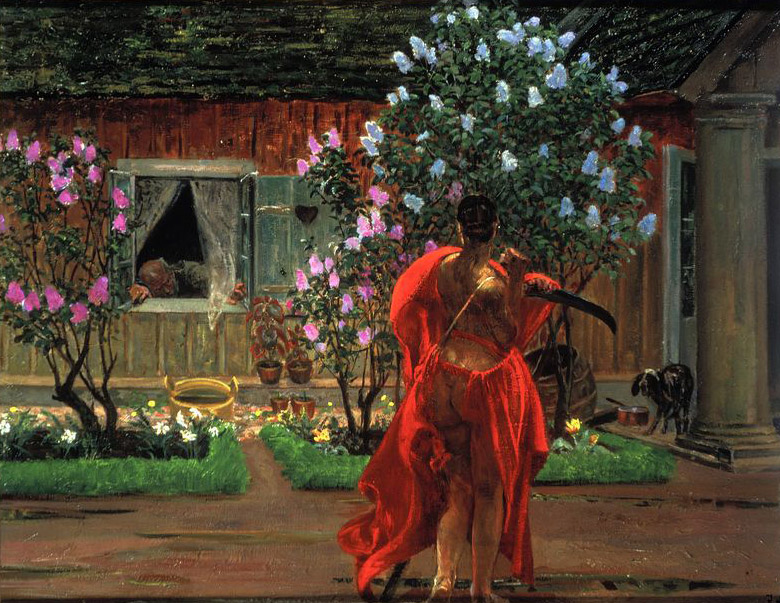
Jacek Malczewski, ‘Thanatos’ , 1898-99, oil on canvas, photo: Ewa Gawryszewska / National Museum in Warsaw
From the symbolist iconography replete with motifs of death Malczewski drew the figure of Thanatos, reaching into ancient sources of European culture. The portrayal of Thanatos as main subject of his work commenced in1898. Over the year he created a series of paintings featuring the theme of death in allegorical manner (Thanatos, Thanatos I, Thanatos II). Ironically, Malczewski portrayed the mythological god of death as a young woman with a scythe in her hands. Her supernatural powers are symbolised by decoratively outlined wide wings. At the same time her robust body shapes evoke association with complex entanglement of matter and spirit, the realm of sensuality with spiritual element, the bond between Eros and Thanatos, which was the common theme of Symbolists’ paintings. Cold, silvery-green moonlight illuminating the artist's family mansion in Gardzienice, evokes anxiety arising from a sence of being on the borderline between earthly life and transcendent being. In his late works the personifications of death appear in the scenery of Malczewski’s mansion in Wielgie, where he spent his childhood, and in this manner reflecting artist’s pondering about circle of life that is closing in.
The autobiographical, nostalgic, and home-seeking trend in Malczewski's art found its peak in the cycle My Life (1914-1920). The motif of a happy childhood connects closely with the awareness of the end of life and reflection on the life journey. As a result of the entanglement of visual memory and emotions, the family residence in Wielgiem, depicted fragmentarily in nine paintings, becomes an essence of the Polish landscape. The creative vision transforms it into a symbol of the paradise lost in the existential sense, and regained in the transcendent reality. The apotheosis of creative possibilities of the artist interweaves with the sense of a spiritual unity of man and nature inscribed into an ideal cosmic order.
In the ideological layer of the cycle recures the thematic triad Poland - Art - Death, around which the entire Malczewski’s oeuvre focuses (Law. Between Life and Death - Homeland - Art, triptych, 1903; My Life, triptych, 1911-1912). With the fantastic creatures - fauns, jellyfish, Muse, Eloe and Pegasus co-exist - in the dimension of artistic vision - persons close to the artist: parents and sisters, and the narrative of magined scenes is stretched between the past and the future. The affirmative artist's relation to art as a vocation in life is inextricably linked to the necessity of subordination of personal life to its strict demands and adoption of patriotic mission carried out by work of painting. Death appears as a necessary and soothing end to the human journey or as a retrieval - in the metaphysical dimension - of lost paradise. And overcoming the passage of time in order to reach timelessness can occur through the arts alone. The musical element, incorporated herein, suggests Malczewski’s understanding of art as a microcosm reflecting the harmony of the universe My Soul, 1917. The apotheosis of creative possibilities for the artist interweaves with the sense of spiritual unity of man and nature inscribed in the perfect order of the cosmos.
Symbolism and Melancholy

Jacek Malczewski, ‘Melancholy’, 1890-1894, oil on canvas, 139 x 240 cm, photo: National Museum in Poznań
The autobiographical motif contributed not only to the question of existence in its universal dimension but also towards ideas of artistic vocation, the nature of art creation, and the sense of art itself. Introduction - a work which displaying relations between art and nature, between inner experience, dreams and keen sensitivity in a realistic convention, opened a symbolic stage of the artist's career in 1890. The figure of a pondering painter – overwhelmed by enormous nature - came back in Vicious Circle (1895-97) a painting illustrating spontaneity of an artistic vision.
A parade of figures born in Malczewski's artistic imagination dominated the space of his studio in his painting-manifesto entitled Melancholy. Prologue. Vision. The Last Century in Poland (1890-1894). In this profound painting, the artistic imagination yields to the forces of the historiosophical vision which summarize one hundred years of national partition and uprisings. The artist's vision depicts not only the heroism and suffering of Poles but also the lethargic dream and apathy into which the country finally sinks. The symbolic multidimensionality of the work is intensified by the contrast of a stuffy studio and a bright landscape outside the window. These two spheres are separated by an insurmountable barrier of the windowsill whose mysterious power pushes away the crowd emerging from the painting. The crowd consists of representatives of all social classes and occupations: young boys, adolescents, old men embody both the tragic nature of history and the cycle of human life; both the essence of the history and the heart of earthly existence.
Tormented Artist
Malczewski developed the subject of torments connected to artistic creativity in several thematic series: in the years 1897-1899 he painted a portrait of an artist tormented by his visions, locked in the studio, whose inspiration is personified by pompous allegory of Polonia. Creative inspiration also take the form of seductive chimeras and harpies.
Figures borrowed from the repertoire of classical mythology have become an integral part of the plastic language of Malczewski. They carry ambivalent meanings associated with both the vitality of erotic instincts and compelling power of the senses, as well as with the conventional order of arts and artistic fiction embedded in the tradition. Antique elements - chimeras, jellyfish, fauna, tritons - connected Malczewski’s world of ideas with iconography of the German Symbolists - Arnold Böcklin and Max Klinger. Chimeras in Malczewski’s paintings tempt the artist with their sensual beauty, embodying the material dimension of art. The theme of listening to the singing lark, to melodies played by crickets and grasshoppers seems also to refer to the essence of artistic creation, the artist's extraordinary ability to intuitively explore the world, capture the rhythms of nature and the cosmos (Lark 1902, Grasshopper, triptych, 1903-1907 , My Song, 1904; Autumn song - Portrait of Włodzimierz Lipoński, 1906, Music, triptych, 1906).
Chimeras also show their cruel face; they enslave the artist and capture him in order to devour him – just as does the Arts, imperious and ruthless, subordinating the life of the artists to her demands (Art, triptych, 1906). Chimeras also tempt little boys, whispering them the secrets of love and awakening in them erotic desires (Temptation of Fortune, 1904; Cowman with the Chimera, 1904; Cowman and Harpy, 1904-1906).
Existentialism
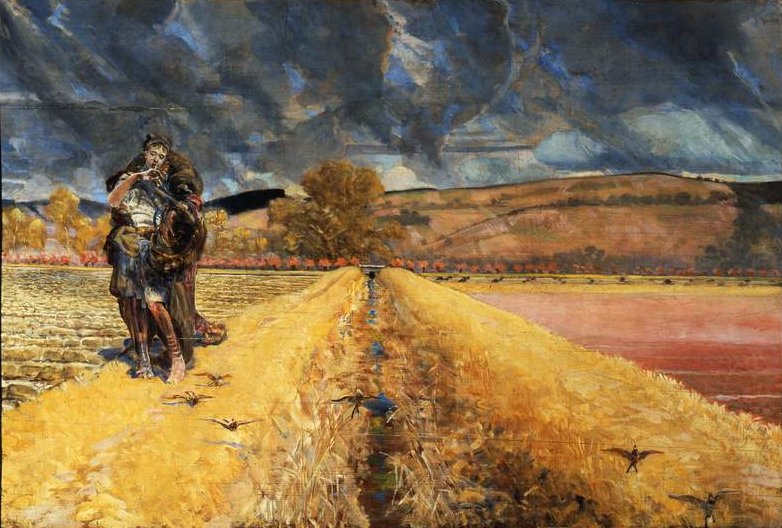
Jacek Malczewski, ‘ Saint Agnes’, 1920-1921, oil on board, 80 x 120 cm, photo: National Museum in Warsaw
In the eighties, an existential trend in Malczewski's art, saturated with erotic overtones, provided inspiration for the series Ondines (1887-1888), which expressed the artist's roots in local tradition, his fascination with folk tales and legends. The folklore repertoire provided Malczewski with new ideas to be transformed in subsequent two series Tales I (1902) and Tales II (1902-1903). Tales series (each series covered three paintings) tell metaphorical stories about: life journey; overcoming obstacles; final lack of fulfilment; discrepancies between ideals and everyday experiences.
In here, the motif of an forbidden source of a "life" water appears - as a frozen, or poisoned well - and becomes crucial for the series Poisoned Well (1905-1906). The motif symbolizes human pursuits, both in the national liberation and existential dimension. It achieves common, archetypical and personal value; refers to yielding to evil and overcoming of it; metaphorically depicts a desire to achieve freedom, truth and happiness (Poisoned Well - Chimera, 1905; Poisoned Well - Rose, 1906).
This symbolic pursuit becomes also apparent in a series of paintings drawing from to the biblical tale of a Tobias-father and Tobias-son. It develops a motif of a shepherd who meets his guardian angel - his guide in a future journey (I Walk with You Angel, 1901; Faith, Hope, Love, triptych, 1901; Follow the Angel, triptych, 1901; Towards Fame, 1903; Angel and Shepherd, 1903).
Spring - Landscape with Tobias (1904) evokes surreal poetics. The painting depicts a delicate figure of an angel with rose-coloured wings and a little Tobias carrying a healing fish, who walk in the quietness of a spring morning through synthesized and rhythmical areas of pink fields. At the end of these series, Tobias's fate and Thanatos's motif interweave in a manner characteristic for Malczewski's artistic expression Tobias and the Moires. The end of human existence is represented in two variants: one takes on the body of an old man returning home only to find at its door the final consolation from the hands of a death goddess (Return, 1898; Consolation, 1911; Thanatos, ca. 1911), or it becomes a return of the already dead into their homeland (Return home, ca. 1911).

