The breakthrough in Fangor’s artistic thinking came in 1958 with the exhibition Studium przestrzeni (Study of Space), prepared together with the architect Stanisław Zamecznik. Fangor showed monochromatic paintings covered with nebulae of white and grey, sometimes with a dash of green or red. However, the novelty of the show lay in the way the paintings created the space around them. Fangor would call this the discovery of 'positive illusory space'.
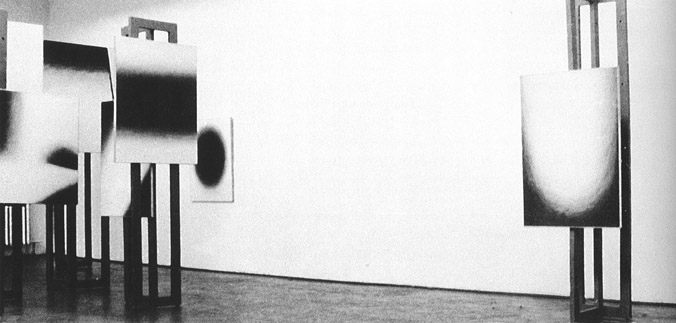
Wojciech Fangor, Study of Space, environment, 1958, Nowa Kultura Gallery, Warsaw, photo: from Bożena Kowalska's book Fangor. Malarz przestrzeni/ Fangor. The Painter of Space, Warszawa 2001
'I’m not interested in what is happening within individual paintings, but what is going on between them', he explained. 'The spectator automatically becomes a co-creator of the work by selecting his path and pace through this group of paintings.'
Study of Space is considered the first environment in Poland, anticipating similar experiments in the West. It also had an important impact on the future evolution of Fangor’s art.
Op-art in the Train Station...
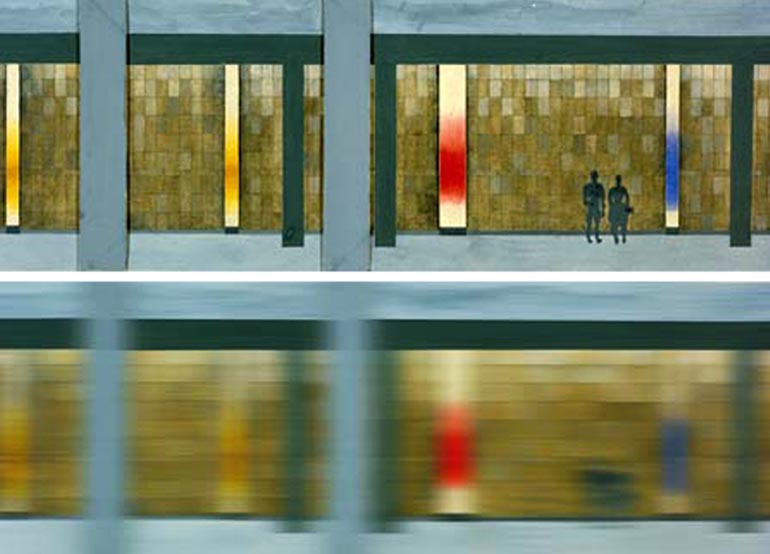
The project of the interior design of Śródmieście railway station (1960-62), designed by Jerzy Sołtan, Zbigniew Ihnatowicz and a team of collaborators - Lech Tomaszewski (structures), Wojciech Fangor (painting), Bogusław Smyrski (visual information) photo: the Museum of Warsaw's Academy of Fine Arts (ASP)
Fangor went on experimenting with optical art. One of the early examples employing this technique in the public space were the mosaic designs Fangor made for Śródmieście railway station in Warsaw (1963). Fangor’s contribution to the highly interesting Modernist architectural project of the team led by Jerzy Sołtan, were the mosaics located on the walls of the station. Their appearance was supposed to change depending on the speed of the approaching train. Although the mosaics have not survived, they can be seen as an intriguing prelude to the Metro designs which Fangor will create half a century later.
...and at the Guggenheim
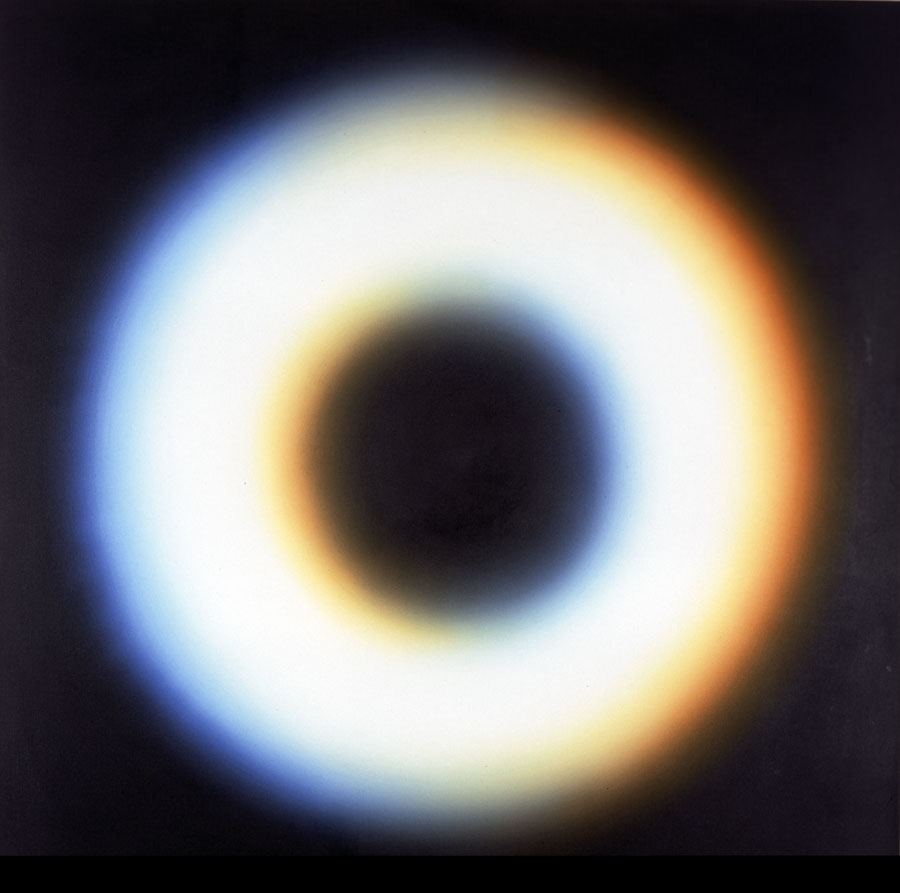
Wojciech Fangor, SM 34, 1974, photo: National Museum in Kraków
In the 1960s, Fangor left Poland and lived in Western Europe for a couple years before eventually settling in the U.S., where his art was recognized as one of the forerunners of the Optical art movement. In 1970 his vibrant, colourful paintings were shown at the Guggenheim. The exhibition is sometimes recalled as one of the few shows that made a perfect match for the remarkable but also difficult (in terms of its exhibiting qualities) architecture of the building designed by Frank Lloyd Wright:
The huge, vibrant surfaces of the paintings covered by the irregular forms of multicoloured and monochromatic circles, waves and other abstract, more or less amorphous shapes produced an environment throbbing with colour and suspended in time.
John Canaday, one of the leading critics of the New York Times, has called the art of Fangor 'Romantic Op'. Even today Fangor remains the only Polish artist to have had an individual show in this institution.