While producing Something Better To Come, you accompanied the people who live on a landfill near Moscow for a period of 14 years. Was it hard to return to a life of your own after something like this?
Hanna Polak: I haven't returned to my previous life. To this day, I'm trying to do something for the people I met there. I haven't forgotten about them and I never will. Since I met the homeless children of the streets of Moscow, my life turned around 180 degrees. Not only because I made the Children of Leningradsky documentary about them.
And how did you happen to find yourself in Russia?
I studied at the acting department of the PWST [State Higher Theatre School]. I was planning to study directing. Unfortunately, one exam went badly and it changed everything. I was crossed off the student list, and to be honest, I really took it hard. Poland became too small, all of a sudden. I was travelling across Western Europe and later I found myself in Russia. It was an extraordinary time – right after the fall of communism the political scene as well as society was going through a fascinating transformation, Russia suddenly opened up to the world.
Why did you stay on in Moscow?
The transformations in Russia attracted media representatives from the entire world, and Moscow became an interesting and dynamic place. I met many wonderful people in Russia during those times, with whom I am still friends and keep in touch today. Apart from that, I felt I was needed there, because I was able to engage in helping the poor and needy. With a group of Russian friends, first I participated in helping the elderly and disabled, who, after the fall of communism, were presented with kopyeiky – pensions that weren't enough to survive on. But then, it was an irregular series of programmes, organised in collaboration with state social aid centres.
How did you meet the Children of Leningradsky?
In 1999, while crossing Kursky station, I saw three small children sniffing glue there. I started to speak with them, and it turned out they were living in that station. The children told me to come in the evening, because then there would be very many of them. So I went to the station in the evening and I was completely shocked. There were more than fifty children there, some of them very little. I could not comprehend that these children were really not needed by anyone, no one was searching for them, no one cared about them. They just lived in the street – they lived and they died.
It was then that I felt that I had to help them somehow, that I couldn't simply walk past them, I had to do something for them. I called two of my friends from Poland, Ewa and Monika, who felt the desire to come to Russia and help the hundreds of street children on the streets, stations, or landfills. Soon, the apartment that we rented near the station was filled with children. The children who did want to change their lives began to come and stay with us temporarily, awaiting a place in a good orphanage, where they agreed to go, or, awaiting return to their own families, with whom our volunteers worked – in order to better the relations of the child with its relatives. Every single day, every moment, counted there – every possible opportunity had to be used if there was the slightest chance of tearing the child off the streets. The degradation of these kids was very rapid. On the streets, they became victims of violence, they entered criminal gangs, got into heavy drugs instantaneously, they just perished, they died.
At first, they were spontaneous actions, carried our with our own means, supported by friends who chipped in, who gathered clothes which I then brought to Russia by car. But later, we created a foundation in Russia, and a group of my Norwegian friends founded the Active Child Aid (http://activechildaid.org) organisation in Norway, which allows you to help the main protagonist of my film, Julia (with the note: Dla Julii/For Yula) or other children. The foundation helps children from orphanages and from poor families in Upper Silesia in Poland. I thought about how else I could help the children.
I began making the documentary Children Of Leningradsky because I wanted to tell the story of these kids and the conditions they live in to the world. In order to learn to make better films, I passed the exam to enrol at Moscow’s WGIK’s cinematography department, for the course conducted by Vadim Yusov, who worked with Andrei Tarkovsky. It was the children from the Leningradsky station who first took me to the svalka and showed me that the largest landfill in Europe is inhabited by hundreds of people. It was the year 2000, Putin had just come to power.
You knew straight away that it was the subject for a documentary?
Yes. But mostly, I returned to the svalka not in order to make a film but in order to help those who lived there. They needed medication, bandages, some had to be taken to hospital. I tried to help as much as I could.
A landfill is a completely closed world. Its territory is guarded and encircled by a wall, behind which there are many dangers. Even the people from the surrounding housing areas know that behind the walls people are living and dying, that there is a brutal struggle going on there.
In the place you depict, the law is suspended. The bulldozer drivers don’t event try to avoid the homeless people. They run over them, as if they weren’t human beings…
It is a state within a state. No code of law pertains to the landfill. If someone dies, no one calls the police. They would not come, anyway. If someone is raped or trampled by a truck, no one calls an ambulance, nor does anyone raise the alarm. The dwellers of the svalka disappear without a trace and no one remembers them.
I was aware that I could not return from there, too. But in my case, the embassy and my family would inquire about me. No one is going to enquire about the homeless. Among the people who govern the landfill the principal rule is that the less it is spoken about elsewhere, the better. That is why the authorities did not want me to come to the landfill with a camera.
Did you feel threatened?
Always. And from different sides. In the svalka, at any given moment you can perish under the bulldozer’s caterpillars; rape and murder are not infrequent. My presence there with a camera was not liked by people who do illegal business there – and there is huge money involved, which is obtained from recycled materials. Besides, there are hordes of dogs roaming about the landfill, and poisonous gases that leaking out from the heaps of rubbish. Every once in a while, the terrain collapses, because it’s all decaying. A man gets stuck underneath and no one even tries to look for him.
In one scene in the film, you barely manage to escape a truck…
In my materials, I have a multitude of such images. Each time, I was lucky enough to have someone warn me. But the risk was very real.
And what the people who live on the svalka fear?
Losing their humanity. They already are aware of the fact that the rest of society perceives them as if they were cockroaches or lice. They are really afraid of entirely losing their dignity.
The camera helped them to experience their own dignity. They could finally tell their stories to someone. That is why I received so much kindness from them, and so much help. My presence there reminded them of the world that they had lost, but it also gave them hope. Because all the people of the landfill live with the hope that – as the title of my film says – there is something better to come. When this hope dies, true drama unfolds – people die while they are still alive, they lose the remains of their hope, and stop fighting for themselves.
From the crowds of homeless heroes, you fished out little Yula. When did you become aware that she should be the main protagonist of the film?
She was it from the beginning. She just often disappeared for longer and it was not possible to film her.
For 14 years, I was gathering my materials, and the form of the film changed gradually. I wanted for Something Better To Come to be a film about Yula, but also about her world and the other people living on the landfill. I wanted to tell of the svalka society through her story.
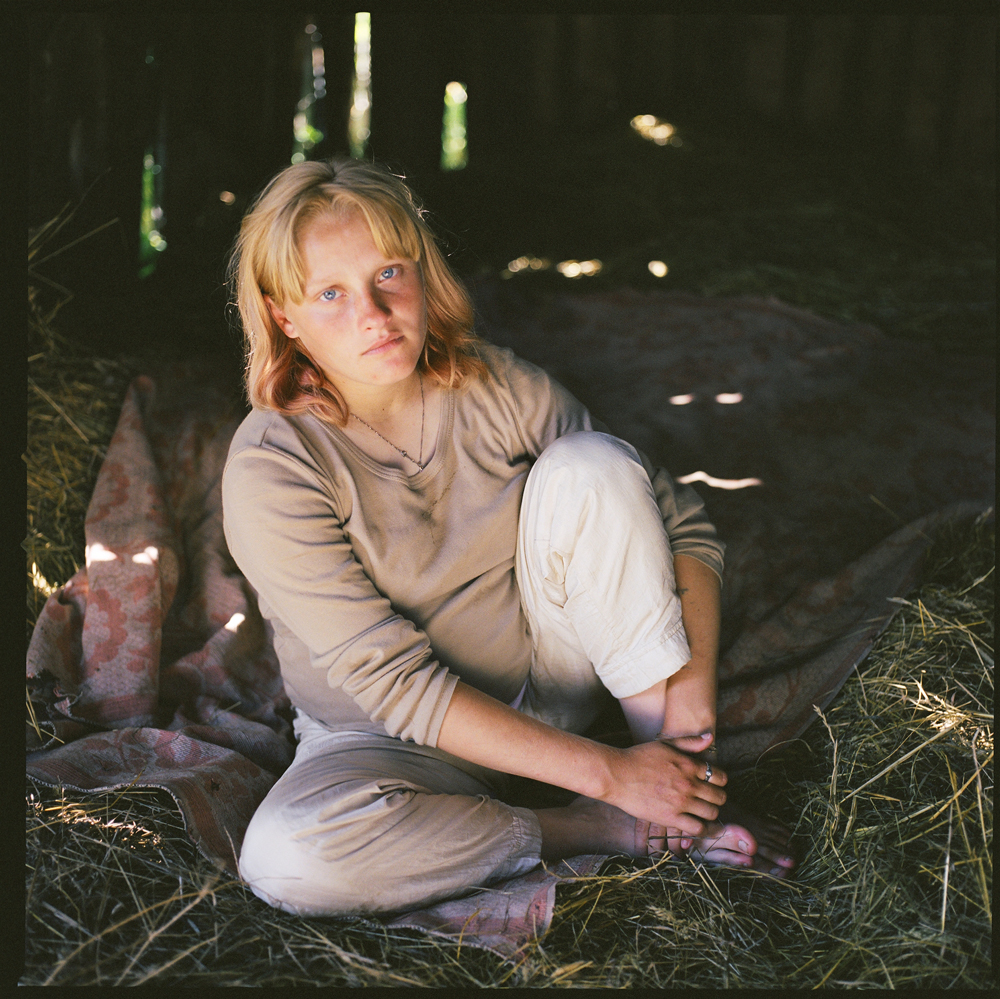
A scene from Something Better To Come by Hanna Polak, photo: KFF
How many people managed to get out of the landfill?
Very few. Many of the protagonists of my film are dead today – they perished under car wheels, or they froze. Yula made it, she has found and apartment, and a job. She also took her mother with her from the landfill, she got out together with her boyfriend.
Did your film help her to escape?
Yula thinks that I helped her a lot, but if my presence and the film really had the power to release energy, then this energy would have also been released in other people. But they did not manage to get out of the svalka.
Yula found herself in the landfill as a small child. No one told her to go to school, and from the youngest age, she was smoking cigarettes and drinking vodka. She could have gotten infatuated with this so-called freedom, but at a certain moment, she understood that it just wasn’t real life. That real life has to built and constructed on your own. In a very short time, Yula became an adult person, capable of taking her fate into her own hands.
Love also turned out to be important. Yula fell in love with a boy from the landfill. Perhaps he was not the most handsome among them, but he was the only one who did not drink. Together, they began to dream about getting out of this place. They found a job outside of the landfill, and they put away money to buy an apartment. Finally, they managed to get out of the landfill.
In your film, there are a few moments when we hear speeches delivered by Putin. Why?
The action of my film unfolds in a concrete place and time. Political accents allow to describe a reality of which I speak, they give the film a historic background. Without this, Something Better To Come would be a story about some kind of a landfill, somewhere, sometime, and one that is concrete.
The political speeches in the film also constitute a slightly ironic counterpoint. When we hear Putin’s voice pour out of the radio speakers, saying how well things are going in contemporary Russia, how life conditions and the economic situation are greatly improving, and on the screen we see the misery of the landfill and people cast out onto the margins of society, bitter irony is born out of this juxtaposition.
But I didn’t want to make a political film that would repeat certain cliches about Russia. These inserts allows us to locate the landfill in Russia, on the outskirts of the multimillion Moscow, and time is also one of the film’s protagonists because the story unfolds over a period of 14 years. Thus these news – often easy to recognise – allow us to picture the passing of time.
How has Russia changed over the past 14 years?
It is certainly not the country it was in 1992. When communism fell, Russians were curious of the world and open towards otherness. Now, they are closing up again, and the nostalgia for tough rule has returned.
This nostalgia is the fruit of propaganda?
The majority of society finds it easier to live in an authoritarian system, when it is the power that makes the decisions for them, and deals with certain issues. In the past, people had a lot of time to get used to this state of affairs. Looking at Russia from a distance, were are not really able to understand the moods within its society, the growing isolation and distrust against the West.
You have already garnered many festival awards for your film, and journalists list Something Better To Come among the most important documentaries of this year. Can this international success change something in the lives of your protagonists?
I always have the hope that someone can be helped thanks to the film. But I have no illusions – it will not happen quickly. But if with time, people’s attention can be drawn to the problems of my protagonists, then it will be possible to influence institutions and legislators, if some individuals will be inspired by the film, then it will be a great success.
When I was making Something Better To Come, I got a lot of warmth and kindness from my heroes, and their lives became a part of my life. I still try to help Yula. I hope that thanks to the film, their life will be at least a little bit better.
Bartosz Staszczyszyn, June 2015.
Translated by Paulina Schlosser, 25/06/2015