The competition, designed to find the most interesting film city design for Mumbai, received as many as 283 projects from all over the world . The Indian film industry, commonly known as Bollywood, is the biggest film industry in the world – more than a thousand films are produced there annually (two times more than in Hollywood) and films reach an audience of up to 3.5 billion people. The idea behind the competition was to create a film city that could cater to the industry, housing all the facilities essential for film production. But it was not only about function: the idea was to create an architectural icon, a landmark for the city as well as an example of the sustainable use of alternative energy sources and other ecological technologies.
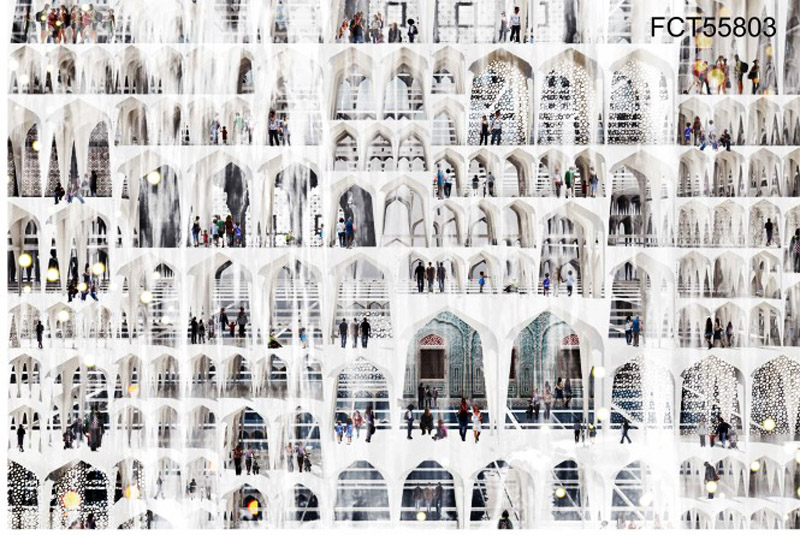
Jagoda Nowakowska, Magdalena Skop, Monika Woźniak, winning project of the Film City Tower | Mumbai: Bollywood Re-Imagined, photo: promo materials
The winners of the competition, Jagoda Nowakowska, Magdalena Skop and Monika Woźniak submitted a design of a skyscraper, whose ascending floors mirror the subsequent stages of film production. The architects also placed a film school in the building as well as a cinematography museum. The jury paid special attention to two of the solutions introduced by the Polish architects. The incorporation of ogee bows, a nod towards traditional Indian architecture, was particularly appreciated as well as the design's unexpected use of water – the architects turned the skyscraper's façade into a waterfall. The water flowing over the elevation not only makes for impressive decoration, as it is also functional: it drives turbines producing electricity for the building and cools it down on hot days. The water curtain covering the façade also makes the building look ethereal and otherworldly.
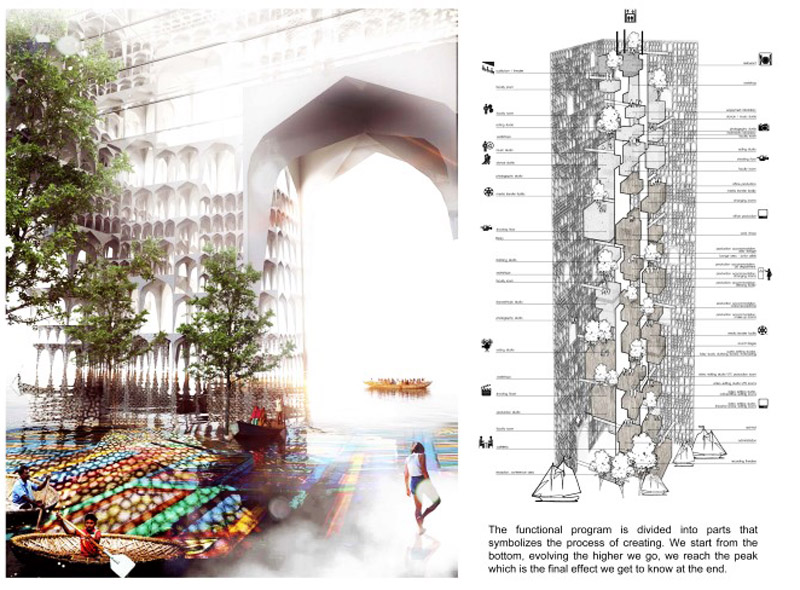
Jagoda Nowakowska, Magdalena Skop, Monika Woźniak, winning project of the Film City Tower | Mumbai: Bollywood Re-Imagined, photo: promo materials
Among the honorary mentions in the competition were designs from the United States, Hong Kong, Argentina, the Netherlands and the United Kingdom. There was also another Polish design honoured by duo Patryk Król and Mateusz Binkowski.
More information can be found on the competition's website: http://archasm.in/past.html