The Palace – Poland’s tallest building – has 44 storeys and towers up above the Warsaw city centre as if over a desert – the area which stretches out underneath is actually Europe’s largest non-administered urban space. Back in the day, parades marched across this space, celebrating the glory of the socialist fatherland. Later, in the 1990s, the space was home to a huge market and an amusement park. Today, coach buses find their parking here. Separated from the rest of the world with the huge 36-hectare square, the Palace of Culture is like a city within a city. Its interiors envelop cinemas, theatres, popular cafes and clubs, Sala Kongresowa (the Congress Auditorium), the Museum of Technology, the Museum of Evolution, a swimming pool, higher schools, the headquarters of the Polish Academy of Sciences, as well as urban administrative offices.
Its 3 288 rooms have the total area of 123 084 square metres. The building stretches 254 metres wide on the side facing Marszałkowska Street, and 212 metres on the one which runs along the Jerozolimskie Avenue. It is 237 m high, counting the antenna support, an integral part of the IGLICA which was added on in 1994. Without the IGLICA, the height is 187,68 m. Its cubature amounts to 817 thousand metres.
Friendship, peace, and 40 million bricks
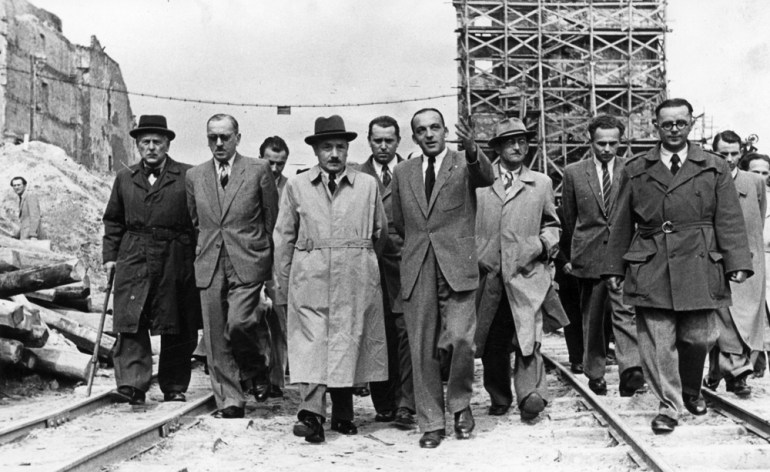
Examining the area on which the Palace is to be raised, Warsaw, 1948. In the photograph: Bolesław Bierut, the President of Poland, in the company of the Minister of the Reconstruction of the Country, Michał Kaczorowski, and Józef Sigalin, the attorney for the Palace’s construction. photo: Sovfoto/UIG / East News
At first, the Palace was never spoken of other than in a solemn and elevated spirit,
"At the basis of the new urban planning and Polish architecture, there lies the friendly exchange of goods, achievements and experiences between the Polish nation and Soviet nations. At the base of the high-rise constructions of Warsaw lies the Polish-Soviet friendship and its materialised testimony: the Josef Stalin Palace of Culture and Science"
– a quote from a January 1954 copy of the illustrated weekly, Stolica (The Capital).
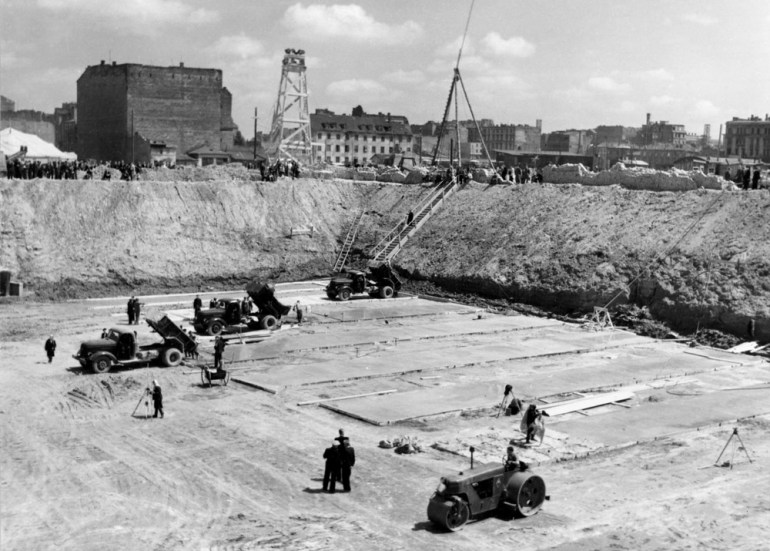
The construction of the Palace of Culture and Science. The concrete base for the foundation, 1950-55. photo: Forum
The building of the Palace (abbreviated PKiN in Polish) took three years, from May 1952 to July 1955. The Palace was designed by a USSR professor of the Academy of Architecture, Lev Vladimirovitch Rudniev who wished to add typical Polish elements to the construction. Together with a team of Soviet architects, he set out in search of national motifs on an expedition to Kraków, Kazimierz, Chełmno, Płock, Sandomierz, Zamość, and Toruń. The Polish attorney for the construction of the PKiN was Józef Sigalin, the chief architect of Warsaw.
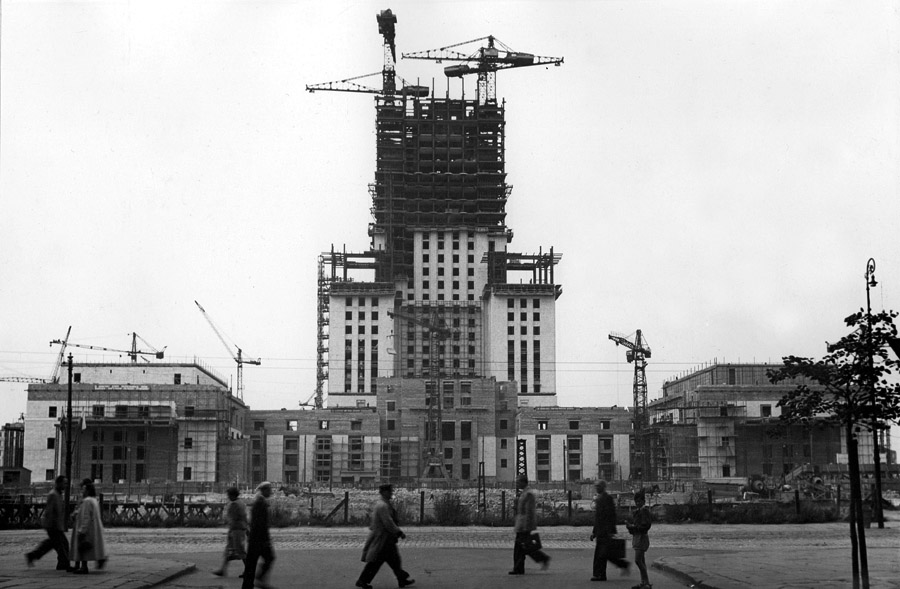
Building the Palace of Culture and Science, 1953, photo: Forum
The workers "towered up towards the skies of Warsaw along with the Palace’s storeys," the Stolica weekly announced (November, 1953). Some 3500 Russians were engaged in the construction work. They lived in an apartment complex raised especially for their stay, which was equipped with a cinema, a diner, a cultural hall, and a swimming pool. "The three constructors – Korostilev, Batchkov, and Gavrish came to Warsaw half a year ago, and they were the ones who, in July, 1952, started the base of a concavity for the building’s fundaments, they were the ones who mounted the first poles of the steel construction. Not little – about 25 thousand tons of steel transformed into the carriers of the Palace’s skeleton – went through their hands. Accurate and patients hands that they are, persevering and stubborn hands,” Stolica pompously announced. 16 soviet workers died in accidents on the construction site. They were buried in a Greek Orthodox cemetery in the district of Wola and the present management board of the Palace looks after their graves.
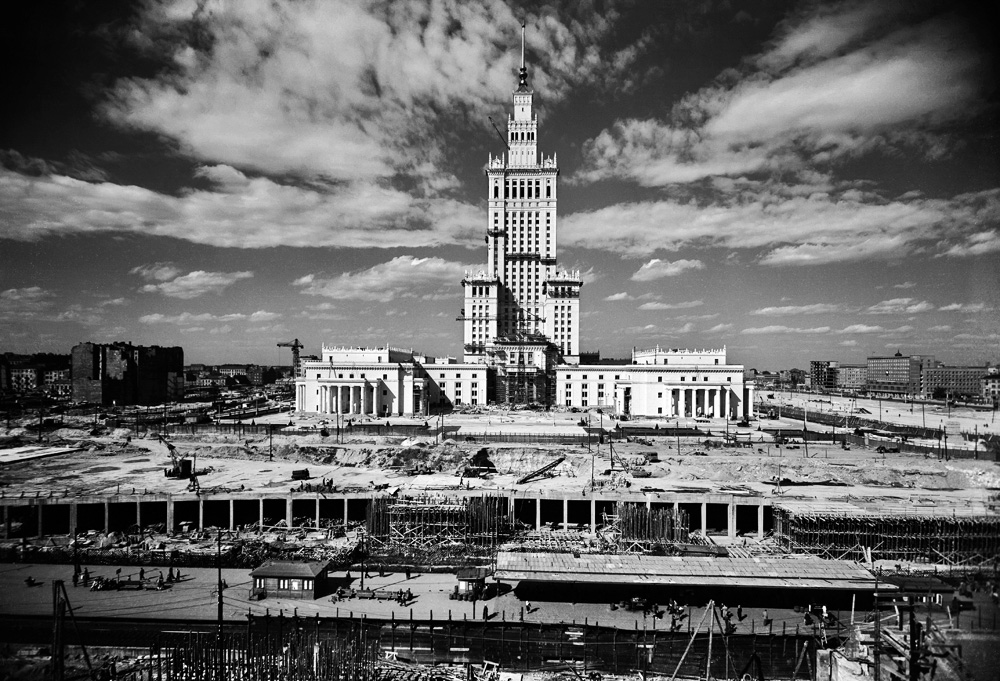
Building the Palace of Culture and Science, 1953, photo: Forum
The Palace was also built by Poles. Stolica accompanied one of the teams: "An organisation of work usually unmet among us. Technique, scale, as well as the direct collaboration with leading Soviet experts enrich its experience and qualifications even further" (1953).
A total of 40 million bricks were used, as well as 26 thousand tons of steel construction. 400 thousand square metres of wall surfaces were plastered over, 10 thousand walls and columns inside the building were covered with fake marble, and 80 thousand cubed metres of concrete and fortified concrete were mounted to make the Palace.
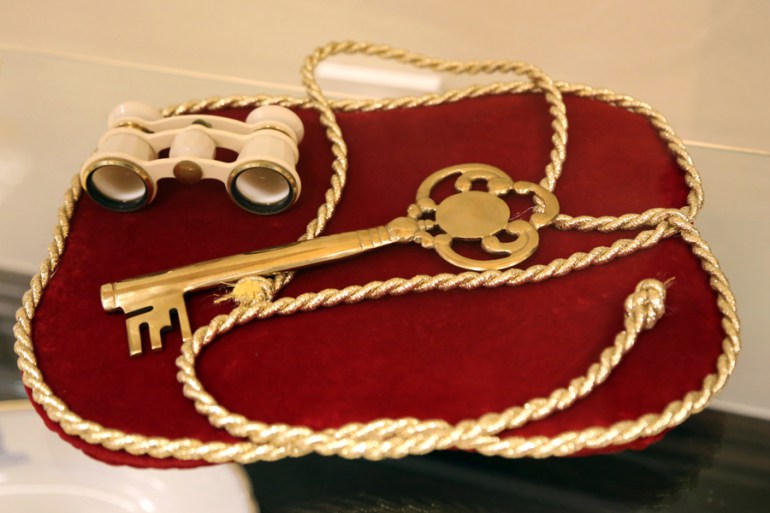
In the photograph: the key used by Prime Minister Józef Cyrankiewicz on July 21st, 1955 for the official opening of the PKiN door. Photo: Joanna Borowska / Forum
The official opening ceremony took place on 21 July, 1955.
Later, some spectacular "second takes" also took place. On New Year’s Eve 2001, the peak of the Palace was officially presented with the second largest clock in Europe. The clock shields on all four sides have the diameter of 6,3 metres, the minute arm measures 2,7 metres, and the hour arm is 3,54 metres long. Granted good weather conditions, the so-called "millennial clock" is visible from a distance of 5 kilometres.
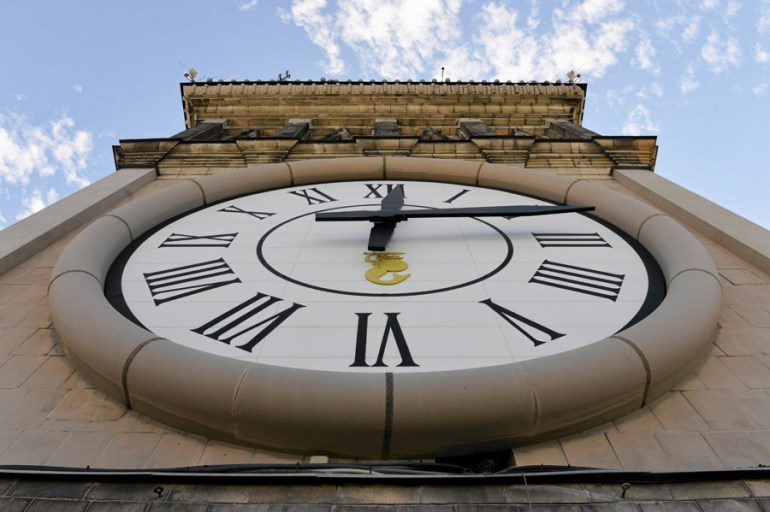
The millenial clock of the Palace of Culture and Science
In any case, when one asks the Palace tour guide what actually made the strongest impression on him, the response is that nothing could ever live up to the private fan area that the Russian billionaire Roman Abrmovich set up for himself during the European Football Championship in 2012. Unfortunately, there is no official information about this fact.
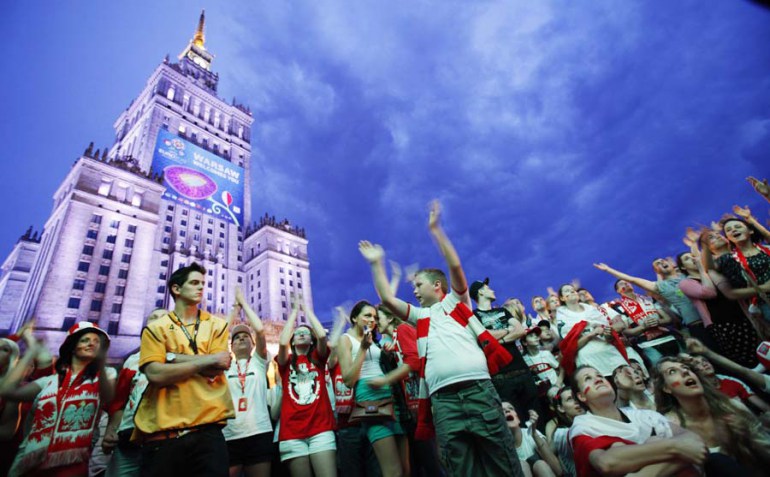
The Fan Area on the Defilad Square, photo: Marek Wiśniewski / Forum
Marriage with the Palace
Tadeusz Konwicki used to look onto the Palace from the balcony of his home. For the writer, it was a symbol of Communist domination, which he called "an upright towering outhouse,” but he also considered it the literary centre of a magical Warsaw.
The best of reporters tried to tackle the Palace. Hanna Krall wrote about it for the Polityka weekly in July, 1975 : "Every fifth among the Palace’s workers has been here for twenty years. The work of so many years shapes many traits within a man: a psychological determination, a sharp eye, aesthetic taste, and even a certain life philosophy, close to the stoic school."
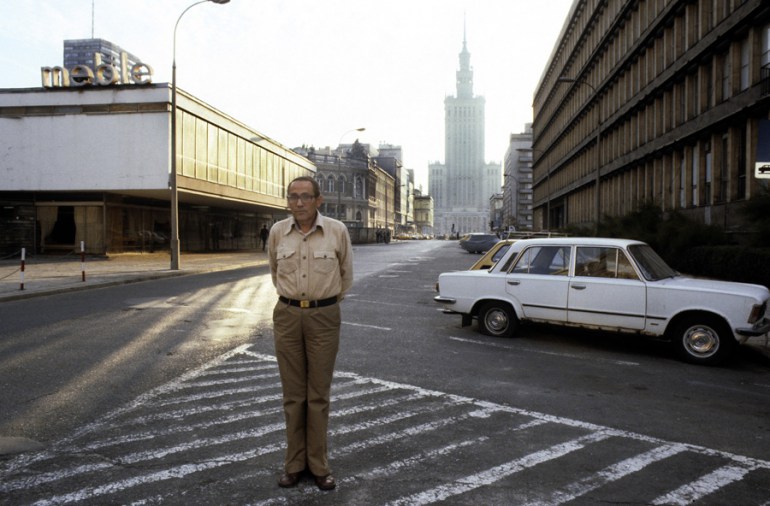
Tadeusz Konwicki in the 1980s, Warsaw, photo: Chris Niedenthal / Forum
In his reportage Kamienny kwiat (Stone Flower), Mariusz Szczygieł finds a confirmation of the thesis that the Palace is much more than just a building. Various letters addressed to the Palace and noted by the reporter bear testimony to this fact. A few examples are:
"Dear Palace, help me, the neighbour’s taken over my territory."
"I am a retired professor of the Polish Academy of Sciences. I am requesting an apartment on the highest floor of the Palace. I would like to record thunder there.”
"I have been to the Palace about ten times. Is it possible to get housing there for medical reasons, for a few years?"
Children asked for their letters to be delivered to Santa Clause "who lives in the Palace on the top floor,” and one woman even complained to the management board of the Palace, saying "The needle radiates onto me so much, that I am having erotic dreams because of it.”
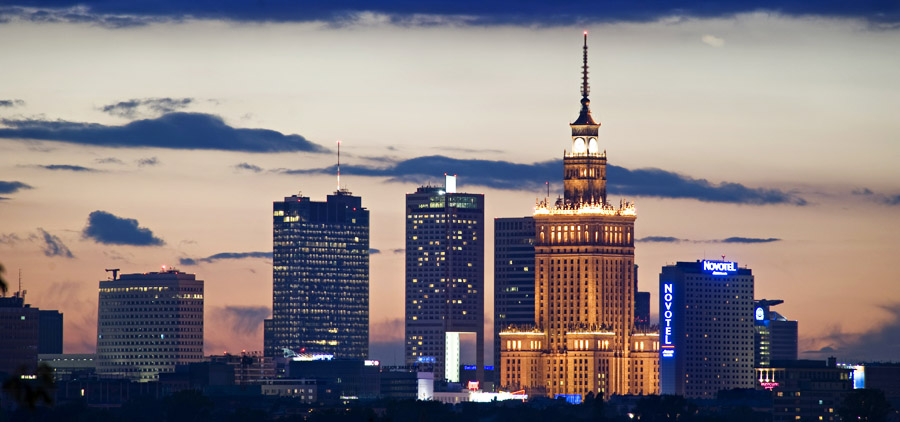
Warsaw City Centre Panorama, photo: Andrzej Sidor / Forum
In 1994, Szczygieł called the Palace of Culture on April Fools’ Day and said that he represented the billionaire Bob Kowalsky from Chicago who had come to Poland in order to spend one billion złoty and that he would like for a huge banner saying "I love Beata Matracka” to hang off the Palace on the first day of Easter. In response, Szczygieł heard that "Today, anything is possible.”
Eccentricities from the Palace’s life are also described by Hanna Szczubełek, a chronicler of the PKiN, who works in an office on its 15th floor. She was hired by the Palace’s first director, Stanisław Barszczewski. In 1995, in a talk with Dariusz Zaborek for the Magazyn of Gazeta Wyborcza, she declared "It is my first and last job. I married the Palace.”
From the Palace’s Chronicle
- July 21st, 1961. The Palace is visited by the first cosmonaut of the world, Major Yuri Gagarin.
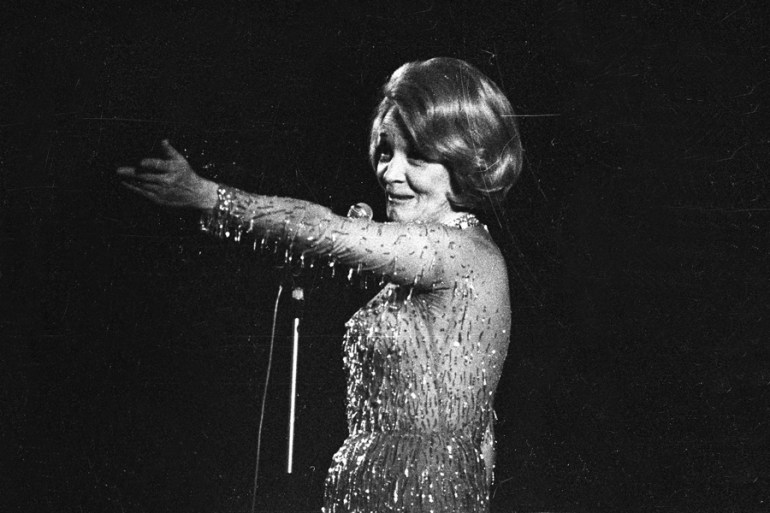
The Austrian artist Marlena Dietrich performed at the Sala Kongresowa (Congress Auditorium), 1964, photo: Zbyszko Siemaszko / Forum
- January 19th, 1964. The Austrian artist Marlena Dietrich performed at the Sala Kongresowa (Congress Auditiorium).
- September 25th, 1965. A citizen of France, Jan Kewermann jumped off of the terrace on the 30th floor (a height of 114 metres). A series of suicidal jumps followed, until in the 1970s the decision was made to install metal bars.
- January 21st, 1967. The Palace of Culture figures first place in the country and first place in Europe when it comes to the number of telephonic conversations conducted inside it.
- April 14th, 1967. The English big-beat band The Rolling Stones performed at the Sala Kongresowa.
- January 23rd, 1981. Workers of the Palace Management Board and employees who were part of the Solidarity movement joined in the strike announced by the NSZZ "Solidarność" head for the Mazowsze Region.
- December 13th, 1981. Because of the implementation of Martial Law in Poland, the activity of workers’ unions is limited, as well as the organisation of cultural events.
- June 14th, 1987. The Pope John Paul II celebrated a mass conducted at the Defilad Square for the closing of the 2nd Eucharistic Congress.
- January 27th, 1990. The last, 11th Gathering of the Polish United Worker’s Party took place at the Palace.
- December 12th, 1991. The Sala Kongresowa hosted a fashion show of Pierre Cardin.
- November 9th, 2001. The world’s most popular magician, David Copperfield performed at the Palace.
- April 16th, 2002. Peregrine falcons nesting on the Palace’s 44th floor have their chicks hatch out.
Author: Jakub Halcewicz-Pleskaczewski
Translated by Paulina Schlosser, 28/07/2015