Henryk Poddębski

Henryk Poddębski, burnt interior of the Orthwein Machinery and Castings Factory, Krasiński & S-ka, Złota Street, August 1915, photo by courtesy of the Museum of Warsaw and the Raster Gallery
Henryk Poddębski (1890-1945) is lauded as the founder of one of the biggest collections of landscape photography in the interwar Poland. Most probably taken in the summer of 1915, his photos document bridges, railway stations and factories demolished by the Russian army fleeing Warsaw in the wake of the German army during the World War I. They are the first recorded photos of Warsaw’s ruins. In the chapter of Ruins of Warsaw devoted to Porębski, Łukasz Gorczyca explains:
At the time, the 25-year-old photographer manifested himself as an artist of sophisticated craftsmanship, a reporter’s instinct, and concurrently an appetite for salient, powerful frames and almost epic compositions.
Jan Kisieliński
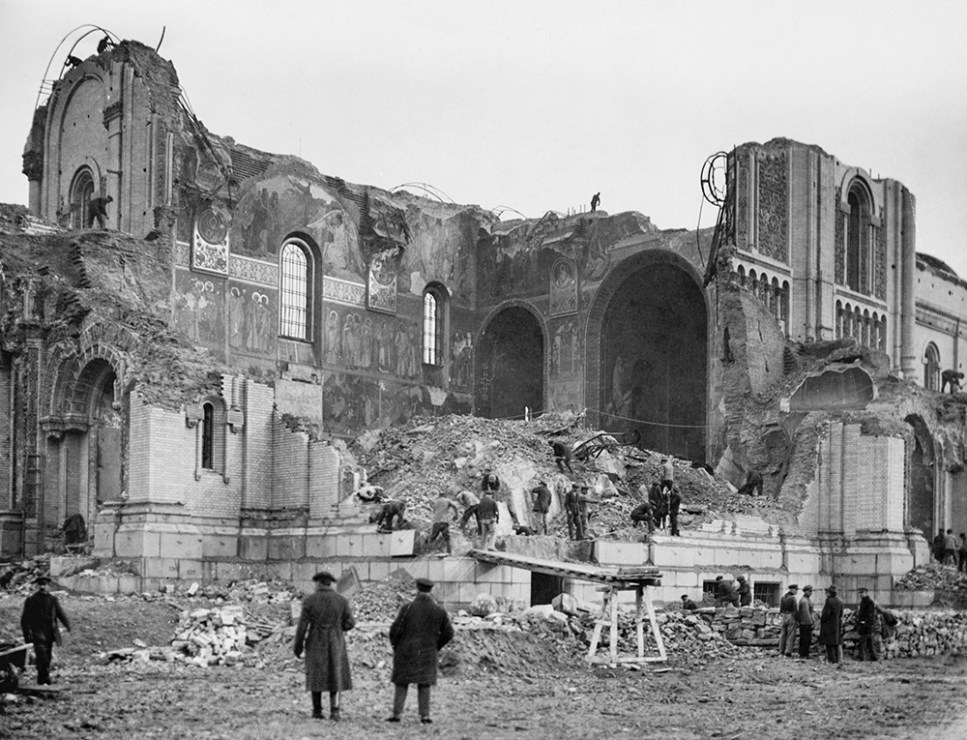
Jan Kisieliński, demolition of Alexander Nevsky Russian Orthodox Cathedral on Saski Square, view from Królewska Street, 8 March 1926, photo by courtesy of the Raster gallery
During the interwar period, Jan Kisieliński was a member of the Guild of Christian Photographers in Warsaw. From 1925 to 1926, he was commissioned by Zygmunt Słomiński, later the Mayor of Warsaw, to document the demolition of Alexander Nevsky’s Russian Orthodox Cathedral on Saski Square. Erasing the monumental building – a symbol of Russian domination – was a profound event in the history of Poland. Kisieliński’s photos depict the demolition work, the construction workers and hidden underground nooks and crannies of the cathedral. In Ruins of Warsaw, Piotr Jamski writes:
His achievements remain unnoticed by researchers and he’s still a quite anonymous artist. Kisieliński’s photos are skillfully framed and exposed. They are much more than just a picture of a random view – they evoke the image of a building being destroyed.
Jerzy Mizerski
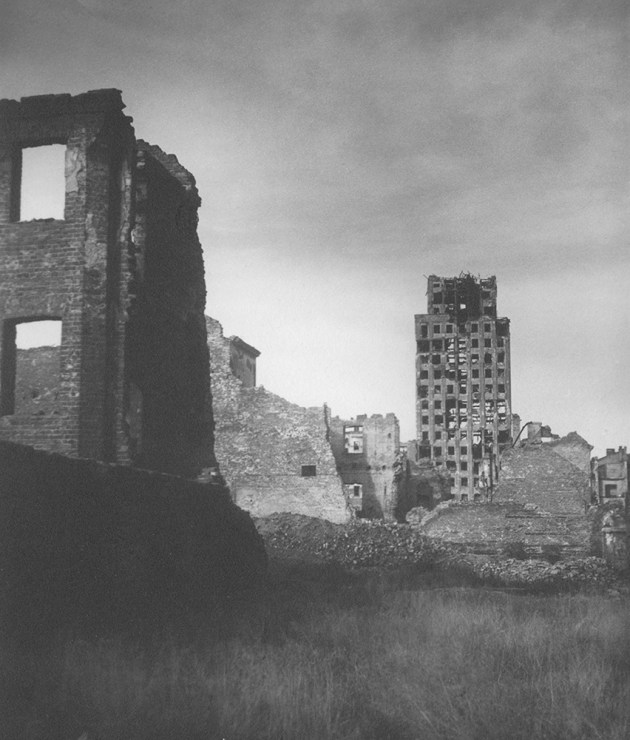
Jerzy Mizerski, Skyscraper (Drapacz Chmur), 1945, photo by courtesy of Raster Gallery
Jerzy Mizerski created a series of several dozen of photo postcards depicting a Warsaw ravaged by World War II. They include snapshots of the remains of the Central Station, the ruins of the famous Prudential skyscraper, as well as rare shots of the Central Post Station at Żelazna Street and the building of Post Savings Bank (now known as PKO Bank) located on at the corner of Jasna and Świętokrzyska streets. Łukasz Gorczyca comments:
This was most likely the most extensive and high-quality documentation of a destroyed Warsaw avaiable to the public. Unfortunately, we don’t know much about the series and even less about its author...
Jan Bułhak
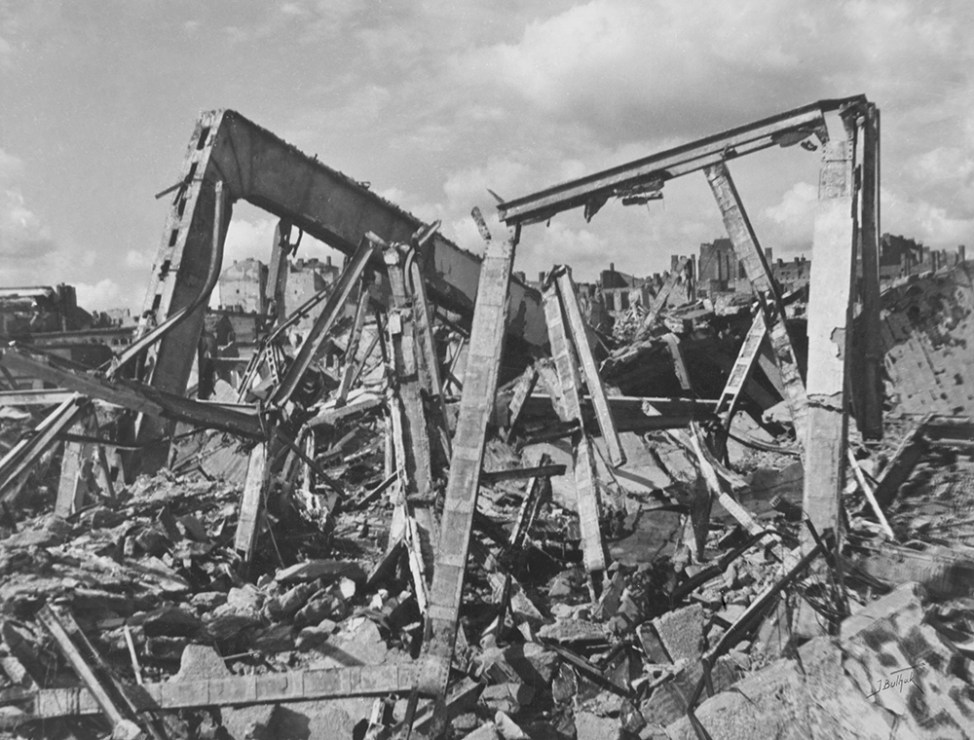
Jan Bułhak, Central Station (Dworzec Główny), 1945, photo by courtesy of the Museum of Warsaw and Raster Gallery
Jan Bułhak, often called the father of the Polish photography, documented ruins and the reconstruction of Warsaw in 1945 and 1946. In his large sea of work, architecture – often resembling the remains of an ancient civilisation – is interwoven with nature, making his photos quite picturesque. In the Ruins of Warsaw, Magdalena Wróblewska writes:
Their goal was not only to preserve the existing image of the city, at that very moment in time, the experience of everyday life, but also to emotionally engage viewers. The book includes both shots set in the pictorialistic aesthetics illustrating vast, landscape-like plains of rubble, as well as more reportage-like pictures documenting the reconstruction process.
Franciszek Buchner
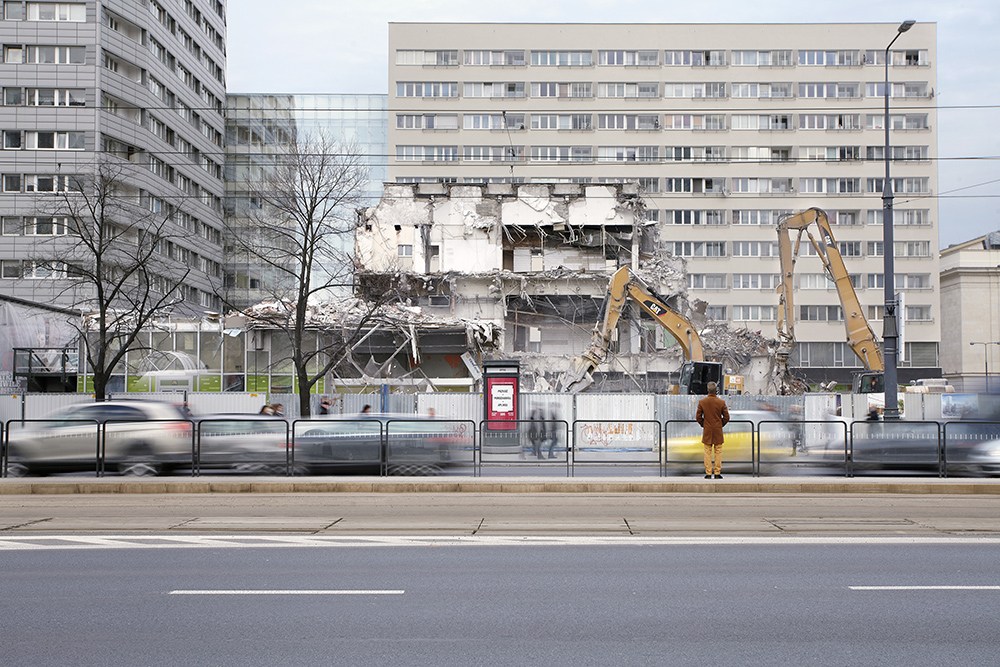
Franciszek Buchner, Sezam Department Store during its demolition on Marszałkowska Street, February 2015, photo by courtesy of Raster Gallery
From 2013 to 2016, the young photographer Franciszek Buchner documented the ruins of Warsaw’s modernist buildings, as well as ones built in the 1990s. Warsaw, a city constantly growing and changing, gradually disposed of the holdovers built under the communist regime after 1989. They have been replaced by office buildings, apartment blocks and shopping malls. Gorczyca writes:
Buchner (…) infuses his works with subtle symbolism. He ascribes monumentalism to the objects he photographs and his frames are static as if intentionally frozen. He consciously uses the skills and poetics of a modern architecture photographer, with their inclination to aestheticisation and fetishisation of buildings.
Sources: Ruins of Warsaw, culture.pl, own materials, edited by Agnieszka Sural, 17 May 2017, translated by AP, 16 Jun 2017