The Ghosts stands out not only thanks to its social theme but also its intriguing form, which shares similarities with the avant-garde and German expressionism. In her debut novel, Ukniewska, who in her youth worked as a dancer in theatres and cabarets, described the backstage of Polish show business, which flourished during the interwar period. The Ghosts was published in 1938 in an atmosphere of scandal, as the book's protagonists bore some resemblance to actual entertainment figures. The novel was hugely popular, and its potential was also noted by filmmakers, both pre- and postwar. In 1979, Stanisław Lenartowicz directed a television miniseries with Izabela Trojanowska in the leading role, and later on, in 1982, its cinema version, titled Tears Won't Help. It was, however, the first adaptation, realised by an ambitious team of artists previously connected to the renowned START association which made history in Polish cinema.
The main protagonist of The Ghosts is Teresa Sikorzanka (played by the debuting Hanna Karwowska), a revue theatre dancer dreaming of a great artistic career but presently hardly making ends meet. The girl has a crush on the singer Zygmunt Modecki (Eugeniusz Bodo), the theatre's biggest performer, but she doesn't want to end up as just one of the stage Casanova's many lovers. She eventually surrenders to the artist's charm and, ignoring her mean aunt's (Mieczysława Ćwiklińska) warnings, she spends a night with him. When the day after Modecki is rude towards his lover, the girl is offended and decides to avoid any further contact with the man. Soon, an opportunity for this arises: when the theatre is shut down as a result of the malpractices of the manager Fensterglass (Jan Kreczmar), the heroine leaves to perform in the countryside, not disclosing her address to anyone. Meanwhile, Modecki begins to understand his mistake and ventures on a search for the dancer.
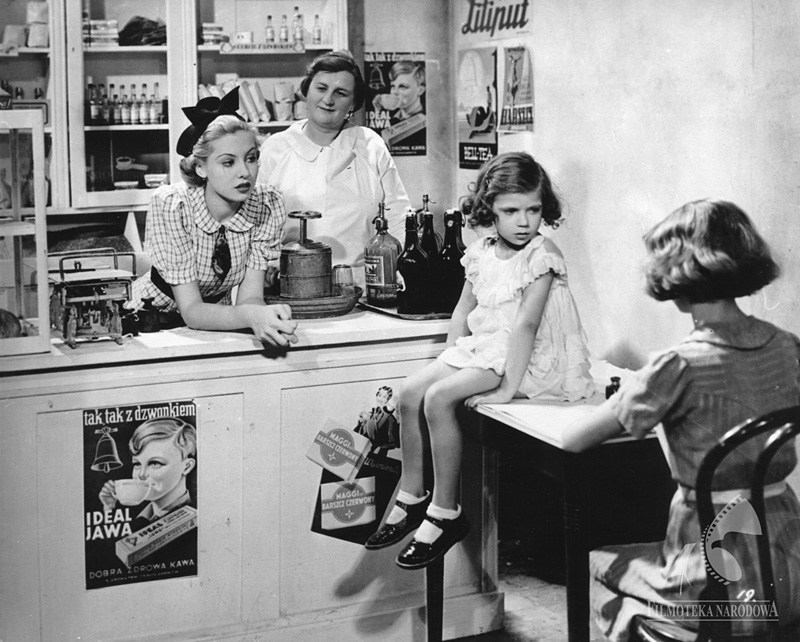
The Ghosts (Strachy), dir. Eugeniusz Cękalski, Karol Szołowski, 1938, in the photo: Hanna Karwowska, Helena Buczyńska (shop assistant), photo courtesy of the National Film Archive/www.fototeka.fn.org.pl
The plot of The Ghosts borders on kitsch, but Cękalski's and Szołowski's film is much more ambitious than typical pre-war Polish romantic movies. Its creators highlight the dramatic social position of women, who, apart from financial difficulties, also have to struggle with cultural problems. Men cynically exploit their dominant professional status towards their romantic conquests, at the same time condemning their lovers, accusing them of greediness and immorality. While being understanding towards the hard life of dancers, Cękalski and Szołowski fortunately escape sentimental clichés. The main protagonist is much more realistic than the pristine, agonised women from the conventional tear-jerkers. Teresa finds herself in a difficult material situation and goes through a crisis, but she can manage. This is already apparent in the first scene, when the girl, whilst longing for Modecki, simultaneously… steals his cigarettes.
The Ghosts was produced by the Cooperative of Film Authors (SAF), a studio founded in 1935 with the intention of creating ambitious films. The directors Eugeniusz Cękalski and Karol Szołowski, as well as the cinematographer Stanisław Wohl, previously of the START Society of the Devotees of Artistic Film, wanted to introduce a new quality to Polish cinema and make films which were not only socially engaged, but also formally interesting. In this adaptation of Ukniewska's novel, the titular ‘ghosts’ – fears haunting the main character and other unfulfilled and precarious employees of second-rate theatres and cabarets – are represented in a very suggestive audiovisual manner. Teresa's anxiety-filled internal monologues, superimposed images, which express her subjective visions, aand chiaroscuro conjure a dark and gloomy atmosphere, especially in the drama's climactic moments. The film's creators very often juxtapose the energy-filled, joyful dance performances with depressing scenes from the life of artists. The most distinctive character in this world is the tragicomic Dubenko (Józef Węgrzyn), a talented balletmaster with the soul of a poet who drowns his sorrow and melancholy in hectolitres of alcohol. Even though music and dialogue play a very important role in The Ghosts, a lot of formal solutions were inspired by the poetics of silent cinema, which in 1938 could be considered anachronistic. From today's perspective, however, it is this film's unique style that distinguishes it from other Polish works from that period. Unfortunately, the outbreak of the Second World War thwarted further development of the filmmakers' project. Karol Szołowski never made another full-length film again, while Eugeniusz Cękalski came to occupy a rather shameful position in the history of post-war cinema, having directed Bright Fields, the first Polish socialist realist production, which lacks any traces of his early inventiveness.
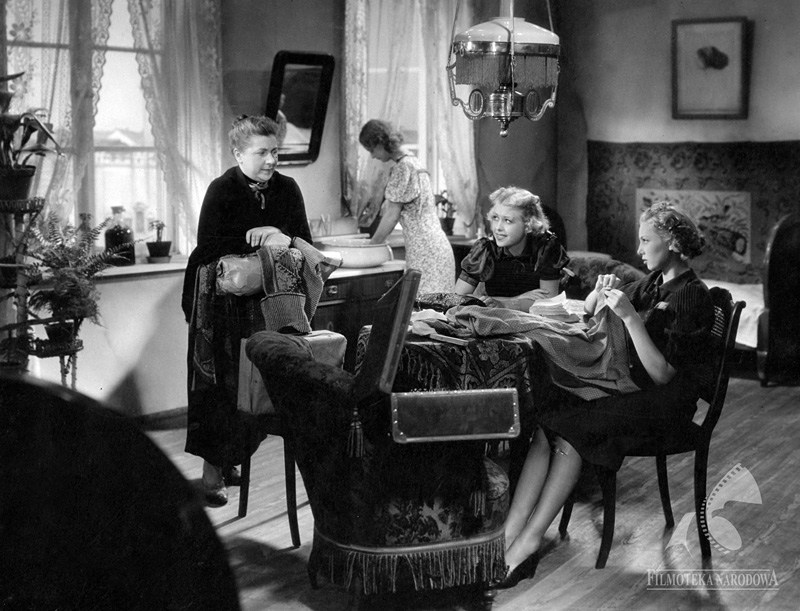
The Ghosts (Strachy), dir. Eugeniusz Cękalski, Karol Szołowski, 1938, in the photo: Pelagia Relewicz-Ziembińska, Hanna Karwowska, photo courtesy of the National Film Archive/www.fototeka.fn.org.pl
The Ghosts (original title: Strachy), Poland 1938. Directed by Eugeniusz Cękalski, Karol Szołowski. Screenplay: Eugeniusz Cękalski, Karol Szołowski, Stanisław Wohl. Cinematography: Stanisław Wohl, Adolf Forbert. Scenography: Jacek Rotmil, Stefan Norris. Cast: Hanna Karwowska (Teresa Sikorzanka), Eugeniusz Bodo (Zygmunt Modecki),
Jadwiga Andrzejewska (Paulina 'Linka' Kłoskówna), Józef Węgrzyn (balletmaster Dubenko), Jan Kreczmar (Fensterglass), Mieczysława Ćwieklińska (aunt Aniela), and others.
Produced by the Cooperative of Film Authors. Black and white, 94 mins.
