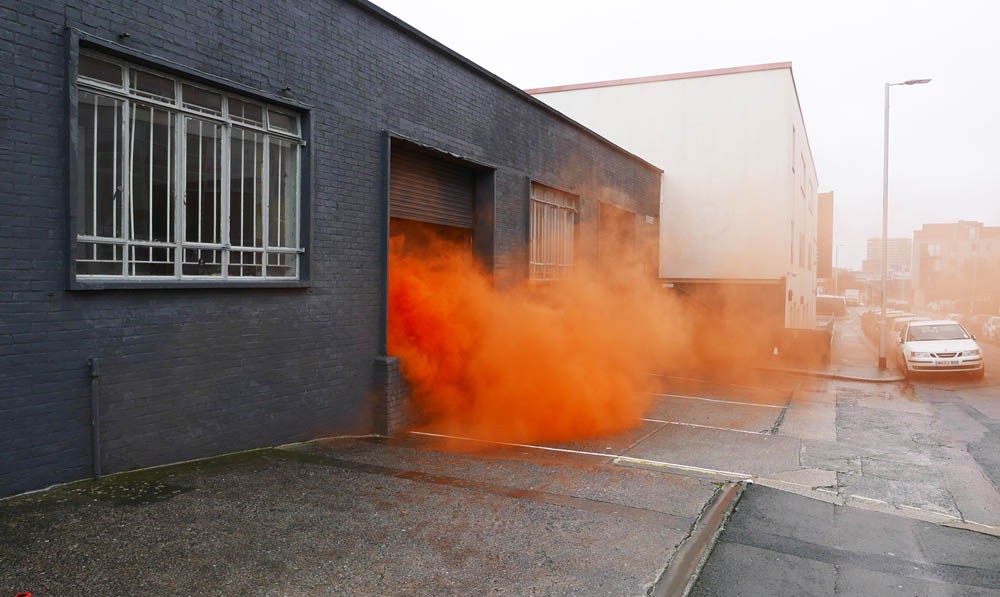
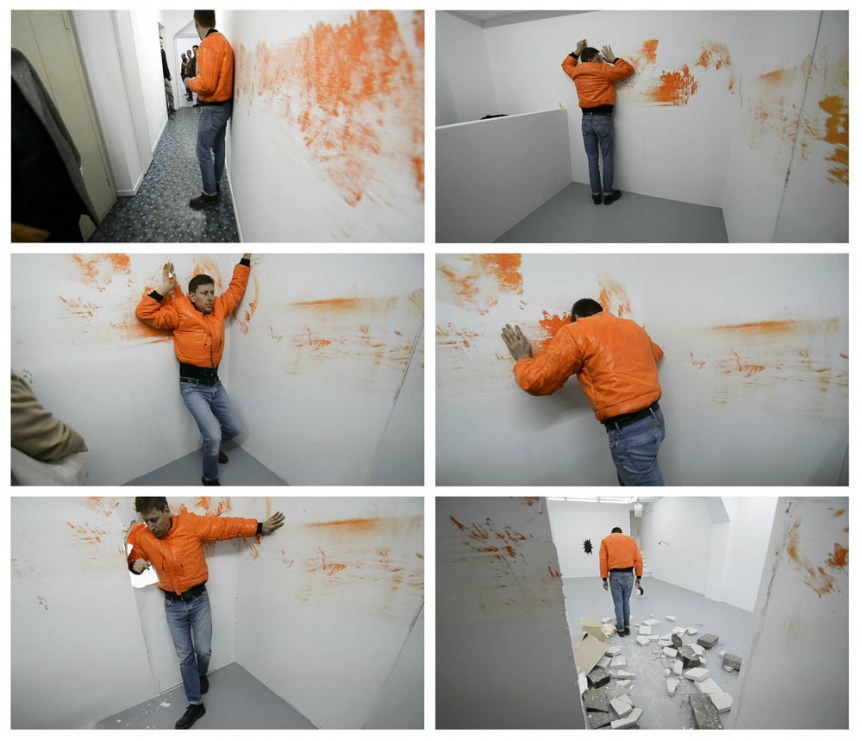
One of the objects most used by Dudek is a military jacket turned inside-out, revealing the orange inner lining. In the 1990s, this jacket was very popular among football fans. Today, in Eastern Europe, orange functions as a token of opposing those in power and the establishment. At the turn of the 1980s in Poland, it was also a symbol of Orange Alternative’s anti-communist happenings, and at the beginning of the 21st century – of the political revolution in Ukraine. Orange is also a colour symbolising aggression – a form of a visible manifestation, contrasting with grey.
During many years, Dudek also amassed an archive of photographs published in underground zines and on internet forums. They form the Too Close For Comfort series, which also shows photo snippets from police archives, showing the artist as a member of the events of the time. The documents confirm the authenticity of his adolescent actions, which today is a matter of artistic interventions connected to the aesthetisation of violence.
In his large-format collages Dudek undertakes the issues of the architecture of the spectacle, working on reconstructing specific events, in which the very buildings and sport events determine the crowd’s behaviour. The stadium is the society’s true Theatrum Mundi, a place which is almost always at the centre of a large-city community (for example the Roman Colliseum, London’s Wembley, and Warsaw’s National Stadium), where hooligan riots interweave with the colourful setting’s choreographic beauty.
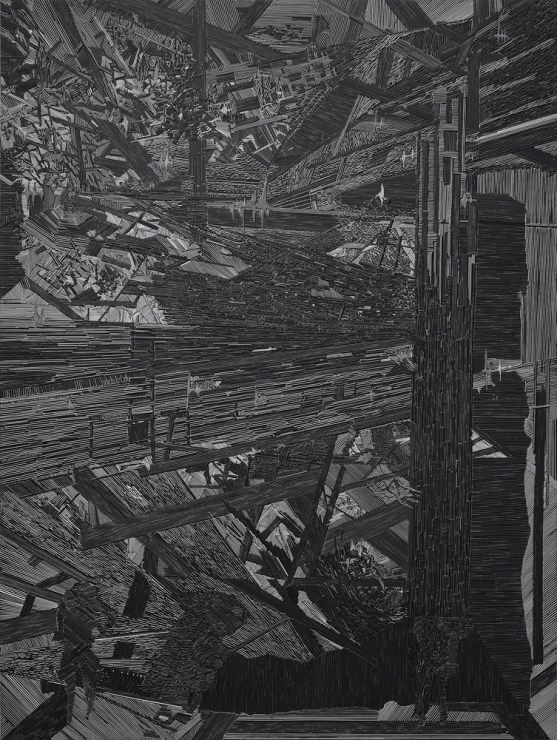
Dudek analyses the crowd’s psychology by using the language of visual abstraction. The attentiveness to detail is supposed to identify the anonymous mass, giving in to uncontrollable emotions. The collages cut with a knife aestheticise anarchy and violence and recapture the state of aggression under the form of a multiple image. They are mostly black and white and resemble an x-ray photograph of a crowd. They become an anatomical study and examine the essence of chosen events, for example, the aggression of a crowd storming a construction site or planned riots in the city and stadium area. In his works, Dudek introduces the structure of specific buildings, such as Heysel and Hillsborough, which went down in 20th-century history not thanks to sports but due to tragic events. They were the scene for the moment in which the audience became the play’s main actor. A skeleton looming over the events presented in the Heysel work, foreshadowing the incoming death, is there for a reason. The second work, picturing Hillsborough, presents the multilayeredness of the 1989 events in Sheffield, where, due to an overcrowded stadium, the crowd was crushed. Furthermore, it also visualises the crushed crowd’s dramatic screams, which is why it also works on senses other than sight.
The entirety of the collage’s composition has an abstract form, which shows the perspective of a singular behaviour in the crowd and architectural space. His works touch upon political-historical and universal issues of the out-of-control crowd’s unpredictability. In this way, similar to his performances, Dudek deconstructs the idea of aggression, which, often unconsciously, is unleashed in the space of the given architecture.
-
2017 – Przesilenia, BWA Katowice, Poland; 10 Summer Afterimages, Galeria Leto, Warsaw, Poland; Dallas Art Fair, Harlan Levey Projects, Dallas, US; Art Central Hong Kong, Yeo Workshop, Hong Kong; ZonaMaco, Harlan Levey Projects, Mexico City, Mexico; In/Out, Greylight Projects, Belgium
-
2016 – Imprints, Harlan Levey Projects, Belgium; The Earth Is Our Radio,Karts, Plymouth, UK; Bazaar Art Jakarta, Yeo Workshop, Jakarta, Indonesia; Art Brussels, Harlan Levey Projects, Brussels, Belgium; Dallas Art Fair, Harlan Levey Projects, Dallas, US
-
2015 – No Matter How, Round and Square, Sala Projeto Fidalga, São Paulo, Brazil; Wall & Mass, Officielle Fiac, Edel Assanti, Paris, France; Revers de Trompe, Academy of Fine Arts Vienna, Vienna, Austria; One way or another – investiga–se o ISSO, Platforma Revólver, Lizbon, Portugal; Department of Subterranea, Art Brussels, Harlan Levey Projects, Belgium; Borders in Motion, Sculpture Project, Dallas Art Fair, Dallas, US; Department of Subterranea, Art Los Angeles Contemporary, Edel Assanti, Los Angeles, US
-
2014 – Deformation Der Stille, Galerie 5020, Austria; I Wish I Had a River, Harlan Levey Projects, Brussels, Belgium; All My Scars, Art Brussels, Harlan Levey Projects, Belgium; Anywhere Out of My Worl, The Loft, Brussels, Belgium; Big Inch, Dallas Art Fair, Edel Assanti, Dallas, US; Wild, Art Rotterdam, Edel Assanti, Netherlands;
-
2013 – Park + Ride, Verbeke Foundation, Belgium, Subterranea Mondial, Art Brussels, Waterside Contemporary, Belgium;
-
2012 – Diagrammatic Form, Banner Repeater, London, UK; Subject to Change, Deconstruction Project, Southend on Sea, UK; Polish Contemporary Arts, Rich Mix, London, UK; At least the “theme” for the moment..., Quase Galeria, Porto, Portugal; Kopalnia i Fantom, Bunkier Sztuki Contemporary Art Gallery, Kraków, Poland; Things That Have Interested Me, Waterside Contemporary, London, UK; Now&After12, Moscow Museum of Modern Art, Moscow, Russia; Snapshot, Galerie Nadine Feront, Brussels, Belgium; Winter Pavilion, Waterside Contemporary, London, UK;
-
2011 – Exico, 16th Biennial of Cerveira, Portugal; Cellar Television, Vienna Art Fair ,Waterside Contemporary, Austria; I Will Eat This Sleepy Town, Waterside Project Space London, UW; Project of Absorbing the Other, Galerie8, London, UK;
-
2009 – Art in an Ephemeral Age, The Art Festival at Hay, UK; XV Bienal de Cerveira Vila Nova de Cerveira, Portugal; Transfer, Galeria Sub–Carturesti Bucharest, Romania;
-
2008 – Visions in the Nunnery, The Nunnery Gallery, London, UK; Pumping Station, London, UK;
-
2007 – Out of the frying Pan into the Fire, Espace Uhoda Liege, Belgium; 11.472, Bargehouse Oxo Tower Wharf, London, UK;
-
2006 – Multiplier, Whiteclub Space Salzburg, Austria; Identikit, Temporary Contemporary Gallery London, UK;
-
2005 – Blick A Blick B, Curated by Tanja Widmann and Johannes Porsch, Salzburger Kunstverain, Salzburg, Austria; Blachowo bzw. Prowizorycznie, Schloss Goldegg Goldegg, Austria