Table of contents: Early life | Demarczyk - Konieczny / Piwnica pod Baranami | International career | Ewa Demarczyk - the movie | Farewell to Piwnica pod Baranami | Retirement |
It sometimes happens in the world of music that an entirely exceptional figure emerges. One that is far beyond judgement and immune to comparisons with other artists – one whose defining features are her uniqueness and an originality that cannot be duplicated. Ewa Demarczyk is certainly one of these artists. She had been likened to Juliette Greco and Edith Piaf, while her interpretations had drawn comparisons to those by the masterful Jacques Brel. And yet, each of these links tells us very little about the hidden art of this remarkable singer.
Early life
She was born on 16th January 1941 in Kraków. She had a marked penchant for music from an early age, and was a likely candidate for a successful career playing the piano. But after she graduated from music school as a teenager, it turned out that the stage had much more to offer her than piano recitals. For Ewa Demarczyk, that was the time to explore; she was not sure which of her interests to concentrate on. Apart from studying the piano at the Music Academy and signing up to study architecture, she also dabbled in acting. It soon turned out, however, that music and singing became her everything.
The plan to study architecture was quickly abandoned, and she quit her piano studies at the Music Academy after the first year. She dedicated all her attention to studies at the PWST in Kraków, which she finished in 1966 as a celebrity. Student life gave her the opportunity to perform her stage debut: at the very outset of her career, Demarczyk worked with the Kraków-based club Cyrulik, the heart of the Medical Academy’s active cabaret. Her debut took place in 1961. News of an interesting singer performing at the Cyrulik took Kraków by storm, only to reach the Piwnica pod Baranami cabaret, which would not let a chance like this pass them by.
Demarczyk-Konieczny / Piwnica pod Baranami
A year after her debut, Ewa Demarczyk joined the Piwnica team in 1962. Her involvement in the famous cabaret owed much to Zygmunt Konieczny who, encouraged by Przemysław Dyakowski, set off to the Cyrulik to listen to Demarczyk’s beautiful voice with Piotr Skrzynecki. The owner of this voice became arguably the most important artist in Konieczny’s career, himself a talented composer whose songs played a huge part in shaping Piwnica pod Baranami’s musical character.
The Demarczyk-Konieczny duet is, to this day, the symbol of a unique and congenial method of collaboration: together, they constructed a musical masterpiece and shaped an exceptional relationship between composer and singer. Konieczny found Demarczyk to be his ideal medium. The singer not only interpreted his compositions in a remarkable manner, but also extracted that ‘something more’ and used them to build entirely original creations that stand out among Polish classics today. Karuzela z Madonnami, one of Demarczyk’s first hits, boasts an exquisite composition and a wonderful interpretation of Miron Białoszewski’s lyrics; it does a fantastic job enacting the movement and rush contained within the words, and captures the atmosphere of the dreamlike eponymous theme park in a triple meter. Indeed, all performances of the song have been very much praiseworthy, but it is only Demarczyk’s interpretation that transforms Karuzela z Madonnami into a true masterpiece; Demarczyk gives full force to that which the lyrics fail to clarify – that which is concealed between music and word. She is statuesque, serious, and at the same time filled with energy, sparkle and life-giving force. There is no need to further reiterate her technical vocal possibilities: her tempo and diction become the tools of poetic expression. Her performance has nothing to do with a shallow balancing act. It does, however, contain a complete reading of Białoszewski’s poetry and Konieczny’s music. This completeness, which comes across in an individual reading of the poet, is a carousel – and this carousel will always whirl and reverberate in Demarczyk’s own voice. It’s not surprising, then, that when she sang Karuzela z Madonnami, Ewa Demarczyk became the star of Piwnica pod Baranami, and therefore the star of Kraków.
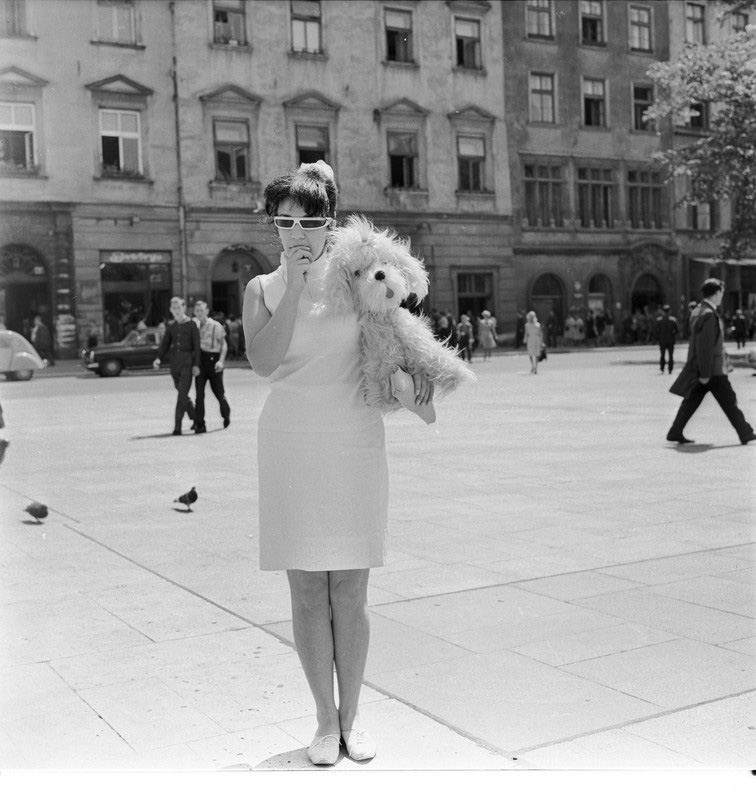
Ewa Demarczyk, 1967, photo: Harry Weinberg / Fotonova
After accomplishing local success (in 1962 she also won the First National Student Song Festival with Karuzela z Madonnami), it was time for her appearance in front of the whole nation. It didn’t take long. After winning the hearts of Cracovians, Demarczyk won the hearts of the whole of Poland when she sang at the First National Festival of Polish Music in Opole, performing Czarne Anioły and Taki Pejzaż. Nobody could compete with her in Opole. Just as big beat was growing more and more popular, she appeared on stage with an ambitious, difficult and original repertoire that was simultaneously determined, dark and powerful. She gave the audience that which Polish rock was still unable to give: artistic independence, a sophisticated fusion of honest, direct emotion and artistic expression that was perfected down to the last detail.
Her creations were striking, and still are. They feature an ascetic economy of gesture, black clothes, motionlessness. And there’s the face: like a mask from ancient theatre, with an unmoving yet piercing stare – the eye never wavers. Blind, or perhaps the opposite – capable of seeing everything, the entire complexity of the world that she sings about. Capable of insight into things invisible to the concert goers. Her gaze is fixed on a point far above their heads, which appears to be the source of all the poetry she had ever sung. Her voice was the vehicle bringing two realities together: the poetic, and the earthly. Blackness is meant to fuse the artist with the stage, gesture and grimace cannot distract from the process, the face cannot divert the listener’s attention from the song. It is the word in its motionlessness that underlines and emphasizes the music. The word, set in motion by Zygmunt Konieczny, brought into life and material being on stage by Ewa Demarczyk. An incredibly varied word it was, and it responded to many strings of poetry: Czarne Anioły (Wiesław Dymny), Deszcze (Krzysztof Kamil Baczyński) czy Grande Valse Brillante (Julian Tuwim).
1963 stands out as the height of Demarczyk’s career. That year saw the release of her first album, which featured Karuzela z Madonnami, Taki Pejzaz and Czarne Anioły (in versions that Demarczyk deemed better than those on her later, debut long-play album). Straight after the Festival in Opole, she was invited to the Third International Song Festival in Sopot, where she won a special award for the originality of Czarne Anioły.
International career
In addition to festival appearances, she had an independent, individual recital at the Summer Theatre organised for her. This was especially significant in the context of her later stage career. At that time, Bruno Coquatrix, director of the Paris Olimpia Music Hall, was also in Sopot. Amazed by Demarczyk’s performance, he invited her to Paris. The artist declined his offer. She decided that it was more important for her to finish Theatre School. This anecdote shows Ewa Demarczyk’s personality very well – a personality that shone through from the earliest years of her career. If art is to remain art, it must be treated with gravity, and requires hard and constant work on the voice, on the lyrics, on their interpretation. And this is why the school, which taught her all these, became more important than a lucrative and prestigious trip to Paris. It was as if Demarczyk had known that she would sooner or later get to Paris anyway – and if she delayed the trip in order to develop as an artist, then it would only result in positive things for her as an artist. Bruno Coquatrix didn’t have to wait until Demarczyk’s graduation, however. She sang at the Paris Olympia Hall in 1964 and won widespread critical acclaim in France, which included press articles, cover shoots and further performances.
After France, she gave concerts in Belgium, Switzerland, Sweden and other European countries. She always sang in Polish. She did not succumb to the fashion of singing in her host country’s language. According to Demarczyk, the poetry she gave voice to was meant to defend itself, without the need for translation. If this was really the case, then it happened thanks to the singer’s exceptional stage personality: she conveyed the meaning of the song in a kind of musical sign language, thus translating the Polish language into all the languages of the world.
Apart from foreign travels, the year 1964 also brought Demarczyk more national success – for example, a prize for Grande Valse Brillance at the Sopot Festival. Concerts abroad and in Poland, performances at Piwnica pod Baranami, awards (Sopot 1965 and Wiersze Wojenne to Baczyński’s lyrics). All this lasted until 1966, when significant changes shook the artist’s life. She finished Theatre School and started independent work with her own band. Above all, she decided to end her collaboration with Zygmunt Konieczny (the reasons for this artistic divorce remain unclear) and began working with composer Andrzej Zarycki.
Between January and February 1967, the artist recorded songs which appeared on her debut album Ewa Demarczyk śpiewa piosenki Zygmunta Koniecznego (Ewa Demarczyk sings Zygmut Konieczny’s songs). The singer was not entirely happy with the recording.
It is a very poor album. I don’t know why someone would care so much as to artificially darken my voice, which is generally light. Besides, the album is full of technical imperfections. A radio recording can always be erased, but an album remains. (Michalski 1990: 180)
And yet, despite technical flaws, Ewa Demarczyk’s debut album became one of the most important albums in the history of Polish pop music.
As the 1960s came to a close and the 1970s dawned, Ewa Demarczyk travelled extensively to international concert venues: Italy, France, Cuba, Mexico, USA, Australia, Finland. She performed in the world’s most prestigious concert halls, including the Carnegie Hall in New York, the Chicago Theatre, the Queen Elisabeth Hall in London and the Theatre Cocoon in Tokyo. Moreover, it was a time of international artistic success – one example that springs to mind is her award at the World Theatre Festival in Arezzo in 1967. Equally, she tried her hand at film music in Jerzy Skolimowski’s Bariera (Barrier) or Jan Laskowski’s Zbyszek, the latter dedicated to Zbyszek Cybulski.
The composition from Bariera is especially gripping – it’s a song written by Krzysztof Komeda to Skolimowski’s words, entitled Z ręką na gardle. This cosy song is an encounter of two giants of Polish music in the 1960s – Demarczyk and Komeda. Komeda’s surprisingly interrupted triple metre, unnerving sound effects and characteristic melody are wonderfully interpreted by Demarczyk. You can hear the master of jazz, but it is Demarczyk’s canto that lifts the composition out of its song status and raises it to the very heights of artistic mastery – one that grips you whole, impressed, terrified, troubled.
Ewa Demarczyk: the movie
In 1970, a music film bearing the title of Ewa Demarczyk was produced. This thirty-minute recording of her concert, directed by Jan Laskowski, remains one of the most important documents of her career. It brings to the fore something that is essential to Demarczyk’s songs: that which operates beyond the direct poetic word, and the music that plays along. Not much, it seems, somewhat monotonous – but after a moment, this uniform picture reveals that the smallest shiver, grimace, gaze and nod become more powerful as signs than all the frenetic stage shows that cotemporary music has to offer.
Unfortunately, the film was only available on television, and Demarczyk’s second album had the fans waiting until 1974 (seven years after her debut!). The album was produced by the Russian studio Melodia. It contained early hits, this time performed in Russian, as well as Polish songs – be they new or previously unreleased.
Farewell to Piwnica pod Baranami
In 1976, Demarczyk bid farewell to Piwnica pod Baranami, though their artistic parting can be traced back to 1972. She often performed, travelled the world, but to the detriment of the contemporary public – she recorded very little, and not much is known about her artistic life back then.
A double concert album was finally released in 1979. Exceptional, and – to this day – entirely reflective of the unique atmosphere during her recitals. Unfortunately, it was also the last release in the singer’s all-too-modest discography. Since the end of the 1970s, not only did Ewa Demarczyk put a stop to studio recordings, but she also gave concerts less often. Instead, she got more involved in the management of Kraków’s Music and Poetry Theatre, also known as the Ewa Demarczyk Theatre since 1985. The artist was gradually pushed away from stage appearances as she encountered problems with managing the theatre, becoming engrossed in confrontations with the city’s authorities, unclear legal arrangements regarding the theatre’s location and attempts at finding a new one. In the mid-1990s, Demarczyk could still be seen performing, but not today – not anymore.
Retirement
Ewa Demarczyk withdrew from public life and successfully hid away from journalists and fans alike. The reasons for her decision are unclear, but we should not try to discover them, just as we should not be surprised by Ewa Demarczyk’s silence. She always found ways to separate her personal life from her life on stage. From the very beginning, she avoided interviews – and in the ones she did give, focused entirely on art and the stage. She did not wish to appear as a friendly face or the girl next door, she did not wish to project the image of a star. She did not want the private, unmusical and unpoetic voice to affect her stage presence. It was the stage voice that was her real, personal, only voice. When it was time for that voice to stop speaking (there may have been many reasons, unimportant though they are), she decided to go silent, leaving behind her recordings in which she still sings as well as she possibly could, in a way that is complete and fully intense. A categorical withdrawal from the media, all in the name of art; in times of televised comebacks, reactivations, re-editions, enriched versions and remakes, such a decision should certainly grant Demarczyk approval. Not many people are still capable of thinking about art in such absolute categories.
Years went by and no trace of Ewa Demarczyk remained. But time cannot erase the musical memory of the Dark Angel. She was still hugely popular when she passed away on 14th August 2020.
Author: Mariusz Gradowski, December 2011; Translation: Ewa Bianka Zubek, December 2013

