Having finished his studies in Kraków, Rycharski came back to his homeland – the village of Kurówko in Mazovia. His artistic activities in rural spaces, often engaging the local community, soon became widely known in Poland. In 2013, one of the biggest Polish commercial TV stations, TVN, devoted an episode of their reportage programme, Uwaga!, to Rycharski.
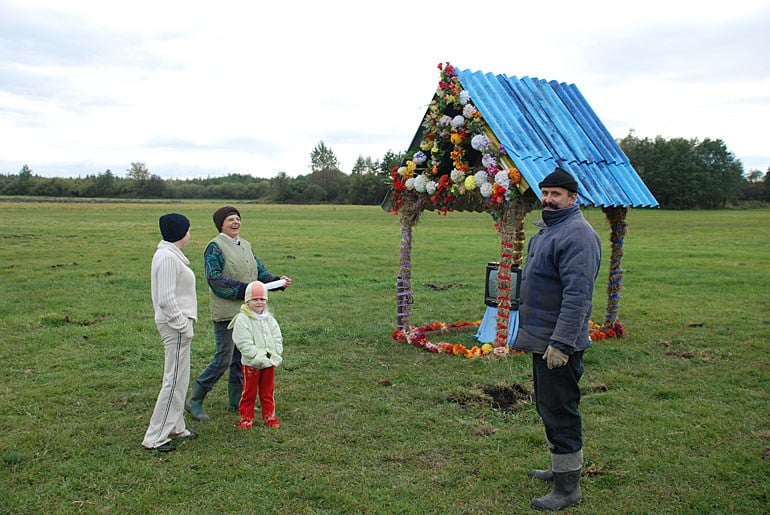
Daniel Rycharski, Multimedia Wild Boar and Bird Repellent, photo: courtesy of the artist
Everything started with a mural depicting a hybrid-animal that Rycharski painted on the house of his grandparents. The depiction, referring to the stories about imaginary creatures aboding local forests, sparked the inhabitants' interest. Many of them wanted to have a similar one done on the walls of their own houses. This is how a series of several dozens of paintings was created – covering the walls of stables, barns, and bus stops. Rycharski was dubbed a creator of rural street art. As he commented in the aforementioned reportage done for TVN done by Ewelina Kuczmińska and Aleksandra Potoczek:
Rural areas are hugely alienated. When it comes to access to culture, they’re excluded. I believe that the inhabitants of villages have the same right to participate in culture that people living in cities have. So I thought something that would help them create art on their own needs to be done.
Soon after Rycharski erected a garden made out of broken agricultural machinery and used 13 acres of a field – handed over to the artist by the village mayor – to construct an installation called Galeria Kapliczka [Roadside Shrine Gallery]. It’s a place of cult devoted to contemporary art, where artistic undertakings are presented.
Next up, Rycharski built a metalwork gate to celebrate the 150th anniversary of abolishing socage tenure in Poland. Another project, Multimedia Wild Boar and Bird Repellent (2011) was aimed at solving the problem of animals destroying local meadows. Today the work functions as a document showing the story behind the work – the construction based on village roadside shrines, in the middle of which a TV set is located. Displaying films about the everyday life of the village dwellers took place in the field – a public rural space. This can be seen as an attempt at renewing social relations. The project is one of the first undertakings by Rycharski in which he uses art as a tool integrating the community.
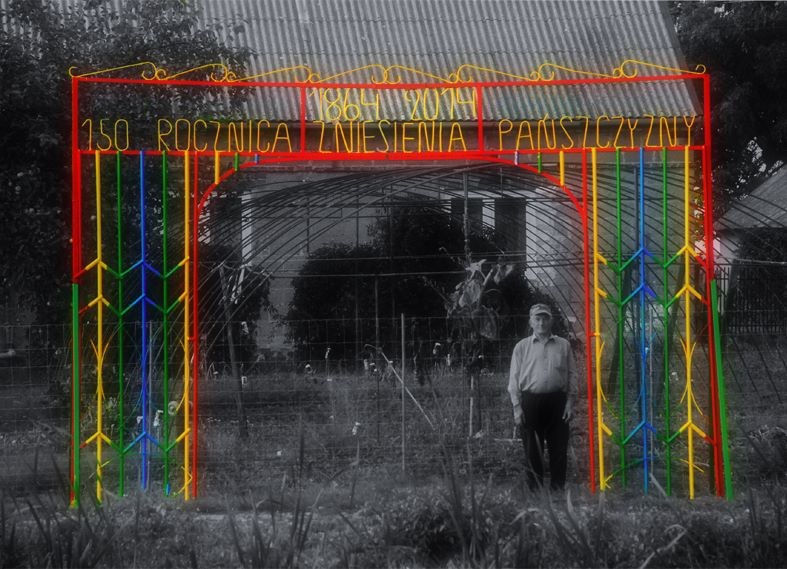
Daniel Rycharski, Brama w Kurówku zbudowana z okazji 150 rocznicy zniesienia pańszczyzny / Gate in Kurówek constructed to celebrate the 150th anniversary of the abolition of socage tenure in Poland, photo: courtesy of the artist
In his works the artists meddles with the stereotypes about Polish province, showing current social and identity problems and another, better side of the countryside. His Monument to a Peasant has been travelling through the regions of Mazovia and Lesser Poland since 2015. The trailer, equipped with an approximately four-metre long boom on which the serf is seated, was presented in front of the old building of the Museum of Modern Art in Warsaw during the exhibition As You Can See. The work was inspired by the graphic art of Albrecht Dürer and was a statue version of the commemoration of the Peasants’ War from the beggining of the 16th century.
In an interview for Culture.pl, one of the curators of the exhibition As You Can See, Sebastian Cichocki, said:
A dream about art which functions, which replaces religious rituals and merges local communities came true in Kurówko. There we find everything we have always dreamed of: working with radical community-minded artists: the spirit of participation, responsibility for the community, a shared sense of authorship, the pleasure of being together, art which develops by itself without the need to be artificially sustained by institutions.
Daniel Rycharski also creates video art. One of his first works was done together with the writer Sławomir Shuty – Oblubienica [The Beloved], recorded in 2008. It narrates a story of a girl living in the countryside, looking for happiness and the meaning of life. In the same year, Rycharski recorded the video What I Was Born For following the convention of a music video and talking about the life of a twenty-year-old girl in a small and poor village of Kurówko. In 2010 Rycharski created Inseminaton – recording his performance during which Rycharski’s naked body both symbolically and literally enters a union with the soil. Two years later (in a co-operation with Michał Zawada) the documentary The Legend of Cineforms, devoted to the improvised light shows that Andrzej Pawłowski did in the 1950s, was recorded.
Originally writen in Polish, January 2017, translated by NS January 2017.

