When she was growing up, she did not think about working in fashion. She wanted to be a film director. In her family home in Katowice the cinema had always been the main topic. She studied history of art at the Jagiellonian University. After graduation she went to Łódź and wanted to apply to the Film School, but it turned out that the deadline to submit documents had passed two days earlier. She decided to wait. She started to work in the antique shop DESA in Katowice and travelled to Kraków to participate in its vivid social life. During one of these visits she met Marian Eile, the chief editor of 'Przekrój' magazine, in one of the cafes.
In an interview conducted by Włodzimierz Kalicki for 'Wysokie Obcasy' she said:
During one of the chats with Marian Eile I told him about my vision of fashion. He immediately decided that I should describe my ideas in 'Przekrój'. I guess he liked the fact that my ideas could be carried out using things that were easily available and cheap. During our first meeting he insisted that I drew and published them. He told me to go to the nearest cafe and come back with a drawing within an hour. Janina Ipohorska had her fashion column and let me join her. (…) I would come with ideas and we would sit to acribe them to the characters, Lucynka and Paulinka, young women who talked about fashion and lifestyle.
First dresses designed (and signed) by Hoff appeared in January 1955 and they were followed by next designs, such as French cut coats or trousers made of 'cajg'. In the 50s, 'cajg' (translator’s note: from German zeug), a cheap cotton fabric, was stocked in all Polish stores, from the Central Department Store to small cooperative shops. And since tight trousers were fashionable around the world then, Hoff suggested to make them from 'cajg'. People loved it. The same happened in the case of 'trumniaki' ('casket shoes'), blacked trainers without laces. Hoff also had an idea of remodelling knitwear blouses that were available at sports shops – they had a long collar and a laced binding. After cutting out the binding, unravelling the collar and putting them on backwards, the blouses would become the trendiest pieces. She wanted people to know what was fashionable. Why? In an interview for 'Gazeta Wyborcza' in 2016, she explained:
Today I feel awkward talking about that, because everything has changed. I'm afraid that not many people can understand it. But then it was very important. That was our fight for freedom, our fight with the Russification. In the 50s this fight included everything: art, culture, interiors, lifestyle, appearance, politics, everything. I was convinced that the ethos of the intelligentsia existed, that the intelligentsia should do something for the country, and not for themselves. That there is the Iron Curtain but we are in Europe after all and we won't agree to be forced out. It was important to make the culture global. And we could see in the streets that the Soviet patterns were invading. The young peasants and workers didn't dominate universities, but they did dominate the streets. They were by definition better, they would get the jobs of the caretakers who could denounce you or the managers who could tell you what to do. We were curious to know what was going on in the west. Even if we managed to listen to the western radio, we listened but we couldn't see. That's why I invented this fashion. I thought that fashion could make people more open-minded, that it taught tolerance. And when you become more open to fashion, you become more open to other things.
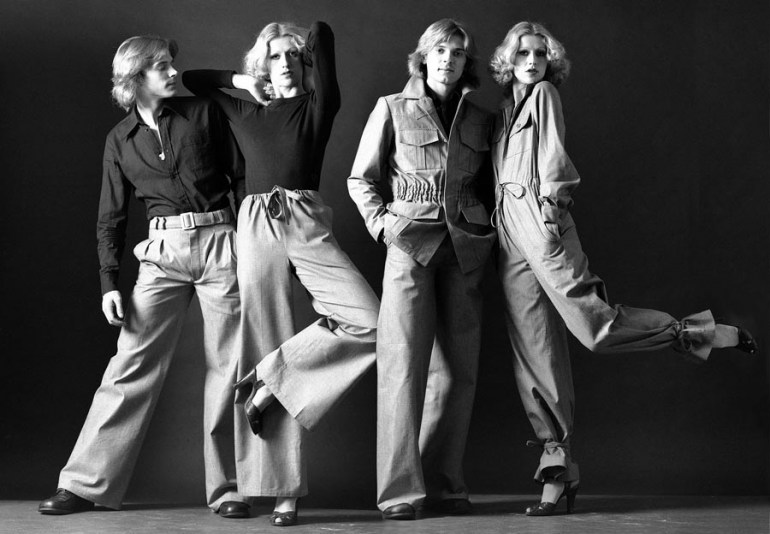
Zofia Rudnicka and Waldemar Wolk Karaszewski in clothes designed by Barbara Hoff, Hoffland, photo: Janusz Sobolewski / Forum
For decades Hoff advised on how to change the look at no cost: 'The neckline is one of these favourable things in fashion that you don’t have to pay for: you need far less material and you can cut your old dress' (1966) or how to get the material for new trousers: 'You do what follows: you buy a tie (it’s not a problem to buy a tie). You give it to your grandpa and in return you ask him for his old trousers. They may be a little worn out, but they’re made of good wool' (1981).
She did not limit herself to giving advice, though. From the beginning of the 60s she had been designing collections – at first for the purpose of the photo sessions in 'Przekrój'. In the interview for 'Gazeta Wyborcza' she said:
I was trying to write my column in 'Przekrój' as well as I could. So first I wanted to check if my dresses looked good in reality. That’s why I would draw a dress, buy a fabric, ask my friend’s mother to cut and sew it and later I would photograph my friends wearing it.
First photographs were taken by Janusz Majewski, who later became a film director. Among the models for 'Przekrój' there were Gerard Wilk, Grażyna Hase, Monika Dzienisiewicz, Sławomir Mrożek, Krysia Morgenstern, Daniel Olbrychski, Krzysztof Litwin, Andrzej Kurylewicz, Wojciech Karolak, Małgorzata Braunek and Wojtek Pszoniak, who even appeared on the cover.
The fashion column in 'Przekrój' was a big thing. In a sense, I had the power over what the people in the streets looked like. But I felt I wanted something different. I didn’t want to tell Poles what to wear, I wanted to make them wear what I designed.
Hoff sometimes went abroad and she knew that clothes which are not expensive can also be fashionable. And she believed that the fabrication of a fashionable blouse costs the same as the fabrication of an unfashionable one. In 1967 she suggested an idea to the management of the Central Department Store (at that time it was the biggest department store, later it was converted into Smyk): she would design dresses, Warszawskie Zakłady Przemysłu Odzieżowego 'Cora' (translator's note: Warsaw Clothing Manufacture Company) would sew them and the Central Department Store would sell them as an original collection of the magazine 'Przekrój' (with an annotation 'Hoff'). That is exactly what happened. The managers of the Central Department Store and Cora signed a contract to produce 11,000 dresses.
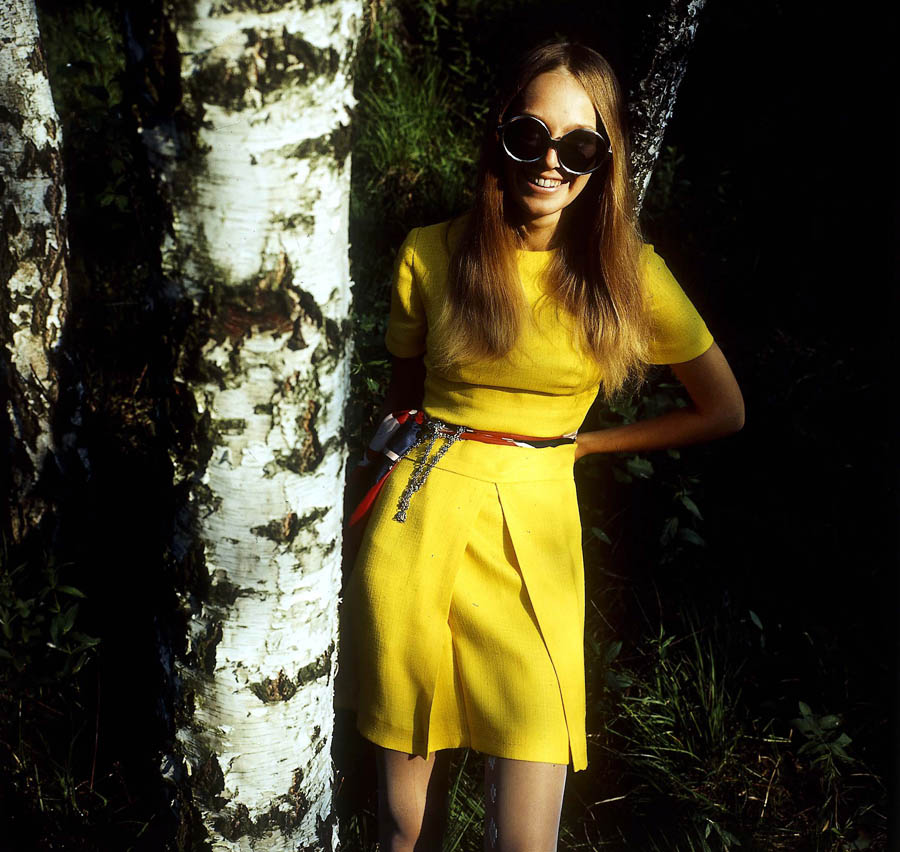
Małgorzata Braunek in a dress designed by Barbara Hoff, photo: Tadeusz Rolke /AG
On the 5th of November Hoff announced in 'Przekrój':
The dresses were sewn in a flash, and we are immensely graceful to all the contractors for that. The collection will be available in the Central Department Store in Warsaw.
Two models photographed by Tadeusz Rolke, Lucyna Witkowska and Iza Łapka, gracefully presented corduroy dresses: sweater-like ones, with a wide roll-neck collar and a back-zipper, shirt-like ones: one dress cut at the waist and the other widening downwards and two loose ones: short and in various colours. Prices ranged from 330 to 380 zlotys.
After a week they appear in the Central Department Store. The panes broke under the pressure of people flooding inside. People took what fell into their hands, regardless of the size and cut. They bought or shoplifted. They even undress the dummies. Belts and ties disappeared. The place turned into hell. The shop assistants locked the designer in the backroom and made her swear that she would never do that to them again. And yet she did – she designed a collection made of velvet and white lace. And again people went mad, queued and trampled themselves. A few months later Barbara Hoff told Teresa Kuczyńska in 'Ty i Ja':
I don’t wish those nerves to anybody, those days spent on fighting with the producer of the ring zip. This ring has to be there, because this cheap dress owes its charm to it, and this wiry ring is the hardest thing to get. I shed a lot of sweat and blood, believe me.
In 1969 she started to run her stall in Junior, the first one of the Centrum Department Stores. The assumption is the same: the clothes will be made of fabrics that are available even if they are not fashionable. What was important was a fine cut and a good idea. And again corduroy dresses reigned: dark red dress with big blue pockets and a wide collar, a pink dress with a blue laced gusset and a high stand-up collar, a blue dress with beige trimmings and a hit, a dress named 'Mariola': a yellow one with a navy blue vertical stripe, a button neck and pockets, also on sleeves. The name was invented by the musicians from the band Silna Grupa pod Wezwaniem, famous after the Opole festival. They appeared in the session which promoted the collection in 'Przekrój'.
Zdzisław Kozakiewicz, who was then the manager of the Junior Department Store, recalls:
Barbara's stall was the frosting on the cake. The Centrum Departments Stores were an experiment in socialist trade. We did not come under any unification, we bargained with the industry on our own, without the intermediation of Spółdzielcze Przedsiębiorstwo Handlu Wewnętrznego (translator’s note: Cooperative Internal Trade Enterprise). Some people said that they were favouring Hoff, but for the Centrum Department Stores that was a promotion. And, indeed, next to her stall there were always many people, queues all the time. If we could, we would have extended the stall, but it was impossible.
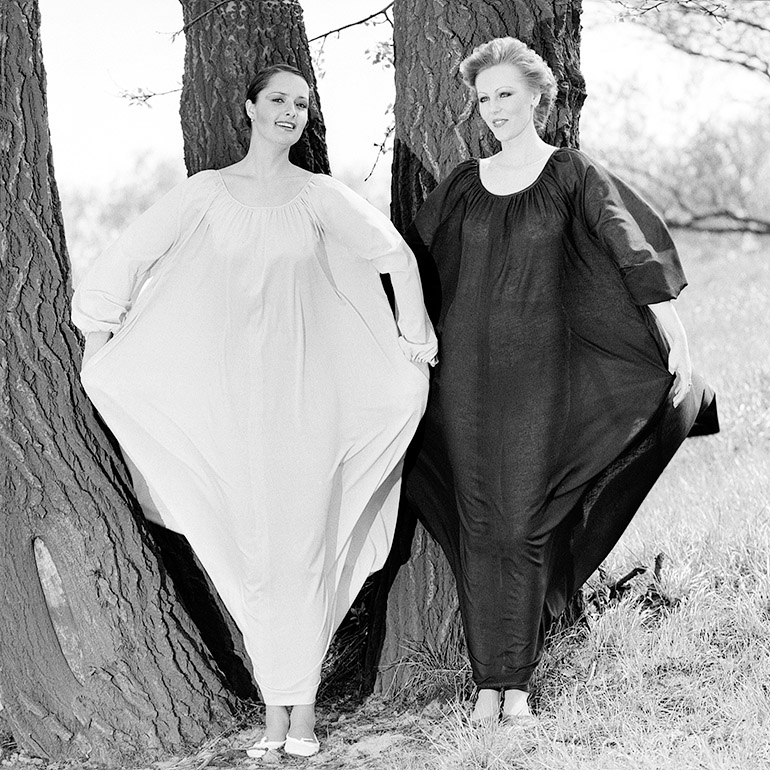
Barbara Hoff, SS Collection, photo: Janusz Sobolewski / Forum
At the beginning of the 70s the stall received the name 'Hoffland'. There were trips from all over the country coming, and Hoff travelled around Poland. She went to Tarnów, Częstochowa, Szczecin, Bielawa, Łódź, Białystok, Bydgoszcz, Kielce, Siedlce, Głuchołazy, Pułtusk. At the best of times she collaborated with almost fifty manufactures and clothing producers cooperatives. She ordered buttons in one place, she talked about fabrics in another, she commissioned the production of blouses in Szczecin and of trousers in Krosno. 'I really don't know why clothing manufactures destroy the patterns of others. They don't destroy mine. Of course I care about what's happening with my project while it's in the making', she told journalists when they asked how she managed that.
She designed clothes that people queued for and their users remembered them even after decades passed: grandpa's shirt, that is a cotton shirt with decorative semicircular gusset in the front, floral dress, military jacket-like parka, long flannel dresses, shirts with Chinese characters, male floral linen jackets, dresses with Gauguin-inspired imprints and finally a number one in the 80s: cotton dresses, sweatshirts and T-shirts with an inscription saying 'Hoffland'.
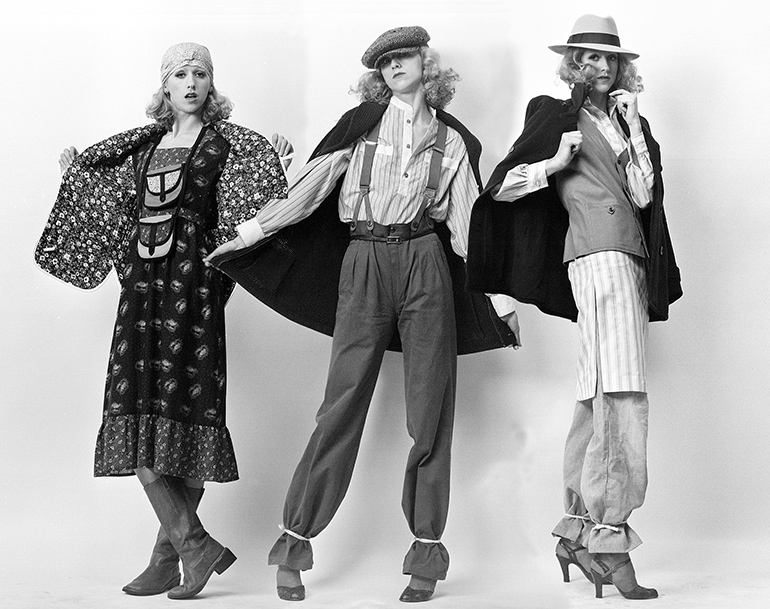
Barbara Hoff’, SS Collection, photo: Janusz Sobolewski / Forum
However, she did not neglect 'Przekrój'. In the 60s in her reports from Paris she described the collections by Pierre Cardin, Balenciaga and Givenchy. In the 70s, when the Parisian prêt-à-porter stylists started to dethrone the haute couture designers, Hoff noticed that immediately. When the Japanese designer Kenzo Takada became a sensation, she knew he was an important designer. When among other trends the glowy and shiny disco clothes appeared, she was unmistakably convinced that these were the clothes that would take off. When Vivienne Westwood and Malcolm McLaren invented punk fashion in London, the readers of 'Przekrój' got first-hand news. When the transformation was taking place, it could be read from Hoff's column. And although she had a feeling that she had taken out a brick from the Iron Curtain, she was aware of what the reality looked like. That is what she told in the interview for 'Gazeta Wyborcza':
Nobody said 'What a success!'. They said: 'Do something to make the queues smaller'. In the one part of the country I sewed the top part, in the other – the bottom, and in yet another part – a blouse so as to make everything match somehow. It was all carried out while there was a complete lack of materials and the manufactures and cooperatives complained that I was bothering them. People would curse! (…) One time a liftwoman kicked me off the lift when I was carrying a pile of boxes with shoes. She told me that was a lift for workers. In the lift she had the power, so she could do it. In the Centrum Department Stores I didn't have a desk or a chair, I worked at home, I drove my own car. In 'Przekrój' they told me that I had a shop in Warsaw and that was why they paid me the lowest rate. When I had a heart attack I remember I thought with relief: 'Oh God, it's my first day off work since eleven years'. Well, actually it wasn't a day off, because there was a deadline in 'Przekrój', I had to send the text for my column. Nobody can enter the intensive care unit, but of course there are ways to achieve everything and my husband managed to come in. He was kneeling next to my bed so that nobody could see him, and I was dictating. There were photos prepared to be published spread on the table at home. Of course, I remembered them. I told him which ones to take and what descriptions to write. He did all this and sent the text in time. They paid me 30 zlotys per line. Today it would be 3 zlotys. Why? Because the text was short. It was then I felt that I was losing my temper with 'Przekrój'.
She cooperated with 'Przekrój' and the Centrum Department Stores until the late 90s, although after the transformation everything lost its shine. There were many novelties around, so clients queued in other places.
In 1978 Barbara Hoff published a set of columns named Cierpienia Starej Werterowej (translator’s note: Sorrows of Old Mrs Werther). Małgorzata Gierycz wrote in a review in a monthly magazine 'Nowe Książki' (translator's note: 'New Books'):
She is more of a phenomenon than a person, just as if she were renouncing her identity, sex and name. Despite this depersonalization, Hoff remains absolutely individual, despite her asexuality, she clearly remains feminine and despite her fantasy and imagination, she remains true.
And that's also partly the Barbara Hoff of the 2000s. Together with her husband, Robert Kulesza, she visits new restaurants, walks around the city, she's up to date with the exhibitions and, although with less and less enthusiasm, also with the cinema. She consistently refuses to anybody who wants to write down her memoirs. She exists as a phenomenon, but keeps her story to herself.
Written by Aleksandra Boćkowska, translated by MW, February 2018

