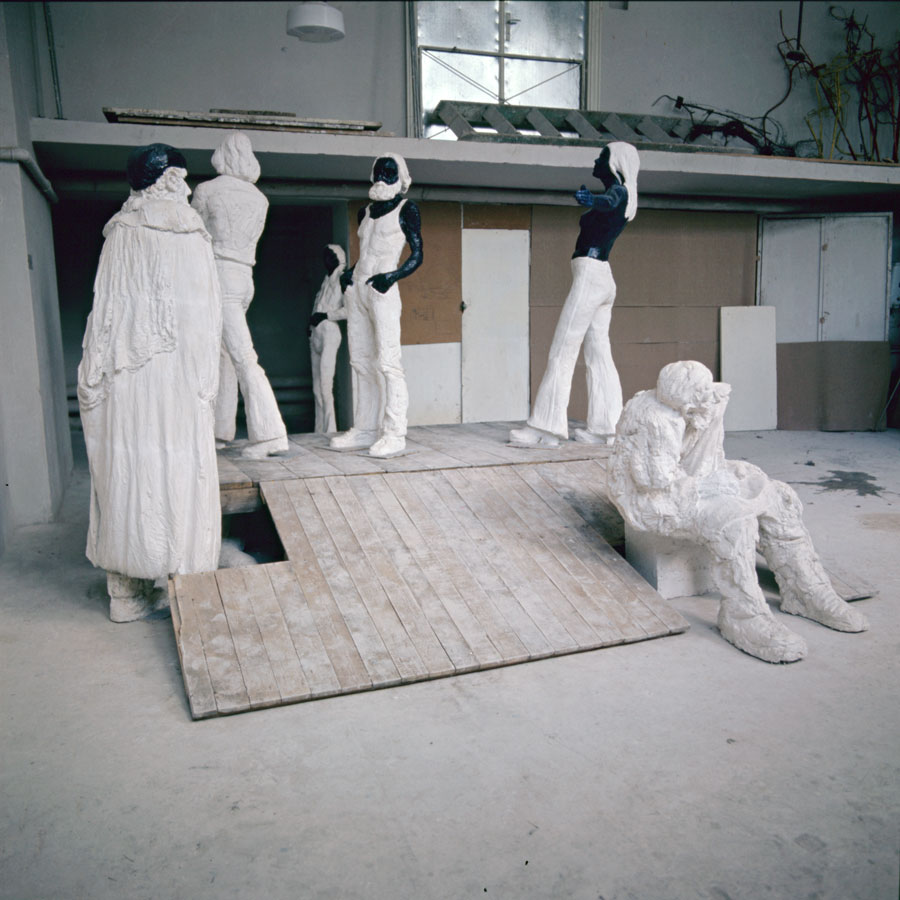
In the late 80s Barbara Falender started using new, more fragile materials, such as porcelain. In Strefy (Zones, 1989-95), the figures appear from behind spirals made of the thin material. In 1995, the artist attached classical porcelain busts to basalt columns based on Venus de Medici, but with the face of a contemporary woman. Crippled by straight cuts, they did not represent perfect classical sculptures Kolumny (Columns, 1995). This gesture can be seen as symbolic of Falender’s work. During that time the attitude of the artist changed:
Until recently the reflection of the perfect human body in art evoked my admiration, it was an artistic beacon for me. And suddenly something changed. In a world where the old canons of beauty were being thrown into the dustbin, my efforts to preserve them struck me as pointless.
Along with her fascination with naturally occurring geometric forms (basalt), Falender decided to introduce geometric elements made with a chainsaw. She began to treat the material very sketchily and almost brutally, leaving traces of sharp cuttings. The most representative work from this period is perhaps Sarkofag (Sarcophagus from 1993 – a kind of a box made of black marble, Dębnik, composed of raw cubes. Inside, like in the sarcophagi of the 80s, there were body fragments of pink, flesh-coloured marble. The artist’s most radical sculpture using geometrical figures was Fatum (Fate, 1995), a pyramid of basalt cubes, dedicated to the death of a loved one. Falender explained:
For the first time I gave up on creating a human figure, it seemed to me that the body is defenceless against finality. (...) I realised that only an abstract form could carry the mystery of death.
In 2011, the artist carved a marble Sarcophagus for her parents. It is a combination between the archetypical sarcophagus, known since ancient times, and a garden hammock. The work is a metaphor for sleep and death, but also proximity.
I tried to capture the coexistence of two people swathed in a shroud in a somnambulistic state, half dead, half alive. – said Falender.
So far, the largest retrospective exhibition of the artist’s work was in the Centre of Polish Sculpture in Orońsko. The works presented there and normally found in private collections and museums, allowed to trace Barbara Falender’s artistic development from her early sculptures of erotic bodies to her geometric and metaphysical creations. Art historian and curator Paweł Leszkowicz wrote about the exhibition:
The sculptures of Barbara Falender contain something which I consider the most interesting characteristic of Polish art of the 60s and 70s. It is an artistic testimony to the moral and sexual revolution that changed and liberated modern culture. However, while this revolution transformed Western culture completely, in socialist Poland it was a marginal phenomenon that was suppressed and censored, and is today difficult to recover. The art of the sculptress is one of the unique remains of this breakthrough, which was never fully realised in Poland, and is now once again negated.
In 2007 Barbara Falender was awarded a Silver Medal for Merit to Culture Gloria Artis. She received the Kamil Cyprian Norwid Prize for the monographic exhibition in the Centre of Polish Sculpture in Orońsko, as well as national and international scholarships (Italy, France). She has participated in several International Sculpture Symposia (in France, Italy, China, Germany, Israel, and others).
To this day, Barbara Falender’s work follows two, though not mutually exclusive, tropes: geometric shapes and fascination with the human body. These motifs were often combined, like in Izyda (Isis, 2007). The allegorical sculpture Rok 2001 (Year 2001, 2001/2005) has a similar character, referring to the drama of the destruction of the World Trade Center towers in New York – a small tin statue of a naked man standing between two pillars. In addition, the artist created outdoor sculptures, where the fluid, geometric forms were incorporated in the surrounding landscape, for example during a symposium at Ben Amira in the Sahara Mała Aisha (Little Aisha, 1999/2000) and a symposium in Guilin, China Pomiędzy ogniem i wodą (Between Fire and Water, 2000). Łoże Penelopy (Penelope’s Bed, 2006/2007), a kind of a cocoon made of wire, wood and plasticine, is in turn a proof of the artist’s continuous search for new methods and ideas.
Falender is also the author of funerary sculptures: those of Krzysztof Jung (2000), Jerzy Grzegorzewski (2006), Anna Skwarska-Kowarska (2012) and the bas-reliefs on the grave of the Burnatowiczów family (2007). Since April 2015 her work Strażnicy (Watchmen) (statues of Tyche, Hermes, Fortuna and Mercury) stands in front of the entrance to the Ufficio Primo office building on 62 Wspólna Str. in Warsaw. Barbara Falender’s works can be found in numerous private collections and museums, including the Centre of Polish Sculpture in Orońsko and the National Museums in Warsaw, Kraków, Poznań and Szczecin.
Author: Karol Sienkiewicz, December 2008, update: AW, April 2015, transl. Bozhana Nikolova, May 2015