Solidarity’s Secret tells the story of the fight for freedom and democracy in the communist regime from a female perspective. Ignored for many years, both during and after the fall of communism, the heroines of Solidarity have never stopped claiming their place in Solidarity’s history. The book reveals fascinating examples of their contribution and numerous sacrifices for the sake of their country’s freedom. Often underestimated, they never took their responsibilities light-heartedly and never wavered from their mission.
PAP: The Women’s Underground was published in 2003; and now Solidarity’s Secret, which deals with the same matter – the participation of women in the underground movement which led to the fall of communism. In what ways do these two books differ?
Shana Penn: Solidarity’s Secret is a new book, even though, in fact, I refer to the same characters and events described in The Women’s Underground. I focus on a group of women who illegally created and published Tygodnik Mazowsze, however, the new book also describes the public discussion which arose after the first book was published; the controversy which broke out after the first attempts had been made to claim a position for women in the history of Solidarity.
The basic question is the same in both books, namely – how did it happen that so little space in the official history of Solidarity has been dedicated to women’s contribution to the movement, who, as a matter of fact, constituted half of the 10 million members of this union.
Why do you think emphasizing women’s role in Solidarity’s history stirred up so many emotions?
I think I have stepped on something crucial, a sort of a taboo. No one would mention women’s merits at the end of the 90s.
Men got all the glory and the majority of the benefits that came along with it. The heroic myth of Solidarity as a male protagonist, an invincible knight, a fighter, a leader to its very centre, was very firm. I believe that my attempts to bring back the memory of women who had actually played a major part in fighting for freedom, were received as a sort of attack on an established vision of history.
Some of the conclusions that resulted from this debate seemed unnerving for some – since we had created the myth of Solidarity without women’s presence, it echoed directly in the form of their absence in the regained democracy – as Agnieszka Graff points out in the debate on the book.
What did women do in the movement?
Women would hardly ever hold positions of power, however, the lower the level of the union, the more women there were, and they did play a big role there. See the group I have been dealing with since the very beginning - Helena Łuczywo, Joanna Szczęsna, Ewa Kulik, Anna Bikont, Anna Dodziuk, Zofia Bydlińska and Małgorzata Pawlicka created an underground information network which almost covered the whole of the country at the dawn of Martial Law. Those women edited and distributed Tygodnik Mazowsze – the most important press channel of the underground; they supported other women – groups consisted of young girls as well as pensioners. There were women whose husbands were in prison and who were not only the breadwinners and took care of their children on their own, but also took the main responsibilities of the conspiracy.
What made women’s activity within Solidarity so special?
They acted in a different way than men – they were more discreet as they wouldn’t have that urge to emphasize their merits and positions like men did; they also cooperated more consistently - they found it easier than men to work as a group.
They were excellent conspirators, editors, distributors, yet they weren’t able to accentuate their virtues. In fact, they didn’t think they were doing anything special. Ewa Kulik once said that for the women of Solidarity, it was much more convenient to speak on behalf of the union’s heroes as no one would listen to its female members.
At the same time, however, women are the heroines of the key symbolic events in the history of Solidarity. Anna Walentynowicz's firing led directly to the outbreak of the August strikes in Gdańsk.
It was Ewa Kubasiewicz who got the most severe sentence of 10 years for handing out leaflets during Martial Law. One of the most important underground publications, Tygodnik Mazowsze, was edited almost entirely by women alone. Also, Jadwiga Chmielowska had to remain in hiding for the 80s as her name was on the wanted persons list until 1990.
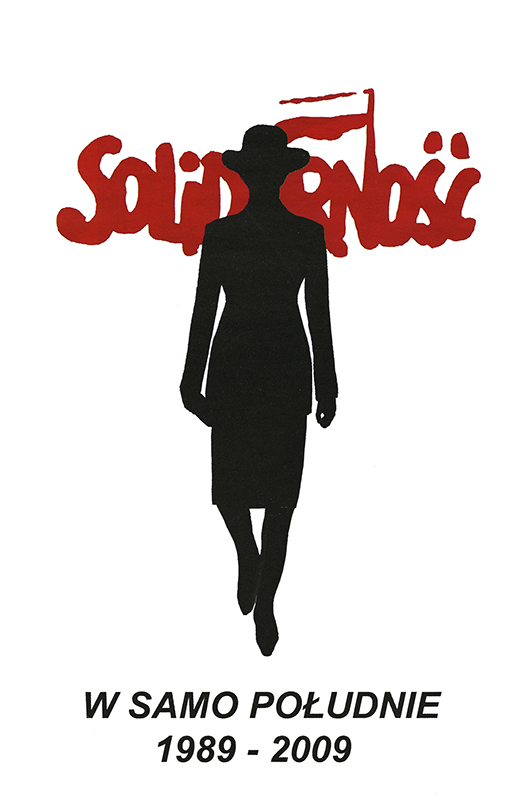
Sanja Iveković, Invisible Women of Solidarity, 2009-2010, photo: Museum of Modern Art in Warsaw
Have the women of Solidarity received credit for their contribution?
I’m afraid not. Those who criticise my approach claim that the women’s role was secondary as it was not them who led the movement, they merely carried out the orders; they didn’t draw up manifestos, but published press; they wouldn’t have to hide away, they would simply help others to hide – they were assisting, not leading.
Such an attitude had a major impact on how small women’s presence in the government of free Poland was in spite of their great contribution to the conspiracy.
The Round Table Talks welcomed only one woman - Grażyna Staniszewska among 60 other opposition members.
Unlike the men, the women of Solidarity were ignored when the honours and state posts were assigned to members of the opposition.
We celebrated a decade of freedom in 1999 – did you notice it was celebrated in the absence of women? Has anything changed after 15 years?
Telling history from a female point of view is surely a lot better perceived now than it was before. New books with a female outlook of the times of occupation and Warsaw Uprising have been written. We gradually get used to the fact that the history can be told considering the female outlook as well. It is not as shocking any more to say that it was not only the overt activity of Solidarity’s leaders but also the participation of tens of thousands of women and it doesn’t matter if it was less spectacular. In spite of it all this, the concept has still not been put into practice – the majority of the Solidarity's heroines continue to hide in the shadows.
Shana Penn is an American author of historical books in the field of Slavic studies, Polish Philology and Gender Studies in particular.
Penn is a feminist, publicist and lecturer at the Mills College.
Her book Solidarity’s Secret has been published by W.A.B.
Shana Penn met the Polish readers during the Big Book Festival which took place on the 14th and 15th of June in Warsaw.