Mikołaj Gliński: When and how did you first find yourself in Romania?
Małgorzata Rejmer: I think it all began with the documentary Dzieci z Dekretu (The Decree Children), which I saw in 2007. It tells the story of a Romania in which Ceaușescu banned access to contraception, and it conveys how the absurd becomes normal, and how the everyday becomes hell, with a constant string of humiliation. It's [shot in] the late 1980s, and factories run gynaecological check-ups of women, with testing material made of frog skin which changes colour in contact with the urine of a pregnant woman. I read all of Herta Muller’s books at the time, but it was only after my trip to Bucharest in 2009 that my curiosity was truly aroused. It was the longing for a city which I associated on the one hand with chaos and crumminess, and on the other hand, with beauty and pathos. For me, in a way it was a 'crooked Paris', an absolute mishmash, the glamorous and the plebeian all in one.
MG: When did you first have the idea of writing about Romania?
MR: In 2010, I began to write my doctoral thesis about Romanian cinema, and I read many books about Romania in a short period of time. And I just couldn’t believe it all. I knew that Romania was a fascinating country for a writer and anthropologist. On the one hand, it’s European and looks up to France and Germany, and on the other hand, it also looks back onto the Balkans and Turkey, it’s a mix of the culturally unique, of the provincial and the peripheral.
MG: Why did you choose reportage as a form of description? Your previous book, Toksymia, was a novel…
MR: I am not too attached to the idea that Bukareszt is a reportage piece. I don’t really consider myself a writer, and even less so a reporter. I am just a person who writes. I don’t have the workshop of a journalist, it’s difficult for me to write about a given subject. Either a subject flows out of me and writes itself, or no one could drag me with horses to sit down by my laptop. My writing is very capricious, and it costs me a lot of energy.
MG: The style in Bukareszt is very rich and diverse. You used different conventions (for example, the chapter about the revolution is written as a play, or even a parody, with acts, etc). You also draw on different cultural texts, (The Ballad of Master Manole, the epic of a lamb) as well as styles. I suppose those are not the typical elements of a reporter’s workshop?
MR: Bukareszt is literary and varied in style, because I had the feeling that this city is eclectic, and and that all of Romania is one big patchwork, and this was something that I wanted to render in the book's language. When I write about a famous Romanian ballad, the language imitates the ballad, and when I write about the chaos of the revolution, I choose the form of a drama. I wanted to adapt the style to the theme, for the polyphony of the book to match the diversity of Bucharest. In the end, if I tried to write all the texts in one style, I would die of boredom. I have to have some fun in my life, to play around with form, and to try out different things. I adore Herta Muller’s reportage from Hunger and Silk, although nobody calls Muller a reporter. Using short sentences, she sketches out touching human portraits and universal stories about humanity. Muller is relentless, she writes with images, doesn't back away from symbols, and she is at the very centre of the texts herself. I prefer this kind of writing to the most meticulous kind of reportage about some incredibly important and pertinent issue of our times.
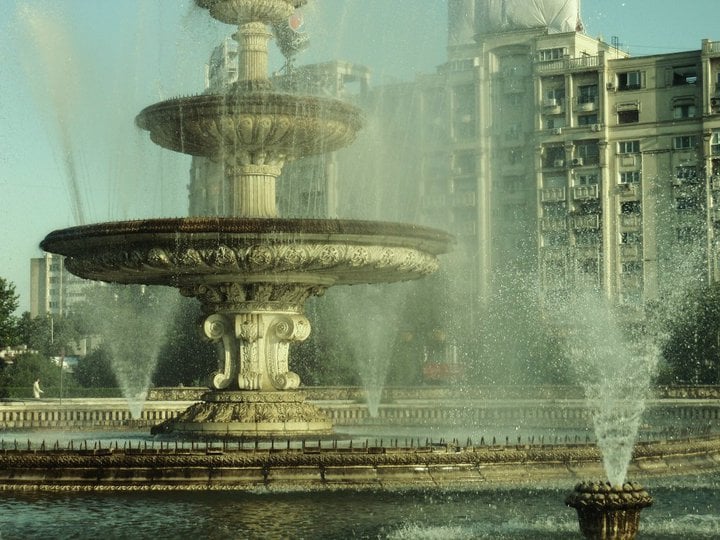
Fifth Unirii in Bucharest, photo: courtesy of Tomek Ogiński
MG: How did your Romanian friends react to your book? You do write about rather terrifying and shameful things from the country’s history: the terror of the security services, people spying on each other, prisons, the completely inhuman stories of women which resulted from the 1966 anti-abortion decree, and the taboo of a revolution – which perhaps never even took place?
MR: The book was read by a couple of Polish friends who live in Romania, and they were quite enthusiastic. Some time ago, a Romanian woman wrote to me saying that after reading Bukareszt, she felt proud of her country again, and wanted to get to know its history. This was moving for me. Only the chapter on abortion has been released in Romania so far, and it was well received. I read comments by young people for whom the text was a discovery, because they had become accustomed to an idealised vision of the Ceausescu era.
Bukareszt is my way of seeing Romania, and a certain selection of facts. You can polemicize about this selection, but it would be harder to argue with the facts. The question of memory is a separate issue – everyone remembers their own past differently, and everyone has their own vision of it. Bukareszt would be a collection of these crumbs, but they are all fragments of a shattered mirror, and they don’t reflect a reality but rather convey a mosaic.
Bukareszt will probably get released in Romania this year, and, possibly, there will then be a discussion around it. It’s possible, but not certain. Romanians are not interested in working through the collective memory. Even at book readings in Cluj and Bucharest, the question hanging over me was "Why do you write about such difficult things from the past? If the present is terrible, why would we need to dig into the past, on top of that?”
MG: Was the work on Bukareszt a difficult experience for you, personally? I am addressing the talks that you had to conduct with people who have had some terrible experiences. Almost all of the topics from the first part touch upon some kind of trauma…
MR: I always approached my protagonists with the conviction that I really want to talk to them, and not that I want to do an interview. These talks went on for hours. I had to recover after many of these stories, and I repeatedly returned to some of them. At times, I would cry together with the people who told me those stories. Suffering is inscribed into life, but I am most interested in the way that these people were able to cope with it. We all strive for normality even in the most abnormal of times.
MG: What was the most difficult thing for you get used to when you lived in Romania?
MR: I didn’t have any problems with getting used to Romania, but for a long time, I live there in house which very much resembled a squat, with parties running on until 5 in the morning. Recently I went to Bucharest once again, and I decided to stay in the old place out of nostalgia. There was a party once again, and this is something that is hard to get used to.
But apart from that, I didn’t have any problems getting acquainted with Bucharest. I spent some time growing up in a small town, and some time in the northern Praga district [in Warsaw], so Bucharest is close to my heart both in terms of the aesthetics and the atmosphere. And when a Romanian friend came to visit me, he even began to mark out [the district of] Grochów in his own way. For him, the Wiatraczna roundabout was evocative of the Fifth Iancului, the Astoria restaurant reminded him of Intermacedonia, and he would call the local kebab place the same way he would in Bucharest: 'Ali Baba'.
Cover of 'Bukareszt' by Małgorzata Rejmer, photo: Czarne publishing house
MG: While reading your book, one can have the impression that many of these historical experiences and situations are, to a certain degree, similar to Polish history, except for over there, things were somehow… a lot worse, a bit like a nightmare. Is it possible to compare these histories? Where do the parallels end?
MR: I cannot answer your question, because I am not able to define where the limits of these similarities lie. I am not the one to trace them out, let the Polish and Romanian readership do it themselves, in accordance with their own subjective feelings.
But looking at this issue from an objective side, looking at the facts, we could say that after 1965, the Romanian version of communism was completely different to the Polish one. It had the face of one man, Nicolae Ceaușescu. He was the one responsible for the situation in the country, he bestowed all of the important posts upon members of his family, and prepared his son to become his successor. Historians call this 'dynastic communism'. Ceaușescu was Romania. But let’s not forget that in the 1960s and 1970s Romanians led rather good lives, and in many ways, their situation was much better than the one in Poland. It was only the 1980s that brought about a sudden collapse and the fall of the state, as well as a suffering of the people with the complete indifference of the authorities.
The chapters on Romanian communism stir a lot of emotion, but it's enough to read Kolymskoye Stories to see a completely different scale of human suffering. No matter what atrocity we would think of, man is capable of inventing a greater and more effective one. In this place, the book should have some kind of quotation about man being the most cruel of all animals. I agree.
MG: What is the stereotypical idea that Polish people have about Romania?
MR: To put it bluntly, Poles associate Romania with poverty, Gypsies and Dracula. It’s all stems from ignorance. Just go there, visit Transylvania, Bukovina and Maramuresz and your whole stance towards Romania changes. Poles have no idea about the scale of Romanian influence on European heritage. They don’t know what extraordinary intellectuals surfaced in Romania in the interwar period. A majority of the most acclaimed ones emigrated. And very few Poles know that Romanian cinema has been storming European film festivals for more than a decade, it’s the country’s best export commodities.
MG: Was your perspective as a person coming from Poland at all helpful in understanding Romania? Poland is unarguably also a country from the East of Europe, and a member of the former communist bloc. It possibly has a similar cultural and historical background, being a quite big but peripheral country, under foreign rule for a period of time, and one looking up to the West with both admiration and fascination…
MR: Yes, I think that this kind of stance that we are saturated with as Poles – the sense that we have been wronged by history, that we are underappreciated and marginalised in Europe – helped me understand Romanians. I often explained to them that Poles have a very similar inferiority complex, a problem of peasant roots, and that they are terribly sensitive to any outside criticism. But for Romanians, Poland is Europe, and it’s almost Germany. When I told them about the 123 years of history under partitions, about the sense of inferiority, Romanians would cry out: 'But in the Middle Ages you were a superpower! And we never had a period of imperial Romania.' They would also often say: 'we have a common enemy, Russia!' In the area I lived in in Bucharest, I once saw a huge, dirty garbage container with the phrase 'Russia e gunoi', meaning 'Russia is garbage'.
MG: What would you consider the best introduction to Romanian culture?
MR: I really like the book by Lucian Boia 'Romanians: consciousness, myths, history'. It’s a great account of the deformations of the Romanian spirit, which often had to deal with radical nationalism, as well as the fantasies of historians straight out of Ceausescu’s stable. From the literary perspective, the most beautiful struggle with Romanian identity was presented by Emil Cioran, he is the Romanian Gombrowicz. Instead of dreaming of grandeur and fame, he dabbled in fatalism and spoiled himself with thoughts about suicide.
MG: Did your work on the book, and the deep immersion in Romanian culture also allow you to see Poland in a different light?
MR: At times I returned to Poland with a curled tail. I thought 'You ingrates, you didn’t like the sidewalks in Warsaw, they were too crooked for you, these beautiful, Polish sidewalks!' I remember this feeling rather clearly, of coming back home from the airport and going through Warsaw. It made me think of a clean, good-natured girl, dressed in a modest yellow, green and peach-coloured dress. An ugly girl who keeps on cleaning herself and trying really hard. Bucharest made me think of an old courtesan in thinning fur, who had fallen into decline but still kept the traces of her beauty and could one day transform into a real beauty.
It’s nice to look at yourself through Romanian eyes. The typhoon of Poland’s internal problems never gets to Romania. Romanians see a country with a heroic history, one which gave Europe the Solidarity movement, and which stood on its own feet after 1989 and proudly raised its head. Poland needs Romania and Ukraine to heal its sense of inferiority. And Romanians like to whip themselves with Poland, with the way we utilise European funds, and our GDP statistics. But our social problems are terrifying similiar: great emigration, youth unemployment, over-crowded housing, young women who don’t want to have children, a frustrated society which is rapidly aging. We are not as far from Romania as we would like to think, although we are a notch up from an economic point of view. There is only one step between a Polish aristocrat to the Romanian boyar.
MG: Your next book is supposed to be about Albania. Why? It must be the only place on the map of Europe which is 'worse' that Romania?
MR: I understand that by 'worse' you mean 'more interesting'? [laughs] When I was still living in Bucharest, I met a Norwegian who, as she spoke Albanian, tried to convince me that I would grow to love Albania, and tried to talk me into travelling there through dozens of stories. For example, she told me about how drivers tried to push her car off the road, because they could not stand the sight of a driving blonde.
In the beginning, I didn’t like Albania. I only had the idea that maybe there are stories there for me after I talked to an anthropologist. She mentioned that the times of communism were a 'small holocaust' for her parents, and complained that no one wanted to talk about this – neither the young, nor the old.
But I wasn't convinced yet. What was decisive was my friendship with a German woman, whom I met on the coast. She was the author of a popular guide to Romania and a walking encyclopaedia who probably knew every village in the country. She showed me many strange corners, and told me about her 14 years of fascination with Albania. I had the feeling that I understood her. When I came to Albania, I associated it with the world of men, Mercedes, bunkers, and verbs. By the time I was leaving it, I thought of Albania through the prism of women, Albanian poetry, space, and adjectives. I would like to capture this twofold side of Albania. Apart from that, I am also fascinated with the way that for decades, this country was completely isolated and how now it is gulping down the contemporary and the European by the mouthful, and how it’s a place that keeps on changing from day to day. To me, Tirana was pot of boiling-hot water, and I would be glad to stick my hand in it again.
Interview conducted in Polish, February-March 2014. Rejmer's book about Albania was later published under the title 'Błoto Słodsze Niż Miód: Głosy Komunistycznej Albanii' (Mud Sweeter than Honey: Voices from Communist Albania) – it won a Paszport Polityki prize for literature in 2019, as well as the Arkady Fiedler Amber Butterfly prize.
