No ordinary closet
When closed – it was cut off from the world, but showed multiple ways of sensing. When open – it revealed secrets. Old, decaying, and stained, alongside a rubbish cart and a trunk, the closet featured in W Małym Dworku (Country House). The play was inspired by a piece by Stanisław Ignacy Witkiewicz and premiered in January 1961 in the Kraków-based Galeria Krzysztofory. Kantor commented:
"I discovered a new theatrical place… A closet. (Kids discovered it long before me). I called the closet the INTERIOR OF THE IMAGINATION"
Inside, there were a dummy in a school uniform hung on a hanger and actors: they were crammed against each other, screaming, talking. The claustrophobic closet reappeared in other plays, among others in Der Schrank (Closet) played in the Baden-Baden Stadttheater. In the German performance the piece of furniture had extra hangers which the actors could grab on to and swing, colliding with sandbags.
The cannon cross
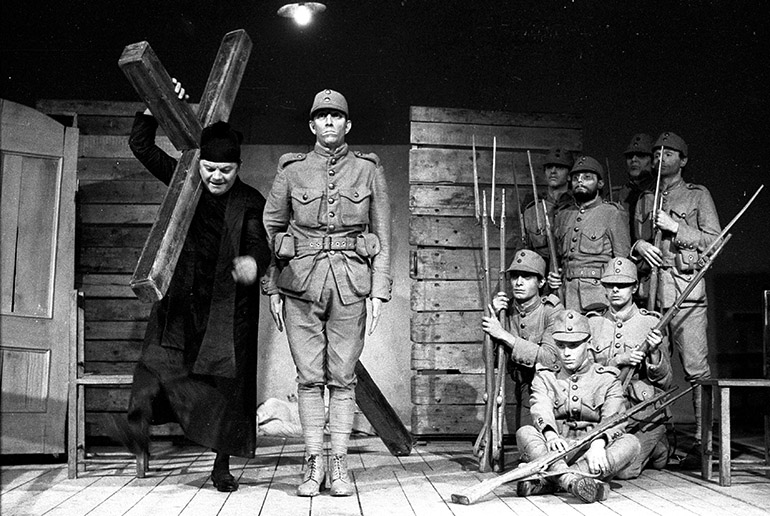
Photograph from a performance of "Wielopole, Wielopole" in the Krakow club Stodoła, Cricot 2 theatre, 1980, photo: Adam Hayder / Forum
The cross, which rested on a metal undercarriage with wheels, resembled a loaded cannon. It was constructed in 1980 as part of the set design for Wielopole, Wielopole. The show premiered in the same year in the building of an old cloister in Florence. The set design was composed of the cannon cross and 15 other, smaller crosses of old wood. Throughout Kantor's career over 30 crosses were made for him.
Did Kantor have an affection for crosses? Kantor grew up in a parsonage under the guardianship of his uncle (the brother of his grandmother). The churches, cemeteries, streets and crossroads in the small, multicultural Galician town Wielopole Skrzyńskie were dotted with crosses. Kantor doesn't use the crosses in his shows to make a religious statement. To him, they are everyday objects, and symbols of the graves of soldiers and protection against evil spirits. In one scene, actors push the cross like a bike.
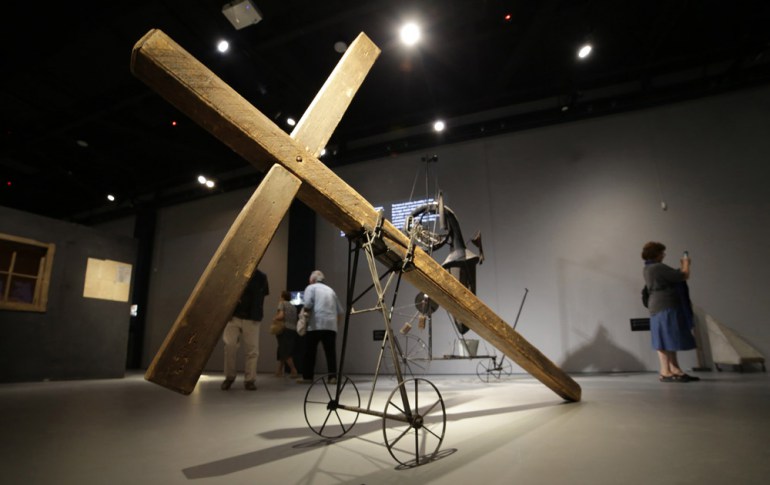
Cross from "Wielopole , Wielopole " 1980. Exhibition at the Centre for Documentation of the Art of Tadeusz Kantor - Cricoteka in Kraków, photo: Beata Zawrzel /REPORTER
Camera gun
His camera pointed at the Army. The photographer checks again. He begins to laugh. He turns some winch. A big gun barrel appears. He presses something— and another barrel comes out, aimed straight at the platoon. Now the photographer roars with laughter.
Kantor drew parallels between photography and shooting in Wielopole, Wielopole. Waiting for the flash of the camera, the actors look like a row of recruits. They freeze when instead of the shutter they hear a salvo. The camera with its gun barrel and scroll with bullets hanging from the side turns into an instrument of torture. Playing the part of the photographer is the actress Rychlicka.
One Does not Look Through a Window Unpunished
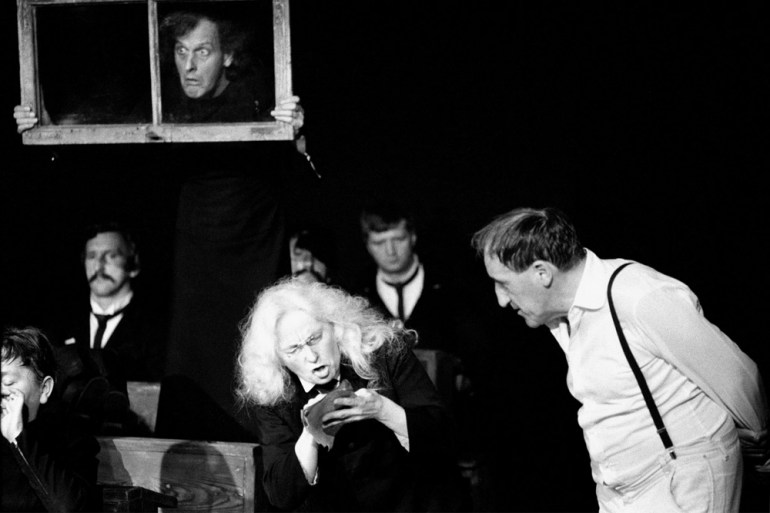
Window from a performance of "Dead Class", Kraków, 1983, photo: Wojciech Kryński / Forum
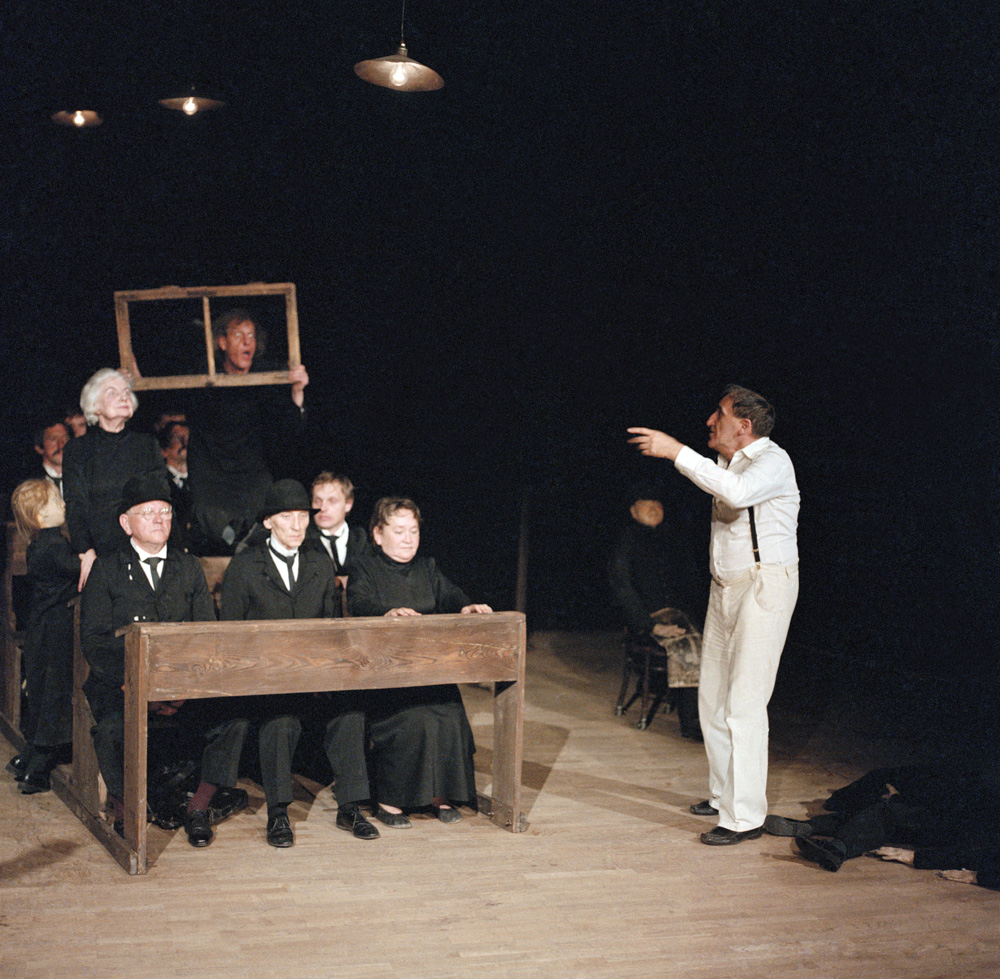
The window is a new piece of furniture in Kantor's "imagination chamber". It calls up and triggers the memory. Commenting on Wielopole, Wielopole, Kantor wrote,
An important window! [...] A long STREET and at its end a PINK MULTI-STOREY TOWNHOUSE. This corner is where I used to lose sight of my mother when she would go away for periods, this exact corner, which was the END OF THE WORLD.
According to Małgorzata Paluch-Cubulska, the window is more than the memory of the cityscape of a Galician town where "old Jewish women hung pillows in red pillowcases from the windows", it's an area of experience. "The window hides many obscure secrets. The window inspires fear and premonitions of what is outside" explained Kantor.
The object was probably inspired by a picture by Stanisław Wyspiański published in 1901 on the cover of Maurice Maeterlinck's play Interior. According to the Virtual Museums of Małopolska website, the draft was the poster for a lecture by Stanisław Przybyszewski and a performance of Maeterlinck's play with Gabriela Zapolska in the lead role. Drawn by Wyspiański, the little girl is peeking through the window the same way that the Woman Behind the Window peeks through the window in Kantor's play.
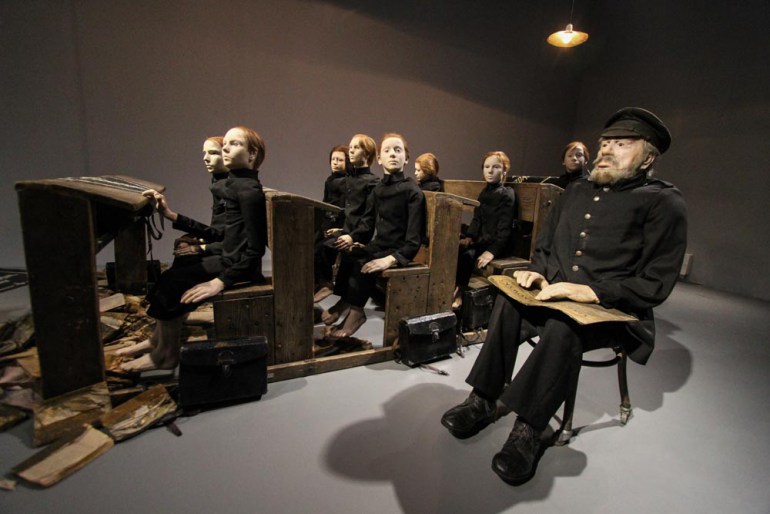
The actors in Dead Class also peep through old, stained glass, and the idea resurfaces in Bardzo krótka lekcja (Very Short Lesson), a series of images called Nie zagląda się bezkarnie przez okno (One Does not Look Through a Window Unpunished), and several other artworks from the 60s, 70s and 80s.
Odysseus by the sink
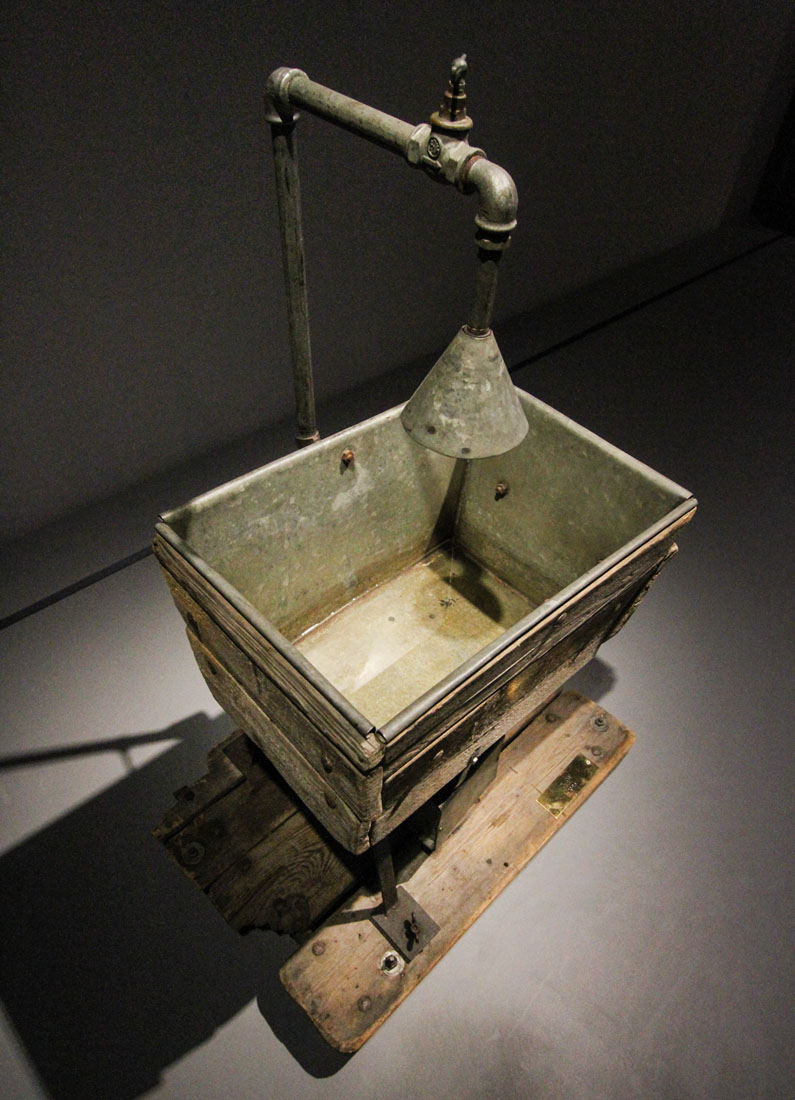
Sink from a performance of "Nigdy tu już nie powrócę". "Nic 2 razy" exhibition , photo: Jan Graczyński / East News
This metal sink was used on stage for the first time in 1985 in the play Niech sczezną artyści (Let the Artists Vanish). Three years later it came with the troupe to Milan for the premiere of Nigdy tu już nie powrócę (I Shall Never Return Here), in which, for the first time, Kantor was one of the actors.
Walking among small metal tables and wooden stools on the Teatro Piccolo stage are the characters from Kantor's historical plays (among them is Odysseus). They blurt out lines and lift up objects from the Cricot 2 repository. The sink is there too. It's a mobile waterpipe designed by Kantor. The closed design of the machine enables it to be relocated. "Reality of the lowest rank" Kantor would call it, while the curator and photographer Wojciech Nowicki wrote,
The sink is a defined place: it's the place of the mother, the servant, a creature of the lowest rank. The kitchen is shabby and belongs to those that deserve it, defined mainly by the sex (it has to be a woman). Kantor's sink, [...] is a place where making food is thought of as a torment: from the beginning, from the gathering of the potatoes up to the washing of the dishes, everything is done by one person. That's one way of looking at a sink -- as a place that is tied to the person who uses it, like a farmer is bound to the earth. From today's perspective the sink is a type of enslavement, but also, if you look at it differently, it's a place of ordinary work (although associated with exploitation). The concept remains the same: a large container under a type of watering can on a platform. A concept of fate, that reoccurs regardless of time and place.